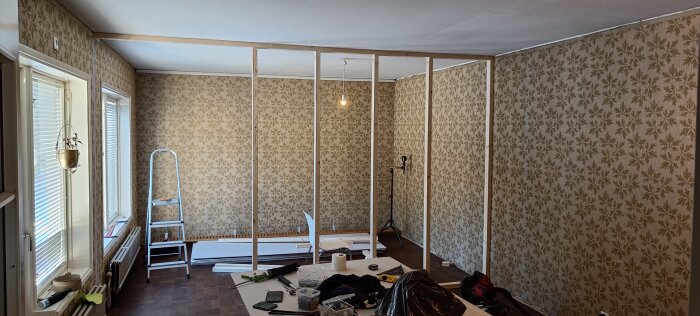
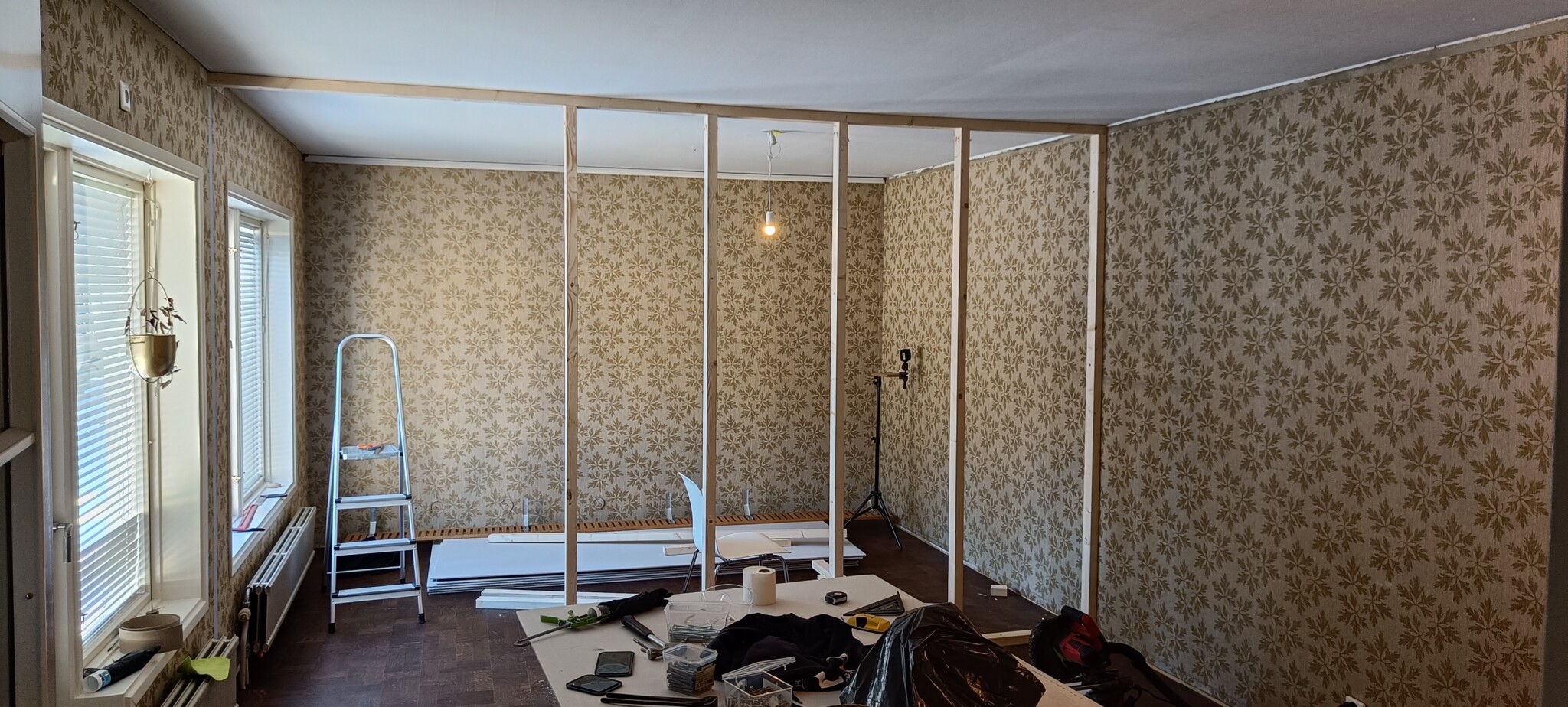
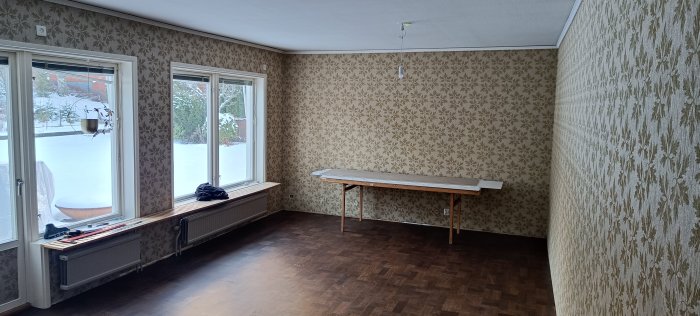
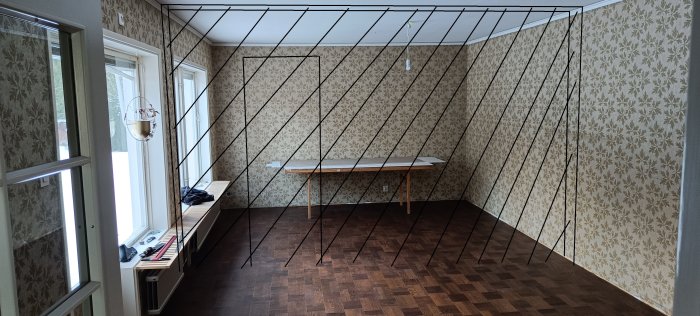
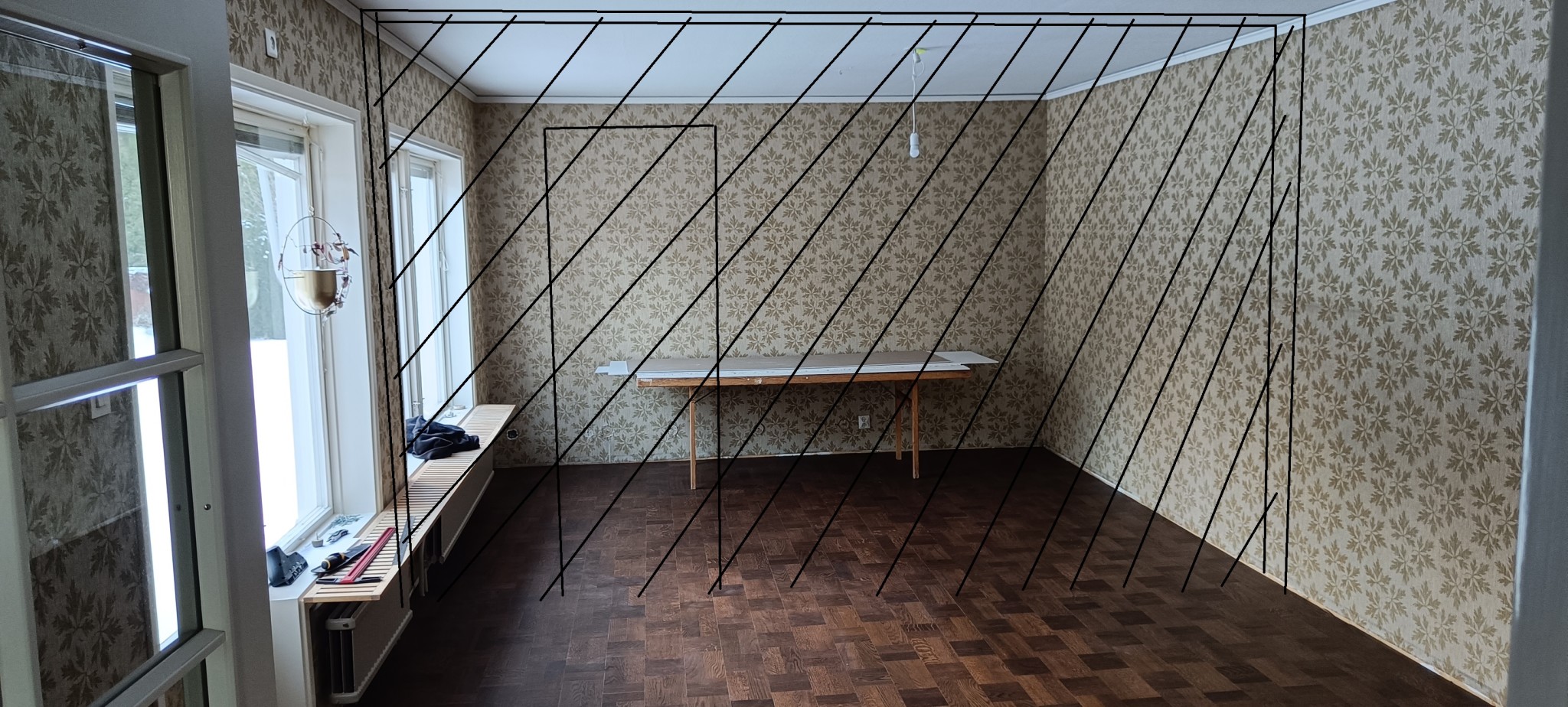
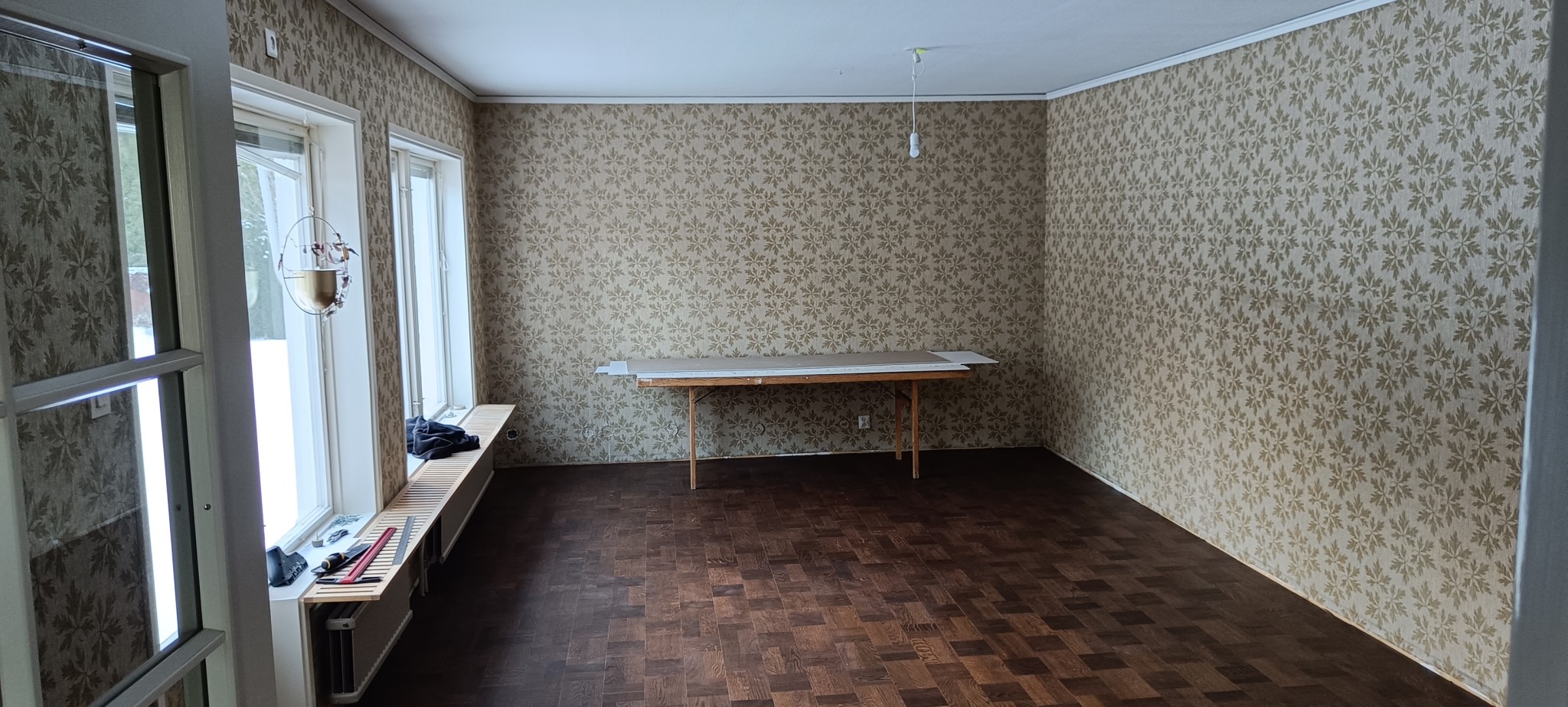
I have a living room that is going to be divided into two smaller rooms by building an interior wall in the middle of the room. The wall will be built between two windows (see image) so I don't have much room for placement.
My question is how to attach wall studs, base plate, and top plate properly?
Wall Studs
I can't find a stud between the windows that I can attach to.
Base Plate
It's a wood joist with chipboard and parquet flooring on top. My stud finder doesn't detect anything over the floor.
Top Plate
The ceiling is gypsum with roof boards underneath. The stud finder also doesn't detect anything.
I assume the wall should be attached to some sort of support even if the new wall itself isn't supposed to be load-bearing?
Current room
Sketch of where new wall will be placed
Cut a 90 mm wide groove in the parquet where the wall will be and screw a 70 mm metal sill centered in the hole. It is good if the parquet has some movement allowance. In the ceiling, you don't need to remove any drywall; you can screw the sill directly through the drywall into the sheathing. Insert wooden studs in between, and then you just need to cover the walls with OSB and drywall.
Edit: the wooden studs that stand against each wall can be glued with some construction adhesive.
Cut a 90 mm wide groove in the parquet where the wall will be and attach a 70 mm metal sill centered in the hole. It's good if the parquet has some room to move. In the ceiling, you don't need to remove any plasterboard, just screw the sill directly through the plasterboard into the rafters. Insert wooden studs in between and then it's just a matter of closing up the walls with OSB and gypsum.
Edit: The wooden studs that are against each wall can be glued with some mounting adhesive
Thanks for the quick reply!
Any particular reason to use a metal sill, or does a wooden sill work just as well?
I assume you need to cut the parquet so it can have some movement, or what is the reason? If you wanted to remove the wall in the future, I thought it would be good if the parquet was intact underneath.
Yes, the parquet must be able to move, so it's not optimal to place the wall directly on it.
Metal track is simple in old houses when you don't know if the ceiling and floor are straight and parallel, no millimeter precision is needed for the vertical studs then.
I don't think you should ruin such a nice parquet floor. You should be able to place the sill on top of the parquet with something in between, such as underlay used under floating floors.
I don't think you should ruin such a nice parquet floor. You should be able to place the sill on top of the parquet with something in between, such as the underlay that is used under floating floors.
You mean like felt paper?
Because foam would probably be too soft for that weight.
But if the wall is not secured downward, it's probably important that it is securely fastened at the sides instead, so there may be a need for extra studs in the walls.
Do you mean like lumppapp?
Because foam might be too soft for that weight.
But if the wall isn't secured at the bottom, it's probably important that it's well secured on the sides instead, so there might be a need for extra studs in the walls.
Lumppapp might work well. If you can get a wooden stud in the ceiling and place one on the floor, you should be able to have standing studs on either side of the door that are cut so precisely that they essentially clamp the floor stud so it doesn't move. I think the floor looks like an old parquet floor that is probably glued down, and I don't see why it would need much room for movement. If it were a floating floor, it would be different, but I don't think it looks like one.
I think the floor looks like an old parquet floor that is probably glued and don't know why it would need much movement allowance. If it were a floating floor, it would be different, but I don't think it looks like that.
I don't know, but there are newly manufactured parquet floors with Dutch patterns.
Lumppapp can be good. If you can get a wooden beam in the ceiling and place one on the floor, you should be able to have standing beams on either side of the door that are cut so precisely that they, so to speak, clamp the floor beam so that it doesn't move. I think the floor looks like an old parquet floor, which is probably glued, and I don't see why it would need much movement allowance. If it were a floating floor, it would be different, but I don't think it looks like one.
The parquet is from 1966 when the house was built. However, it's freshly sanded and varnished.
From my own experiences (renovated 2019-2022):
Expect 1.5 MSEK - then add 300k as "miscellaneous". This assumes you hire contractors for everything. This does not include sills, additional insulation.
So it would end up being closer to 6 MSEK for a row house (with a tiny lot), a community association with all it involves. Moreover, direct-acting electricity, which isn't exactly appealing given the expected electricity prices for quite some time. True, it's Amundön (it's cozy), but still... If it's absolutely necessary for you to live in the "right" postal code (Hovås), then you'll have to swallow the bitter pill - otherwise, I think it's insanely much money for such a small dwelling. We ourselves live in Lerum municipality and here you can get a real house in good condition for the same money.
Now I don't believe it costs 1.5 million to put up an interior wall. Sure, the material prices have risen, but you should probably get a quote from someone else.
guessing you would write to someone planning to completely renovate a row house
Now I don't think it costs 1.5 million to put up an inner wall. Sure, material prices have risen, but then you should probably get a bid from someone else
guess you meant to write to the person who was going to completely renovate a townhouse
Haha, good! Replied in the wrong thread . Thankfully the inflation isn't that high. Yet
From personal experiences (renovated 2019-2022):
Expect 1.5 MSEK - then add 300k as "miscellaneous". Assuming you hire craftsmen for everything. This does not include sills, additional insulation.
It would thus be closer to 6 MSEK for a townhouse (with a tiny plot), a joint property with everything that entails. Additionally, direct-acting electricity, which is not very attractive given the expected electricity prices for a relatively long time to come. Granted, Amundön (it's cozy), but still... If it's absolutely necessary for you to live at the "right" postcode (Hovås), you'll have to swallow the bitter pill - otherwise, I think it's insanely expensive for such a small residence. We live ourselves in Lerum municipality and here you can get a proper house for the same money in good condition.
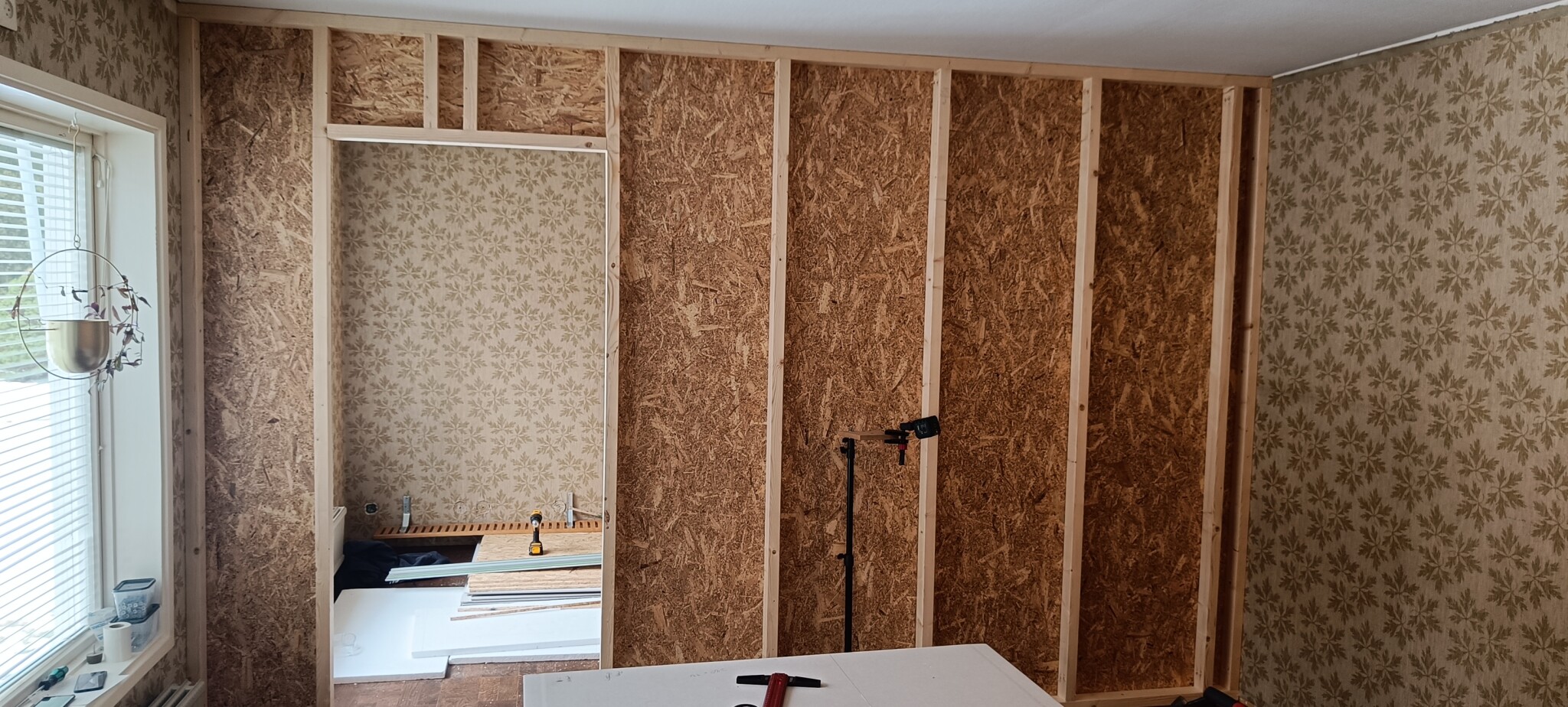
Update with results and how I finally did it. Time will tell if it was the right choice.
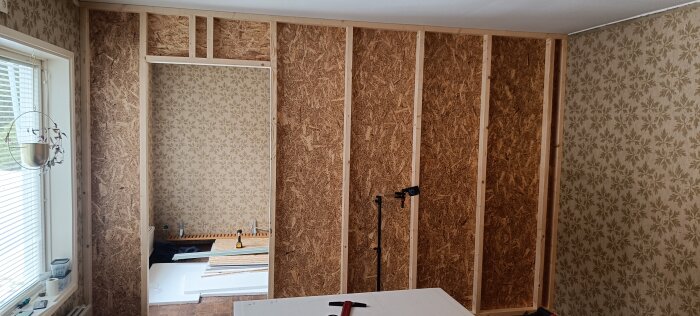
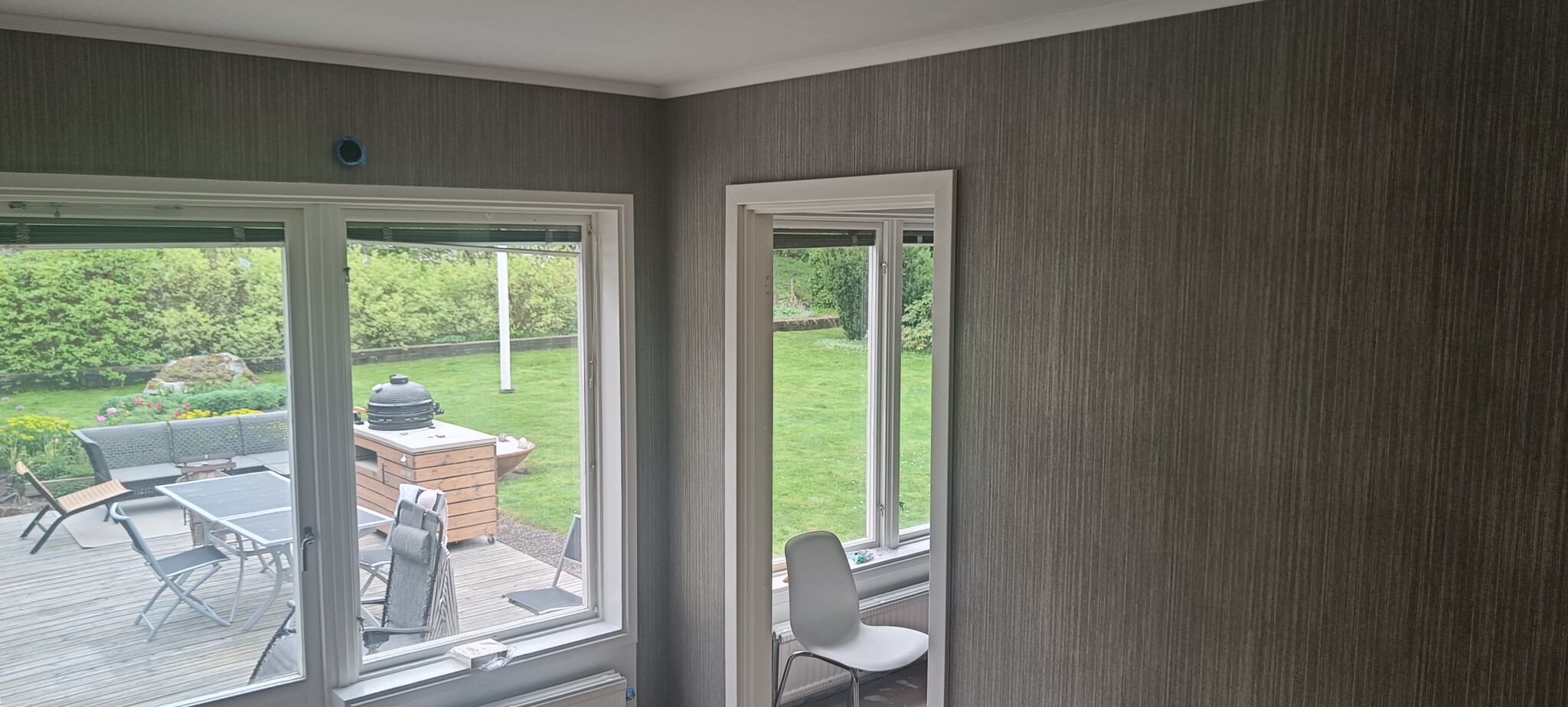
Framed the wall by screwing the ledger into the ceiling. Construction glue and screws for the wall studs. Lumppapp was placed under the sill as recommended and was screwed in two places with slightly larger pre-drilled holes through the parquet, which can hopefully be repaired if the wall is to be removed at some point. The idea was that the parquet should be able to move freely without touching the screw.
Used OSB and gypsum on both sides.
Studs going up
Ready to pull electrical
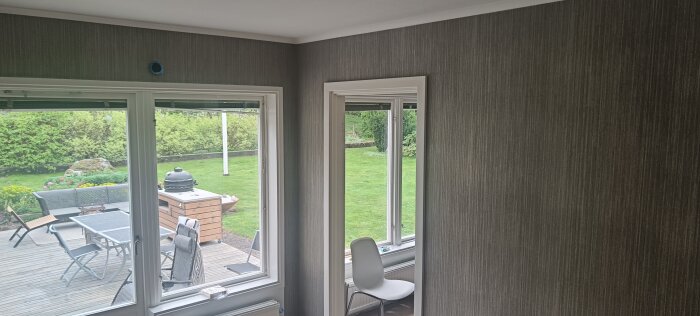
Finished wall after door frame installation and wallpapering
Click here to reply
Vi vill skicka notiser för ämnen du bevakar och händelser som berör dig.



Henningelvis said:
BirgitS said:
 . Thankfully the inflation isn't that high. Yet