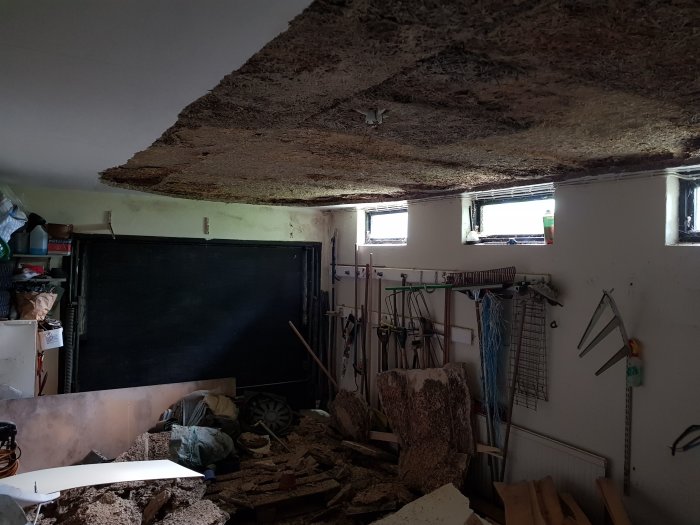
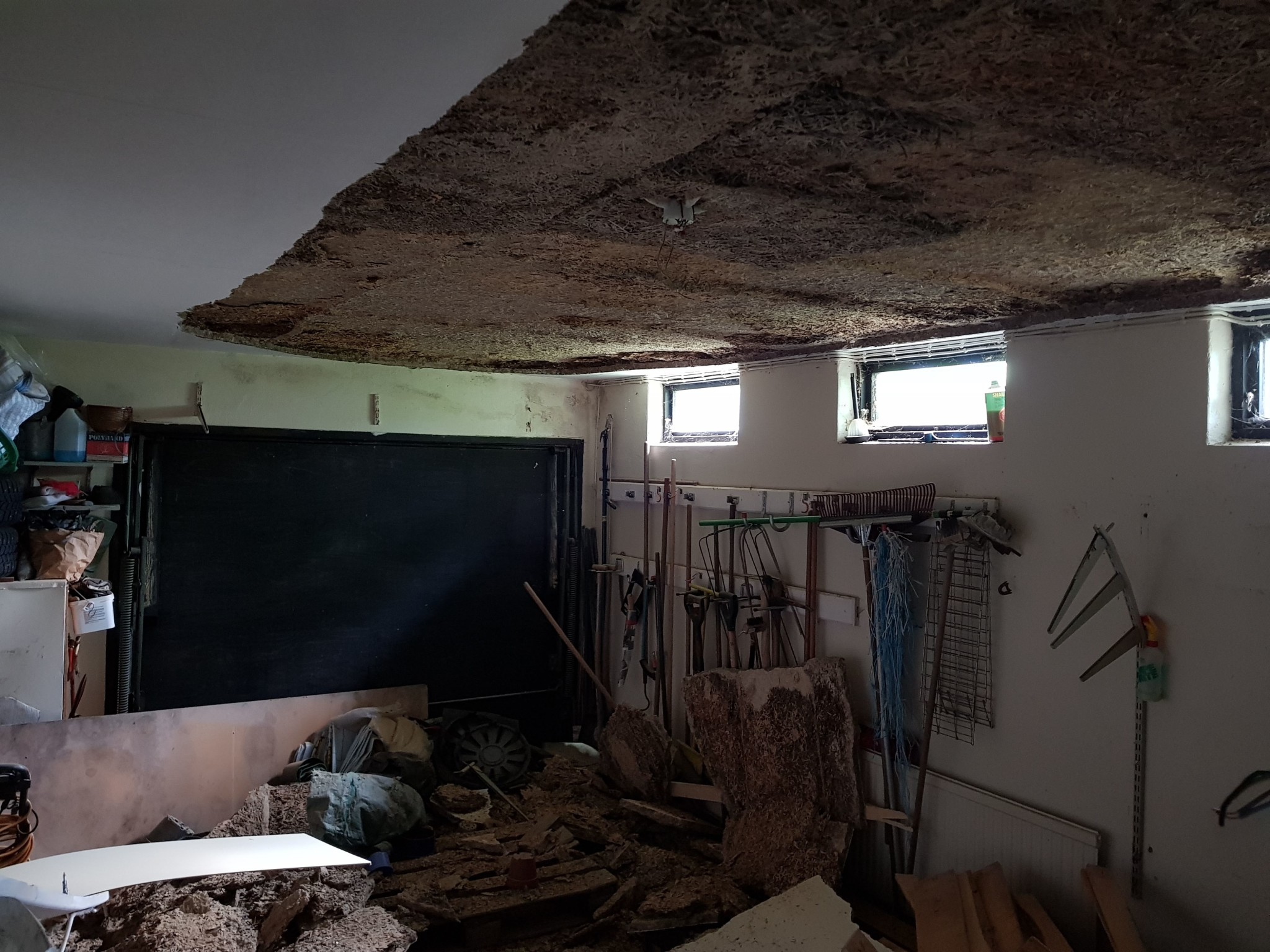
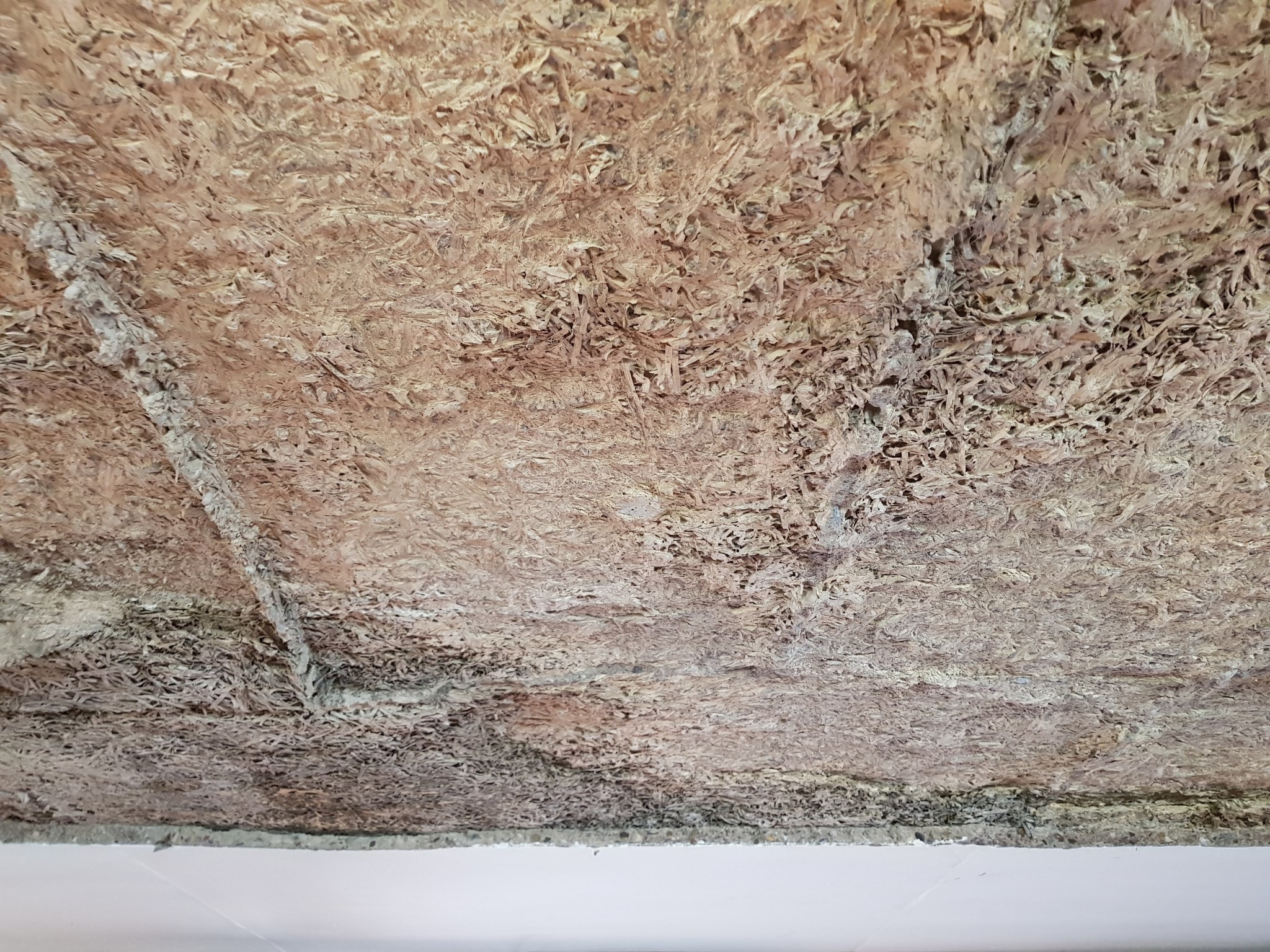
We have a split-level house with an attached garage where the roof functions as a terrace. The problem is that the bottom layer of the roof inside has collapsed! The construction seems to be as follows:
1: A formwork was built.
2: A layer of about 4 cm under-concrete was poured (unreinforced).
3. Träullit panels (for insulation) were placed in the partially wet concrete.
4. A load-bearing layer (reinforced) was poured on top with waterproof concrete according to building drawings (no additional waterproofing layer).
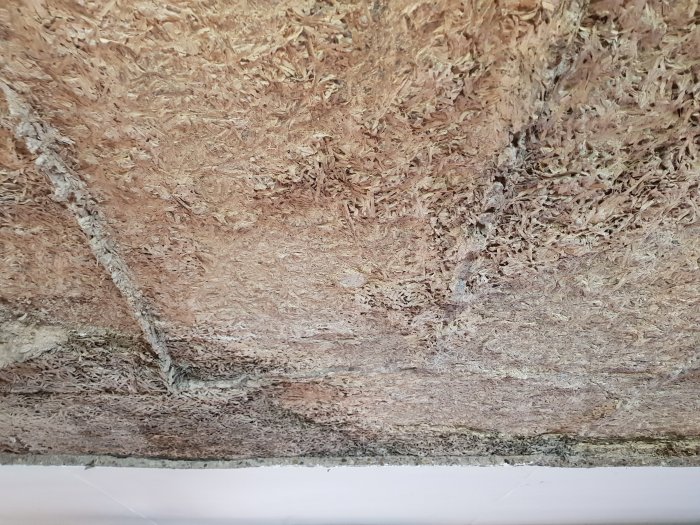
When we moved in 11 years ago, there were visible cracks in the underside of the roof and lime deposits, but everything seemed stable. Two weeks ago, a ceiling lamp was hanging by only the wires, and we saw that the ceiling more and more resembled a hammock (the car has been parked outside since then). The day before yesterday, the bottom concrete layer and most of the Träullit collapsed. It was clear that the Träullit had been placed in overly dry concrete in spots and therefore had not adhered. The lack of reinforcement in the under-concrete likely led to cracks, and because the underlying layer was not anchored upwards, it fell down. Moisture has likely also had an impact as the Träullit seems less hard and a bit "crumbly" in some areas.
Shortly after we moved in, we applied a waterproofing layer and tiles on the terrace, which has prevented moisture from seeping in (since then).
Looking back, the building construction seems quite flawed (lack of reinforcement at the bottom, Träullit laid in too dry mix, no further anchoring of the ceiling upwards, lack of waterproofing layer). But perhaps that's how they built in 1975?
Now to the main question; what to do now?
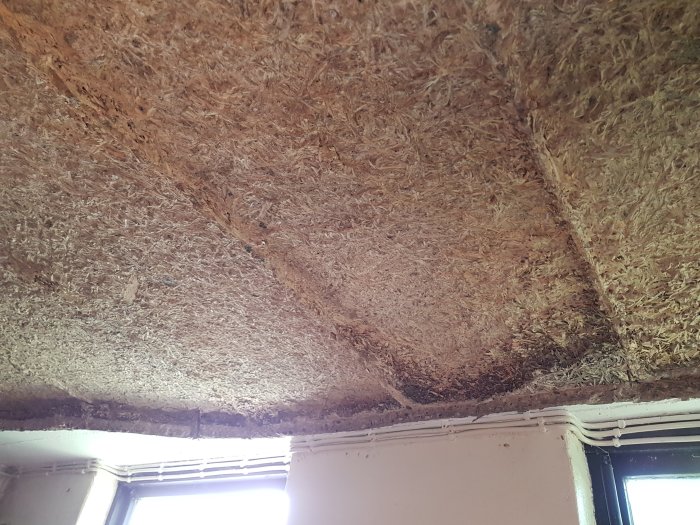
The Träullit needs to be replaced with some insulation to avoid condensation when the concrete slab is cold in the winter. One could consider attaching isodrän to the ceiling and then some kind of ceiling panel/bathroom panel. The problem is that the ceiling is very uneven due to "casting burrs" formed between the Träullit panels. Another solution could be some kind of insulating foam that is sprayed on and leveled so that ceiling panels can be screwed on. However, it feels like foam traps any potential future moisture. You do want the concrete to "breathe" downward since there is a waterproofing layer on top, right?
Does anyone have experience with something similar or good tips?
Personally, I believe the roof is too heavy and thin, causing it to sag. They used to like concrete in the past, but today they might not use that material for that small garage?
Have been searching for diffusion-open insulating foam but can't find any such product on the market. Does anyone know of something like that?
An alternative could be stone wool ground board which is a bit more compliant than isodrän. Perhaps one could get it to sit quite tightly against the rough concrete if screws are set closely and then fiberglass/minerit boards are placed underneath.
Yes, it is true that träulliten adhered well to the top layer of concrete. However, it did not adhere particularly well to the approximately 4 cm thick layer of underbetong that formed the inner ceiling. This layer was not anchored upwards at all except where it had partially adhered to the träulliten. Additionally, this bottom layer was completely unreinforced, which meant that the cracks that developed had devastating consequences for this bottom layer.
I don't understand why they didn't include a reinforcement mesh. I'm a "layman" here, but I understand enough to know that without reinforcement, you get cracks, and once cracks have formed, there's nothing to hold it together. Furthermore, the reinforcement mesh should have been anchored with other reinforcement upwards into the top layer of structural concrete. How could anyone build like this with a clear conscience?
There are (or rather were) marks from the panel seams in the ceiling from which the mold was constructed. Therefore, I believe the bottom layer was cast and then träullit was placed into the wet layer. However, it is clearly visible in the fallen concrete pieces that in some places it worked as intended, while in other places they probably waited too long for some reason, and the träullit did not sink into the concrete that had already begun to set. The träullit has only left impressions in certain areas (in the underlying concrete), while it has adhered better in others.
Here is my solution
1. Tear everything down to the load-bearing concrete layer.
2. Insulate using the same method as insulating a basement wall from the inside with steel studs and insulation boards. NOTE! without plastic sheeting.
3. Drywall.
Exactly, that's roughly what I was thinking! But one complication is the "casting flash" about 2x3 cm as seen in pictures 2 and 3. Possibly, you could cut the insulation boards so they fit precisely between these grooves and lie like the original boards in träullit. Alternatively, you could sand down the flash, but that feels like a real chore. The question is somewhat about how precise you need to be. How important is it to avoid any air gaps over the insulation boards due to the existing irregularities? It feels like if air gaps form, there's a risk of condensation, but here I feel I'm on shaky ground and lack solid information. I thought that if you attach the boards and use plenty of screws, you could still achieve quite a good fit.
Steel studs would be optimal for then being able to mount plaster or fiber cement, but the base is so uneven that it feels like the studs would deform as soon as you start fastening them. Maybe smoothing with a diamond cup on an angle grinder just where the studs will sit would be enough? However, there's a looming risk of a stiff neck ;-), as there are quite a few meters that need to be leveled.
Maybe it's enough to knock off the "gjutskägget".
I don't know if the insulation should lie against the concrete ceiling or if it's okay to have an air gap.
The determining factor is the distance between the concrete ceiling and the top edge of the windows.
Not much needs to be attached to the ceiling. Most of it is attached to the walls depending on the span.
See a similar example http://www.europrofil.se/system/undertak/fribarande-undertak
Thanks for that link! Informative!
I just went down and measured and the layer of concrete + träullit = 75 to 80 mm thick. This means that it could work well with 70 mm metal studs in a free-standing construction. I will probably place the insulation directly against the concrete ceiling to avoid an air gap as much as possible. According to the following link (https://www.isover.se/isolera-kallarvagg-inifran), you can also place insulation above (behind) the studs to avoid thermal bridges. If you do that, you might have to settle for 45 mm metal studs, which you build as a combination of free-standing and suspended ceiling since the span is several meters.
Knocking down the casting burr is probably the least labor-intensive and dust-free method. It should work well with a demolition hammer and a broad chisel. The hardest part will probably be removing the remaining träullit and getting down the rest of the concrete that isn't cracked (4-5 m2). I'm thinking that maybe you can cut grooves with a concrete saw and then pry a little to get it down. It's possible that the träullit will come off relatively easily if you chisel with moderate intensity. I also thought a bark spade might do the job...?
It is wise to start from the principles of insulating a basement wall. You should consider where the moist indoor air will condense if you place the insulation directly against the concrete ceiling...
I would rather say that you should have a ventilated air gap between the insulation (performed with isodrän) and the concrete ceiling. In this way, you ventilate out the moisture that otherwise risks condensing against the concrete ceiling. Otherwise, it is completely correct to use steel studs and plasterboard.
A tip is to borrow the book "få bukt med fukt" from the library, as it goes through, the question is what happened when you applied a waterproofing layer on the outside of the concrete, it might be that you also prevented moisture coming from inside from being transported through the concrete and ventilated away on the top side.
My point is that there didn't seem to be major problems after 30 years with the original construction, but 10 years after your measure, the situation is different. It might be worth considering a bit before taking action.
Thanks, great book tip, I'll check if I can find that book!
Already when we moved in (before the roof was sealed from the outside) there were clear cracks and settlements in the sub-concrete, it was only a matter of time when it would fall down. The sealing layer is diffusion-open but waterproof (Höganäs tätslamma FB3). The original problem was that it leaked into the garage...
The intention was to stop the degradation (carbonation) of the concrete by applying a sealing layer and naturally to make it waterproof.
According to the construction plan, the bearing layer should be waterproof K300 concrete. It might have been so for a few years but over time micro-cracks likely form, which has its consequences. I don't think concrete roofs are built without a sealing layer nowadays...
Interesting that you advocate for an air gap. The original construction had no air gap (concrete+träullit+concrete), but on the other hand, one can say that moisture from the inside could hardly enter the construction.
I'm not sure if I'm thinking correctly here, but if you have fiber cement/fiber concrete boards under the battens, you should be able to make it quite sealed. Like latex seal around and in all the joints. Can moist air still get in then?
I've thought about Isodrän, but having the boards up close would be difficult to achieve since the boards are relatively inflexible and the roof is uneven. But if you need an air gap, that's a different matter!
Spontaneously, it feels like an air gap allows a "larger" amount of moist air to condense. Absence of an air gap = no circulation (i.e., no replenishment of new moist air) = less condensation, or?
Yes, if nothing else, over time leaks will occur where moist air rises... You should at least avoid organic material in your ceiling construction where you might get microbial growth (mold).
I think you could benefit from a call to isodrän's support - they are very helpful. It might also be helpful to discuss the issue with, for example, JAPE.
Ideally, you shouldn't insulate at all, to be completely honest, but instead place it on the top side - but it's too late for that now.
Vi vill skicka notiser för ämnen du bevakar och händelser som berör dig.