
6,667 views ·
18 replies
7k views
18 replies
HELP! Need to calculate forces etc...
Hello I need some help from you knowledgeable folks with a little question I have. I want to hang a kitchen cabinet on my concrete wall. Now, this is not a regular kitchen cabinet, but one I expect might weigh 300kg (don't ask why  ), which means I need good fastening tools, but I've got that problem solved.
So now to the next part, does my planned construction work (see image). Can the rods carry 300kg (almost 3000N) without breaking at the weld?
PLEASE help me with this, and if you can't, but know where I might get help, please let me know too...
Note that I can't have rods thicker than 45mm, preferably 35mm... Thanks in advance!!!d^_^bd^_^b
), which means I need good fastening tools, but I've got that problem solved. So now to the next part, does my planned construction work (see image). Can the rods carry 300kg (almost 3000N) without breaking at the weld?
PLEASE help me with this, and if you can't, but know where I might get help, please let me know too...
Note that I can't have rods thicker than 45mm, preferably 35mm... Thanks in advance!!!d^_^bd^_^b
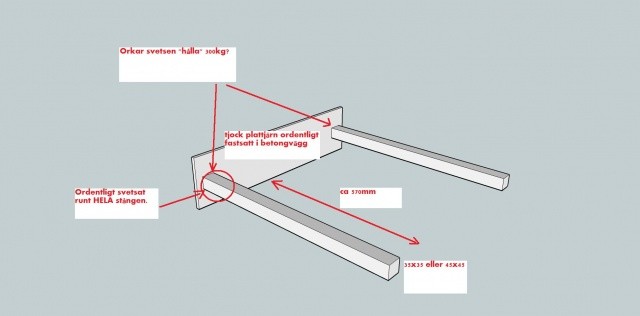

Is the load going to be at the outer edge of the bars or all the way against the wall? I would guess that you also need something to secure the cabinet at the top, like suggested above, a sheet along the entire backside.
It also depends on the weld's geometric design and weld quality.
In theory, the welded material is stronger than the base material. Problems arise from incorrect execution: slag in the weld, pores, root defects, too bulging welds, incorrect a-dimension, and so on.
Instead of a plate underneath, one could consider stiffeners welded under the beam on a slightly wider flat bar.
In theory, the welded material is stronger than the base material. Problems arise from incorrect execution: slag in the weld, pores, root defects, too bulging welds, incorrect a-dimension, and so on.
Instead of a plate underneath, one could consider stiffeners welded under the beam on a slightly wider flat bar.

The first question is what kind of cabinet it is (not the contents). Is it a base cabinet that should sit near the floor, or is it a tall cabinet that also sits near the floor? Or an upper cabinet that sits above a countertop?
Judging by the length of the rods, it doesn't seem to be an upper cabinet?
Judging by the length of the rods, it doesn't seem to be an upper cabinet?
mycke_nu
You might have missed that the construction must hold 300kg, so the plate won't work...
Noseone
The weight is distributed over the "arms."
BorgP
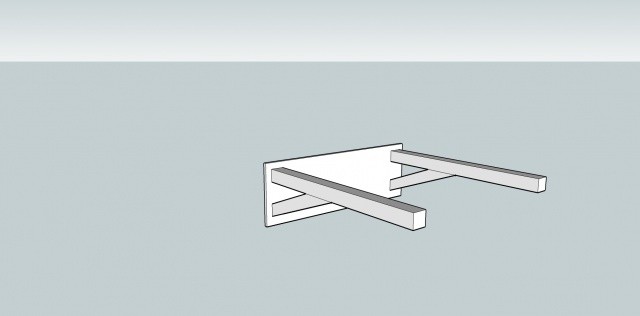
Professionals will weld the construction, but I understand what you mean. I attach a new image that might be a better solution.
hempularen
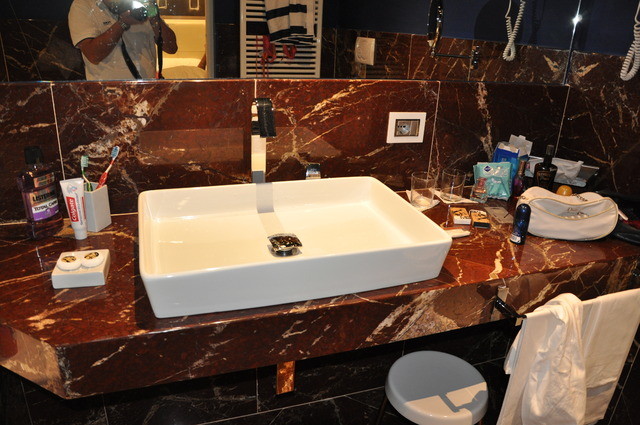
These are cabinet frames, the rods should be installed inside the cabinets. I also attach three images so you hopefully understand me a bit better; note that this is in a bathroom and I want to hang a cabinet. But the principle is the same, that the cabinet should "fly."
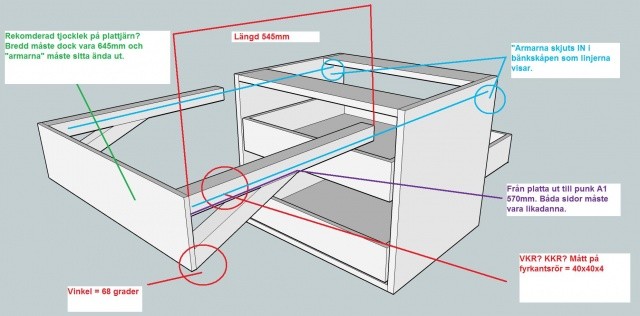
I attach three images of a similar construction and a new "drawing" of a new solution.
The flat bar attached to the wall is 10mm thick (or does it work with less?) and the "arms" extend 570mm and have dimensions of 40x40 with a thickness of 4mm.
The front edge of the "underarms" extends to the middle of the "upper arms."
If anyone knows how to calculate this professionally or knows someone who might know, please reach out.
Thanks in advance
You might have missed that the construction must hold 300kg, so the plate won't work...
Noseone
The weight is distributed over the "arms."
BorgP
Professionals will weld the construction, but I understand what you mean. I attach a new image that might be a better solution.
hempularen
These are cabinet frames, the rods should be installed inside the cabinets. I also attach three images so you hopefully understand me a bit better; note that this is in a bathroom and I want to hang a cabinet. But the principle is the same, that the cabinet should "fly."
I attach three images of a similar construction and a new "drawing" of a new solution.
The flat bar attached to the wall is 10mm thick (or does it work with less?) and the "arms" extend 570mm and have dimensions of 40x40 with a thickness of 4mm.
The front edge of the "underarms" extends to the middle of the "upper arms."
If anyone knows how to calculate this professionally or knows someone who might know, please reach out.
Thanks in advance



builder henke
It is mostly the "arms" that have to bear the most, but of course, it should be reinforced properly at every joint. But, if a regular base cabinet can handle all the weight I indicate, then "mine" should be able to as well, even though it's "hanging" in the air?
It is mostly the "arms" that have to bear the most, but of course, it should be reinforced properly at every joint. But, if a regular base cabinet can handle all the weight I indicate, then "mine" should be able to as well, even though it's "hanging" in the air?
I don’t think there are any problems with the welds of the construction with the slanted supports; however, you will experience very large tensile forces at the top attachment of the disc to the wall, at least 1000 kg (10,000 N).
To reduce the lever effect, I would let the plate against the wall extend all the way down to the bottom edge of the cabinet. The plate must, of course, also be sufficiently stiff for the extension to be beneficial.
To reduce the lever effect, I would let the plate against the wall extend all the way down to the bottom edge of the cabinet. The plate must, of course, also be sufficiently stiff for the extension to be beneficial.
I believe your construction will settle over time. I bought IKEA's square legs and placed them just about halfway out from the wall,

Member
· Västerbottens län
· 18 064 posts
The "height" of the flat bar is the problem. If the distance between the bottom edge and the screw holes at the top is 50 mm, with the load of 300 kg evenly distributed, there is a force of 3000N approximately 300 mm out. The force on the screws will be 300/50x3000N=18000N=1.8 tons. If you double the height to 100 mm between the edge and the screw, it becomes just under 1 ton.
My suggestion is to place a stainless steel sheet triangle bracket that is as tall as the cabinet. Either inside before assembling the cabinet or outside with a cover panel, if there are several cabinets to be mounted, the sheet should be placed between them.
The sheet doesn't need to be thick, about 1 mm or so.
Protte
My suggestion is to place a stainless steel sheet triangle bracket that is as tall as the cabinet. Either inside before assembling the cabinet or outside with a cover panel, if there are several cabinets to be mounted, the sheet should be placed between them.
The sheet doesn't need to be thick, about 1 mm or so.
Protte
mycke_nu
I understand what you mean, but I talked to Hilti (www.hilti.se) and they recommended a screw anchor (?) called HUS-H10. This should handle 1600kg (http://www.hilti.se/holse/page/modu...4FEF5176DC18EC41.node3?lang=sv&nodeId=-219396).
With this, the need for having a plate, as you said, that goes all the way down to the bottom of the cabinet is eliminated.
builder henke
It's not IKEA; I'm going to build it myself from MDF 22mm.
Fixar_Krille
It doesn't necessarily have to be that way.
prototypen
Congratulations on the title of Godfather
Don't you think that a "height" (of the flat bar) of 150-200mm would be enough?
You wrote that if you place the screws 50mm from the bottom, the force would be 18000N (1.8 tons) and that if you doubled to 100mm, you would end up just under a ton, which then confirms that it's okay to use Hilti's screw anchors that can handle 1600kg if you place them (2-3 pieces) 100mm from the bottom edge of the flat bar.
The problem I see is more whether the weld seams can handle the weight and not so much if the cabinet will one day collapse because the fittings have come loose.
The plate you recommend, what would it be for? Sorry if I'm slow hehe...
Thanks for now
I understand what you mean, but I talked to Hilti (www.hilti.se) and they recommended a screw anchor (?) called HUS-H10. This should handle 1600kg (http://www.hilti.se/holse/page/modu...4FEF5176DC18EC41.node3?lang=sv&nodeId=-219396).
With this, the need for having a plate, as you said, that goes all the way down to the bottom of the cabinet is eliminated.
builder henke
It's not IKEA; I'm going to build it myself from MDF 22mm.
Fixar_Krille
It doesn't necessarily have to be that way.
prototypen
Congratulations on the title of Godfather
Don't you think that a "height" (of the flat bar) of 150-200mm would be enough?
You wrote that if you place the screws 50mm from the bottom, the force would be 18000N (1.8 tons) and that if you doubled to 100mm, you would end up just under a ton, which then confirms that it's okay to use Hilti's screw anchors that can handle 1600kg if you place them (2-3 pieces) 100mm from the bottom edge of the flat bar.
The problem I see is more whether the weld seams can handle the weight and not so much if the cabinet will one day collapse because the fittings have come loose.
The plate you recommend, what would it be for? Sorry if I'm slow hehe...
Thanks for now