OK, now I will show my total ignorance about this stuff How do I ensure in the simplest way that the wall I am building (leca) will be completely perpendicular? It's bad enough to get the exact measurements (2544*4410 mm).
I know you're supposed to measure diagonally, but how do I do this in the best way? The diagonal will be over 5 meters, which is the length of my measuring tape. Mason's string is a bit flexible, so it's hard to achieve precision with that.
A full-sized building board can also be used as a square and measure the area quite accurately, in combination with mason's line attached to stakes outside the construction area.
Here is the sole I have cast. It should be reasonably perpendicular but not enough for me to dare measure from its edges. The red line shows where the wall for the greenhouse itself should be. The others will become permanent planting boxes, also masonry. I plan to use masonry strings to guide me once I get the precise measurements and angles.
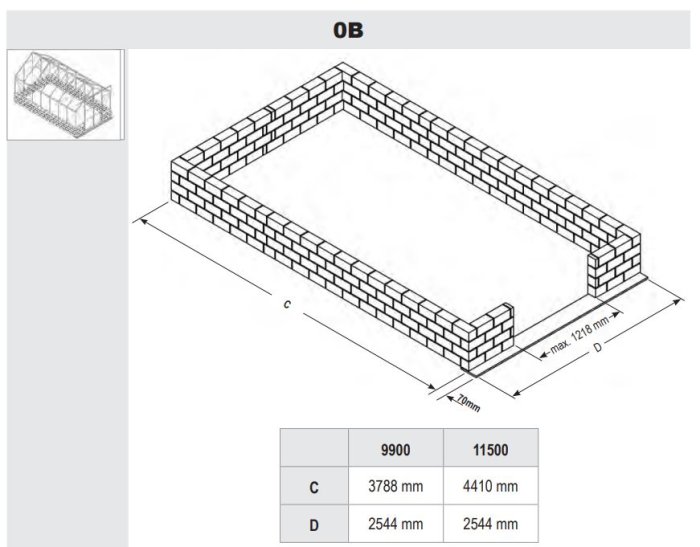
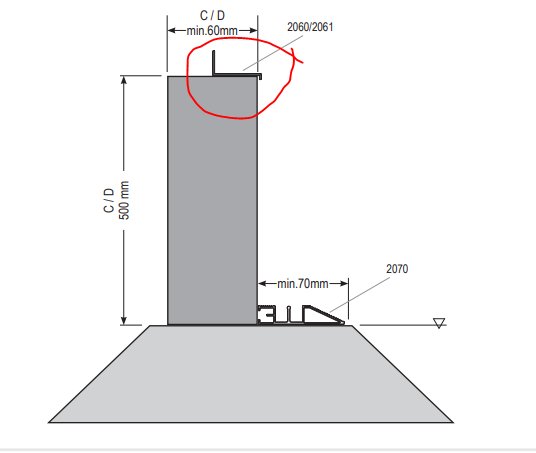
In the instructions for the greenhouse, you can see that the outer dimensions should be 2544x4410 mm, so I should stay a bit smaller than that to allow room for plaster, I assume. Should one cut about 1 cm off each side of the wall? If it ends up a few millimeters too small, it's probably better than a few millimeters too large. The worst that can happen then is likely there will be a slight gap at the circled area in the image below, but if the wall is too large, the "lip" of the frame will end up on top of the wall?
Full-size construction board can also be used as a square and to measure the area quite accurately, in combination with mason's line attached to stakes outside the construction area.
The only problem is getting one of those construction boards home without a trailer
But smart with such a measuring tape. Small cost in the context.
Leca is convenient. A few mm too much and you take out the angle grinder with a diamond blade. A few mm too little and you add a bit more plaster.
Yes, the angle grinder will have to be the emergency solution. But I'm thinking it might be better to cut 1 cm off each side to be able to adjust with the plaster. That is, a total of 2 cm in width and 2 cm in length.
What I'm most worried about is it being skewed, i.e., not being perpendicular. I suspect that a greenhouse doesn't have any room for adjustment for that kind of thing considering the glass.
Cross-measure just one meter from two of the corners and the tape measure will suffice. It's impossible to maintain millimeter precision when laying bricks, so it is more than enough.
The easiest way is to spend 200 kr on a new tape measure.
I built our greenhouse foundation with an error margin of +-2 mm on all measurements. Measured with a laser. In the end, it didn’t matter because the tolerance on the items in the kit from Williab garden turned out to be significantly more than that…
Cross-measuring with the mason's string is difficult, I think, as it flexes too much. That's why I used the laser, but if you don't have that, a longer measuring tape works just as well functionally.
I built our greenhouse foundation with an error of ±2 mm on all measurements. Measured with a laser. In the end, it didn't matter because the tolerance on the parts in the kit from Williab garden turned out to be significantly more than that…
Cross-measuring with the mason's string is difficult, I think, it flexes too much. That's why I used the laser, but if you don't have that, a longer tape measure is just as functional.
If one were to look for excuses to buy new toys, is there any cheap cross laser that is good enough for the job?
In principle, I would say any, the only thing is you need to be a bit of a night owl if you don't use a receiver as the lines are difficult to see in daylight outdoors.
For the cross measurement, I used a distance laser.
Measure a distance of three decimeters from one corner, four decimeters from the other. When the diagonal is exactly 5 dm, you have a 90-degree angle in the corner.
Measure a distance of three decimeters from one corner, four decimeters from the other. When the diagonal is exactly 5 dm, you have 90 degrees in the corner.
Yes, good suggestion, but even better a larger triangle of 6-8-10 or 9-12-15 (then any measuring errors have less impact).
Measure a length of three decimeters from one corner, four decimeters from the other. When the diagonal is exactly 5 dm you have 90 degrees in the corner.
True. I didn't think about not having to measure the entire diagonal. That's actually possible too. I'll experiment a bit at home
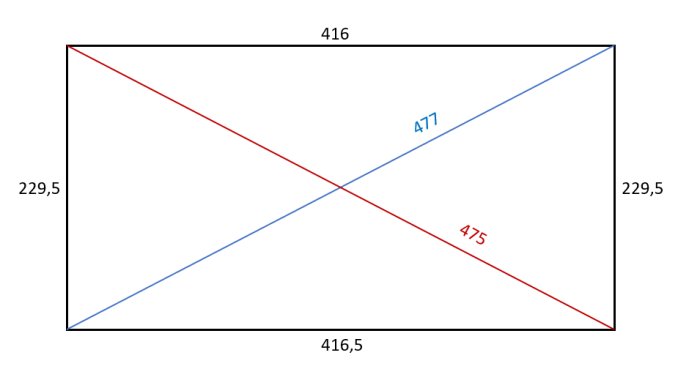
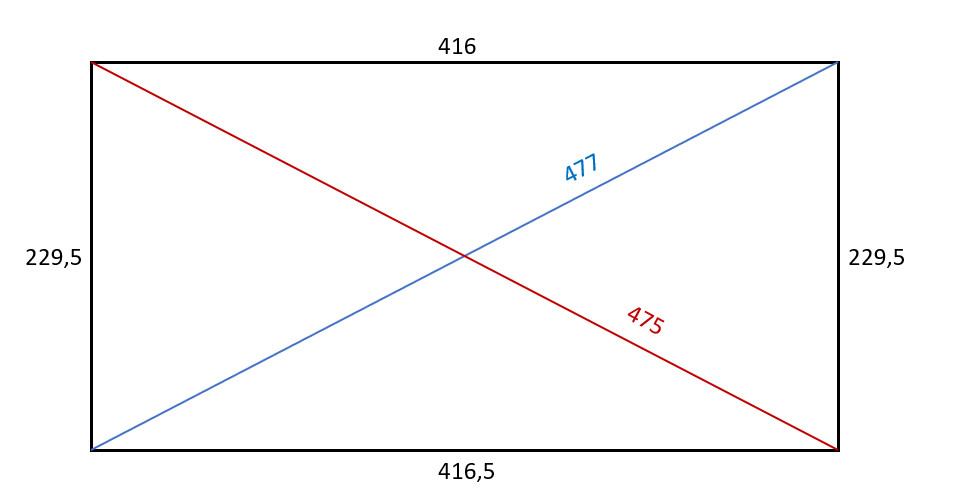
OK, so I have tried to measure a bit. This is what I have come up with. I actually have two questions:
1. Is it sufficiently perpendicular to use as a basis when I build up to the greenhouse kit? Good enough?
2. If not, what is the easiest way to adjust it to good enough?
What I have measured is the inner edge of the cast sole. I plan to use it as a starting point when setting the strings for masonry. All measurements in cm.
Vi vill skicka notiser för ämnen du bevakar och händelser som berör dig.


 How do I ensure in the simplest way that the wall I am building (leca) will be completely perpendicular? It's bad enough to get the exact measurements (2544*4410 mm).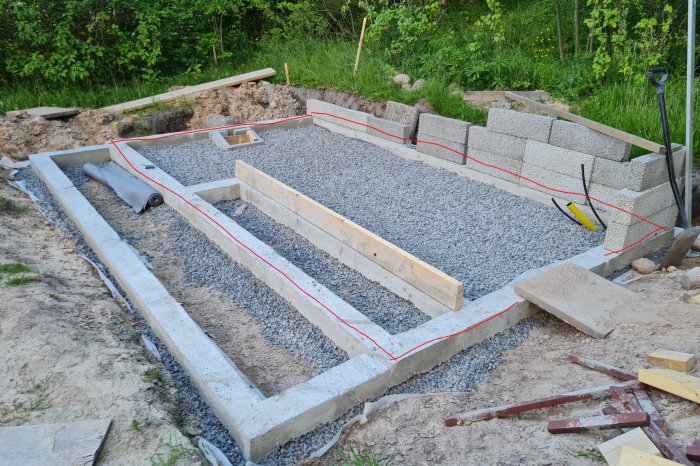


mexitegel said:
I built our greenhouse foundation with an error of ±2 mm on all measurements. Measured with a laser. In the end, it didn't matter because the tolerance on the parts in the kit from Williab garden turned out to be significantly more than that…Fujim said: