Hello
I plan to build a sunroom with a slab extending from our house. Our roof extends about 1 meter where the sunroom will be. When I measured at a suitable height to make the foundation, it seems reasonable to make it slightly lower than the indoor floor, that is, approximately 245 cm below the roof height.
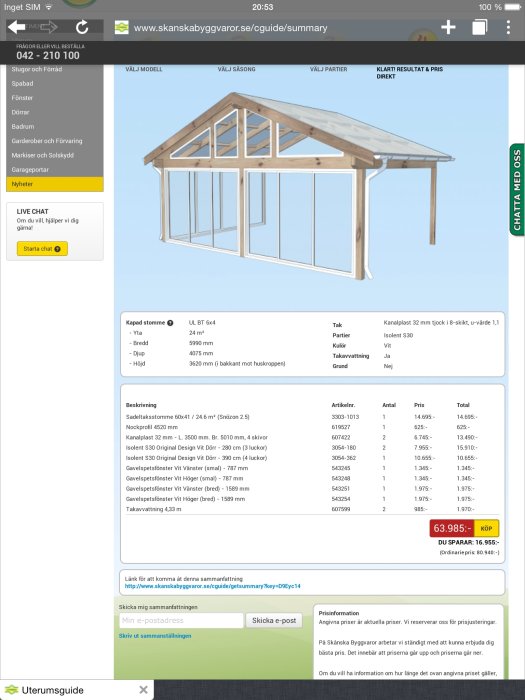
Now to the question. If I buy the following sunroom, the gutters on the sunroom will be 225 cm above the new concrete slab. This means they cannot be connected to the current roof gutters, is this a problem? I can't really put two beams on my sunroom to raise the height; it would look very strange. I also can't build the new foundation at 225 cm height as it would be above the door into the house.
Grateful for help on how this can be best resolved.
Thank you for the response. I was a bit confused there regarding gravity and the water's path.
However, a follow-up question. I will have the conservatory in the middle of a long side, which means 2/3 of the house's water will run down into the new gutters for the conservatory.
Do you think it's reasonable to lay pipes underground that terminate at the lawn's drainage? The drainage is new and consists of ample amounts of large macadam stones as well as drainage pipes. Under the deck, there's also crushed stone since it used to be a stone patio there. We also don't have a basement in the house if that's of interest to know.
The alternative would be to connect where the current gutters are leading down, but then I would need to tear up newly laid edge stones and ruin the roots of a very nice tree?
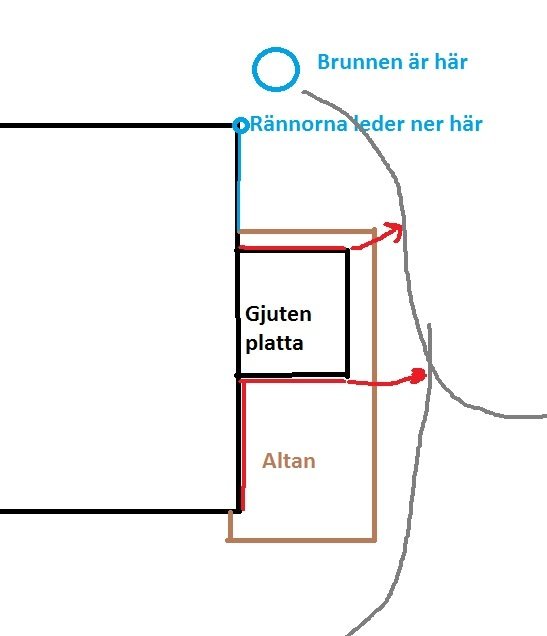
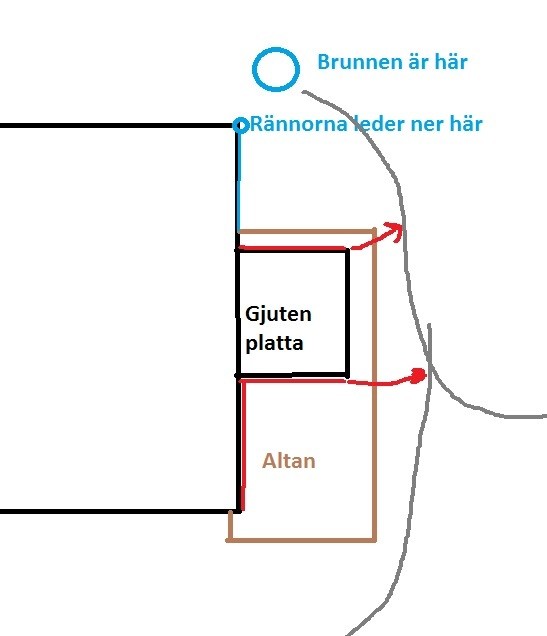
OK, I assume that the entire existing roof slope on the long side only leads to a single downpipe (the one you marked "The gutters lead down here" in the image above? Meaning you don't have a downpipe at each corner of the house?
Where does the stormwater pipe go then, directly to the "Well", or does it go to some kind of soakaway or somewhere else? If they go directly to the well, you can choose whether you want to lead the "red" pipes directly to the well too, or connect them somewhere on the line in the ground after "The gutters lead down here."
You should ideally not lead down stormwater to any drainage. Definitely not to the house's drainage at least, I'm not quite sure what "the lawn's drainage" means or where it is located (is it the gray lines?), but it is probably made to make the lawn drier, and then I personally wouldn't lead EXTRA water THERE instead. You ideally want the water from the roof to go away to the well. But maybe the drainage can suffice as a "soakaway" if that's the case. Some solve roof water by just leading the water out a couple of meters from the corner and letting it flow onto the ground there, and that works for them.
However, I would personally prefer to lay pipes to the well, just make sure to have a slope on the line and avoid too sharp bends where blockages can easily occur, otherwise you're quite free in routing and can avoid trees, etc.
OK, I assume that the entire existing roof slope on the long side only ends up in a single downspout (the one you marked "Rännorna leder ner här" in the image above? In other words, you don't have a downspout at each corner of the house?
Where does the stormwater pipe go then, directly to the "Brunnen", or does it go to a soakaway or somewhere else? If they go directly to the well, you can choose whether you want to lead the "red" pipes directly to the well too, or connect them somewhere on the line in the ground after "Rännorna leder ner här".
You should ideally not lead stormwater to any drainage. Absolutely not to the house's drainage, at least—I don't really know what "lawn drainage" implies or where it's located (is it the gray lines?), but it's probably made to make the lawn drier, and then I personally wouldn't lead extra water THERE instead. You want the water from the roof to go to the well. But the drainage might suffice as a "soakaway" if that's what you mean. Some solve the roof drainage by just leading the water out a few meters from the corner and releasing it on the ground there, and that works for them.
Personally, I would probably prefer to lay pipes to the well, though—just make sure to have a slope on the line and avoid sharp bends where blockages can easily occur, otherwise you're quite free in the installation and can avoid trees, etc.
Thank you for your response. I didn't make a completely clear map. Yes, it's correct that the water only flows off one side to the well. This well (I think it's called a stormwater well) channels all water from the house, yard, and downspouts. It goes further into the street's system, so there's no issue if I can connect there. The problem is getting it there without sacrificing the lawn. How deep do I need to dig? Is it enough to maintain a few cm slope per meter, or are there recommendations for depth?
I agree that it might be unwise to direct it toward the lawn drainage, but I thought since it's deep and has a lot of stones around, maybe it could absorb it?
Are there any regulations for drainage that one should adhere to?