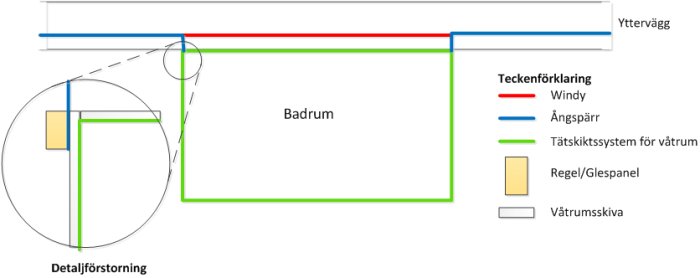
You're not supposed to trap material between two impermeable layers, which leads to the interesting situation in bathrooms, where you normally have the vapor barrier on the indoor side of the insulation around the entire house, and then the waterproofing layer inside the bathroom itself.
I read in Bygg-AMA (could have been another industry rule, and it was quite some time ago) that you should solve this by replacing the vapor barrier just at the bathroom with a wind barrier, like Windy.
How have you builders handled this situation? Has anyone done that, or do you go ahead with double waterproofing layers and hope it works out? Or in some other way?
Can't say this 100%, but from what I've read, it should be sufficient if the waterproofing in the bathroom is tighter (less permeable) than the vapor barrier in the outer wall. That way, any potential water can move in one direction.
Not sure if I'm on the right track, so any bathroom carpenter is welcome to comment.
Regards,
Thomas
But isn't regular vapor barrier plastic just as impermeable as normal waterproofing systems for wet rooms?
Surely this forum is full of people who have built bathrooms in their new constructions, isn't anyone willing to say how they chose to do it ?
I'm not really looking for the absolutely correct answer, but how it's usually done. I suspect that this is an area where there is a theoretical solution that few use...
In other words, most people probably go with the waterproofing in the bathroom and leave the vapor barrier in the outer wall as is.
I will probably do as Bygg-AMA recommended, replacing the vapor barrier with Windy in the outer walls of the bathroom and connecting the remaining vapor barrier to the waterproofing layer in the bathroom appropriately.
Overzealous private builder, yes indeed! Having spent a lot of time and expensive T-tape to make the vapor barrier tight, it feels so wrong to open it up.
I will, but it will take some time . The bathroom is at the bottom of the priority list, and it doesn't go so fast when building yourself.
Right now, I've wrapped the entire extension in plastic since I expect we'll move in before we fix the new bathroom.
That is, I planned to clamp the plastic between the studs and the wet room boards.
In the less tidy reality, there will probably also be some Tacoflex tape and corresponding adhesive for the vapor barrier that I bought at the same place (befestigungsfuchs.de, Tacoflex is the same tape as the expensive Swedish T-flex but at a third of the price).
Hmm, that's how it was stated in the industry regulations I read. When I think about it, it's probably overkill if you make sure to connect the vapor barrier to the waterproofing layer in the bathroom.
Otherwise (if you don't connect it to the waterproofing layer), the idea is to prevent the area without plastic from becoming a complete opening in the vapor barrier, as humid indoor air would still enter from the side, from the rooms next to the bathroom. Since the windy is more open than the vapor barrier (but more closed than nothing at all), any moisture trapped between the waterproofing layer and the windy can still ventilate through the windy.
If I have to justify using the windy even though I connect the plastic to the waterproofing layer (a justification that's purely an afterthought ), it's because as a private builder, I build slowly, and it can take a while between opening the vapor barrier and applying the waterproofing layer. Since by that time we will have moved into the other rooms and it will be heated, it's to provide some protection against condensation in the meantime. I had the same problem when I added insulation to the laundry room, I had to tear down a batch of insulation that became soaked before I could close it up and paint with waterproof paint.
Vi vill skicka notiser för ämnen du bevakar och händelser som berör dig.


 ?
?