As the title suggests, I've accidentally glued a paper strip with regular wallpaper paste without realizing it.
I noticed that the strip was slightly bubbling in a few spots on the wall. I thought I was a bit sloppy with pressing the strip into the glue, so on the ceiling, I decided to be very thorough! And I was; no bubbles after the filler there.
Then I was in the basement and noticed a bucket I had set aside to use, as I had done in the first room I renovated: "wet room adhesive"... sigh! As if that wasn't enough, I ended up using 2-year-old wallpaper paste. Oh well. I also noticed after the second coat of paint that you can slightly see the middle of the strip in one spot on the ceiling.
I can live with this mistake; after all, I haven't plastered perfectly in the rest of the ceiling even though I've tried.
BUT... I understand that you're supposed to use wet room adhesive so that it doesn't bubble when you add moisture in the form of filler, and apparently even paint on top of the filler - but can anything else happen other than bubbling during this period? In other words, is there a risk of something else happening after the paint has dried? Greater risk of cracks or anything else?
I use regular wood/paper glue. Very strong and easy to apply, dries quickly, and doesn't react when plastering.
I use a brush to apply it, then a cloth to press in the strip/spread the glue.
Never thought of using wood glue actually! Might be something to try in the next room.
Otherwise, that's about how I did it, although I used the plaster quite a bit after I saw it had bubbled on the wall.
1977bjorn said:
I tried various types of plaster as well as wet room glue and it still bubbled
That bad, huh? I used Biltema's wet room glue in the living room, and the strips didn't bubble there. I was pretty meticulous with the plaster even now in the bedroom but… To be honest, I'm quite doubtful that I would have fixed anything regardless of what you all said when I think about it… I don't even know where I would start to tear down plaster and strips.
To prevent cracking, it is very important that there is suitable filler behind the tape between the boards. Without filler, it is very likely that the paper tape will bulge out if the wood behind the boards swells and shrinks. There's nothing to hold it back. Why fiddle with different adhesives to attach a paper tape when it's so simple to lay the tape in filler as you should?
Why mess around with different glues to attach a paper strip when it's so easy to place the strip in putty as you should?
because it's not easy for amateurs to embed the strip in putty AND that's not how you should do it, it's just as good or better to glue it, but it takes longer.
if you glue according to instructions, it is practically impossible to fail.
because it is not easy for the amateur to plaster the strip AND that is not how it should be done, it is just as good or better to glue, but it takes longer.
if you glue according to instructions, it is virtually impossible to fail.
Which instruction. Are you watching 5-minute crafts?
I would gladly like to see the source stating that you shouldn't place the paper strip in plaster and that it's better with glue.
Can't say anything about wallpaper paste for paper strips that the thread is about but... A filler intended for joint filling is much easier to use, less bubbling, than e.g. Beckers medium allround filler which I find way too dry. This is my experience at least.
Can't say anything about wallpaper paste for paper tape as the thread is about, but... A filler intended for jointing is much easier to use, bubbles less, than, for example, Beckers medium allround filler which I find way too dry. This is my experience at least.
that was probably exactly the filler I had problems with, even the fine filler…
To prevent cracking, it is very important that there is suitable filler behind the tape between the boards. Without filler, it is very likely that the paper tape will bulge if the wood behind the boards swells and shrinks. There’s really nothing to hold it back. Why bother with different adhesives to attach a paper tape when it’s so easy to lay the tape in filler as you should?
It is of course quicker to place the paper tape while filling, my opinion is that it's easier to make mistakes. Ironically, I made a mistake with the gluing too, so...
You ask about the source of Mathias's claim, but do you have a source for your claim that it would be worse to glue the paper tape? I'm not saying it's not so, I just don't see why it would be worse (assuming it's done correctly) to glue? You plaster on top anyway, shouldn't the strength be the same?
losskägg said:
than e.g., Beckers medium allround filler which I find much too dry. This is my experience anyway.
It's Beckers Medium I've used, can see how it doesn't work well to plaster the tape with, feels quite dry as you say.
I encountered a problem when gluing. The mistake I made was not first filling the gap. I glued directly. During gluing, the following steps should be correct:
Fill - Let Dry
Sand
Glue
Fill
I did so with the cut joints and had no problems there.
With the right filler, it's not hard to see the time-saving in doing everything in one step...
I delved into this before I filled my walls/ceilings. Both methods are correct, and neither is wrong. I don't have a source on that now, so you just have to trust me.
As an amateur, I thought it was just a matter of buying an expensive filler, and it would work to apply wet on wet, but it wasn’t.
To the original poster; if it doesn’t bubble after filling and painting, it’s fine.
What an instruction. Do you watch 5-minute crafts?
I'd love to have the source for why one shouldn't put the paper strip in putty and that it's better with glue
5-minute crafts. What is it?
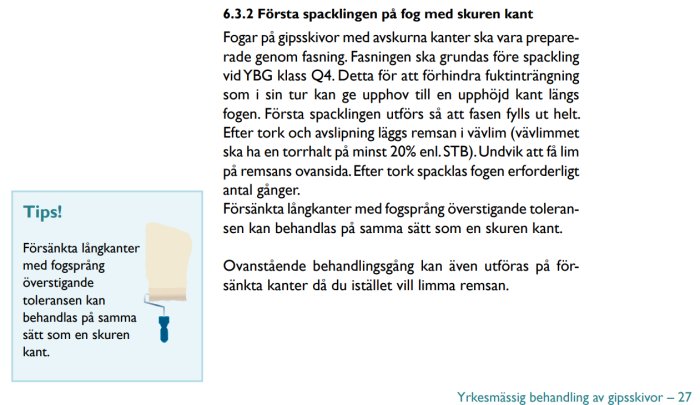
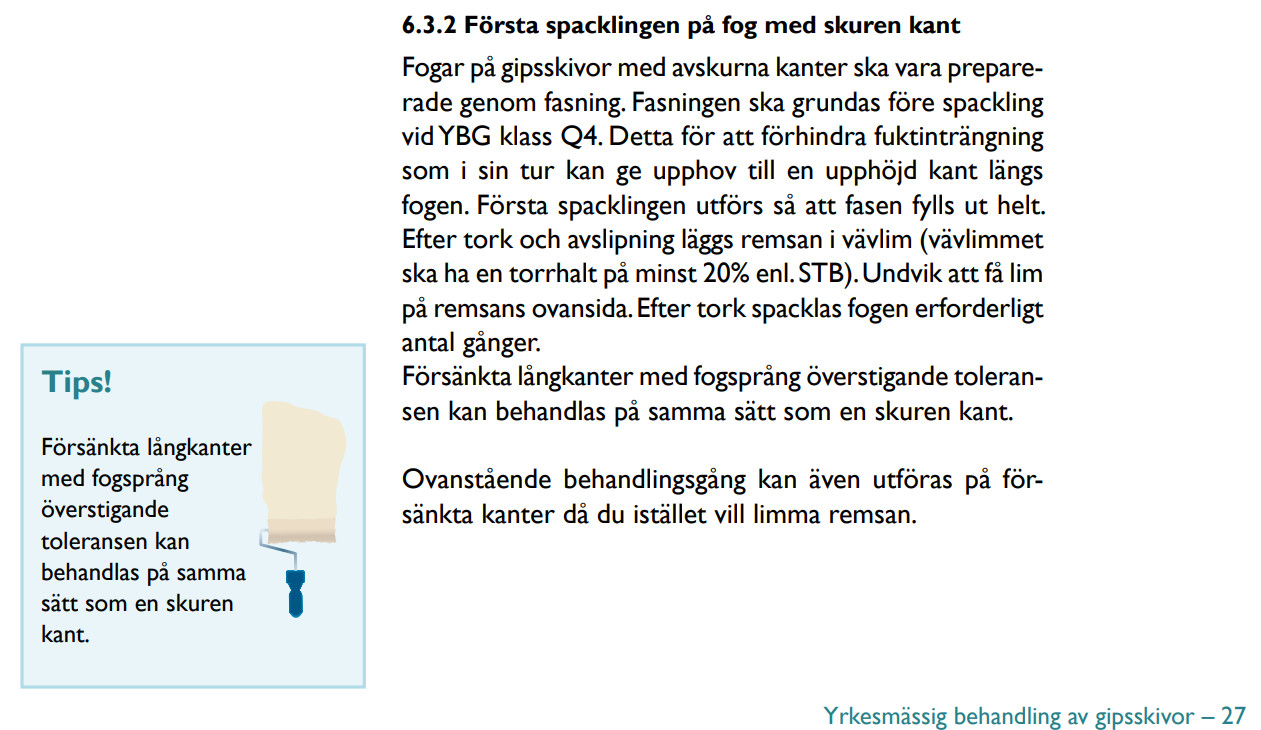
I read the industry regulations from ybg.
I haven't said that one shouldn't put the paper strip in putty. I've said that it is better if you glue it. It has always been stated in Ybg that the most exposed seams should be glued.


EddieHansson said:
1977bjorn said:

MathiasS said:
losskägg said: