
53,899 views ·
24 replies
54k views
24 replies
Casting own L-support
Member
· Västra Götalands län
· 13 posts
Hey, I'm planning to support the ground and eliminate slopes with L-shaped supports in different dimensions as part of some garden landscaping!
What's the cheapest option? Casting the supports myself or buying ready-made ones? I don't want to know what would be best, as I know the quality is probably better for a purchased L-support than a self-made one!
I've calculated for a large support: 2m high, 2m wide, 1.2m deep base, 10/15cm thick material! This results in a volume of 740 liters of concrete/cement! This would be about 57 bags of 25kg coarse concrete at 40 SEK each = 2280 SEK/support.
It's roughly half the cost of purchasing one of the same size! Have I miscalculated? There will be additional costs for reinforcement and molds, among other things. But you avoid shipping, and if you think about it, you can cast the supports where they are going to be, so you also avoid the effort of moving them!
What type of concrete should be used for this type of project?
What's the cheapest option? Casting the supports myself or buying ready-made ones? I don't want to know what would be best, as I know the quality is probably better for a purchased L-support than a self-made one!
I've calculated for a large support: 2m high, 2m wide, 1.2m deep base, 10/15cm thick material! This results in a volume of 740 liters of concrete/cement! This would be about 57 bags of 25kg coarse concrete at 40 SEK each = 2280 SEK/support.
It's roughly half the cost of purchasing one of the same size! Have I miscalculated? There will be additional costs for reinforcement and molds, among other things. But you avoid shipping, and if you think about it, you can cast the supports where they are going to be, so you also avoid the effort of moving them!
What type of concrete should be used for this type of project?
Member
· Västra Götalands län
· 13 posts
Member
· Västra Götalands län
· 13 posts
You seem to have experience, what if you cast in sections then? That is, cast the bottom first and reduce the pressure on the casting plate! Let the reinforcement stick up and cast the wall afterwards! Will it turn out bad/good? Durability issues?jhenrikj said:
There is no problem with casting the bottom part first and then the wall panel. Sure, you'll get an ugly casting joint, but in terms of strength, there are no issues.
However, that's not where you'll encounter problems with the formwork. The wall panel is the problem because you get a tall column of concrete where there's enormous pressure at the bottom that wants to push the form outward. You need to build a substantial support that holds the form in place... if it fails, it's basically over, and you'll have to remove all the concrete and start over from scratch.
The best option is to cast the elements lying down... but then you have the handling issue of raising them up later.
However, that's not where you'll encounter problems with the formwork. The wall panel is the problem because you get a tall column of concrete where there's enormous pressure at the bottom that wants to push the form outward. You need to build a substantial support that holds the form in place... if it fails, it's basically over, and you'll have to remove all the concrete and start over from scratch.
The best option is to cast the elements lying down... but then you have the handling issue of raising them up later.

If you cast the wall lying down first, with protruding reinforcement where the slab should be. Then you raise it to the correct position and cast the slab. I’ve never tested it, the thought just crossed my mind now 
The wall is likely to weigh a ton, but there are solutions for that.
Sent from my X10i using Tapatalk
The wall is likely to weigh a ton, but there are solutions for that.
Sent from my X10i using Tapatalk
A wall, built with shell blocks, with a height of 180 cm thickness of 20 cm and 70 cm "sinking foundation," costs about 1000 SEK/m in material cost. This includes plastered on both sides and concrete roof tiles on top.
First, the sinking foundation was cast, then casting up to half height and finally casting to full height.
First, the sinking foundation was cast, then casting up to half height and finally casting to full height.
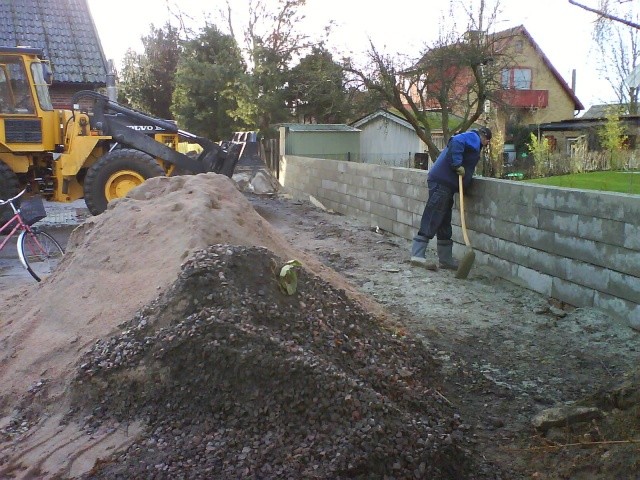

Now I kept mine to more modest dimensions like 1x1 meter with a 60 cm base, but on the other hand, I cast 33 of them.
They were made lying down and then tipped out of the mold. I placed them with the help of a digger.
Then I made about 35 linear meters of T wall with a 60 cm base and varying height up to 1.20. However, they were cast in place.
They were made lying down and then tipped out of the mold. I placed them with the help of a digger.
Then I made about 35 linear meters of T wall with a 60 cm base and varying height up to 1.20. However, they were cast in place.
Member
· Västra Götalands län
· 13 posts
Hmm, ok I may have over-engineered the supports, but I'm an engineer, that's how I work ;-)
What type of concrete should be used? Coarse concrete?
What type of concrete should be used? Coarse concrete?

Do you understand what you're getting into now?
2m height with earth pressure is not something you joke about with homemade calculated reinforcement and casting joints in homemade mixed coarse concrete...
I think you should look into buying proper supports.
2m height with earth pressure is not something you joke about with homemade calculated reinforcement and casting joints in homemade mixed coarse concrete...
I think you should look into buying proper supports.
Member
· Västra Götalands län
· 13 posts
Winners find solutions! See opportunities where others see problems!pjfj said:
What is the cost of a finished block/support?