The subject has been discussed many times, I have read on various forums.
The circumstances vary a bit.
And of course - always best to insulate from the outside. But....
A thought experiment... If for the moment I don't want/can't dig up around the garage but want
to insulate from the inside to save on heating costs.
The conditions today. An old garage/workshop that has two floors above it that are uninsulated (like storage, etc.) at about 70m2.
The walls are cast in concrete (about 25 cm thick).
On the sides, the walls (10 meters long) are partially below ground. Sloping ground, so the outer walls are visible from maybe 50 cm to 120 above ground. (ceiling height in the garage/workshop is 2.10).
The back wall (7 meters wide) is almost completely below ground.
The front wall (7 meters wide, gates, etc.) is not below ground (though a little on one side).
No wall insulation today. However, the roof is insulated. With what, I do not know. Old building.
There is an existing waterborne heating system (which needs to be reviewed)
I want to maintain 5-10 degrees during the cold months for the dehumidifier to work well and some basic comfort. When I'm in the garage, I can put on a bit of extra heat.
Anyway, to keep heating costs down which are likely to be quite substantial as it is only concrete in the walls, I'm considering insulating a bit if possible.
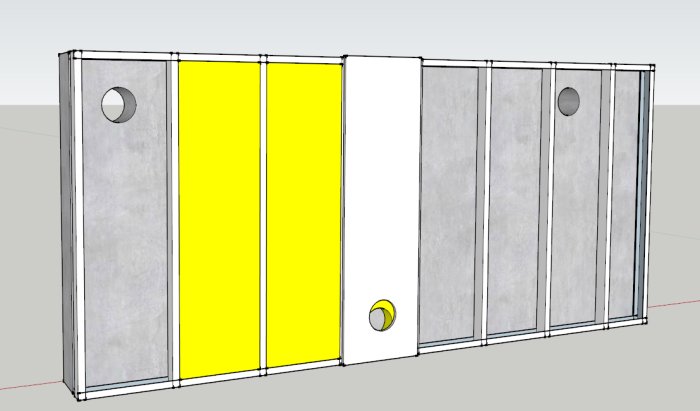
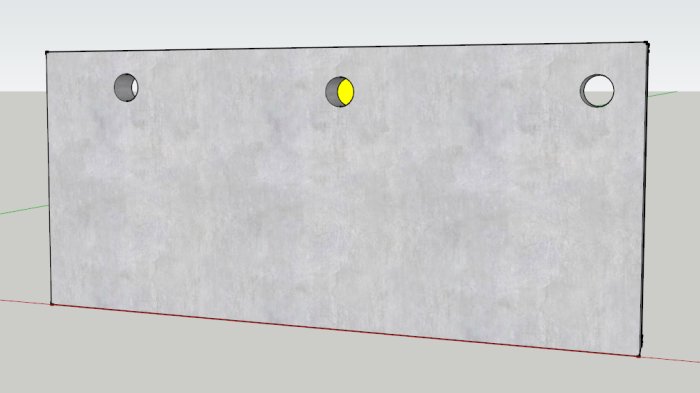
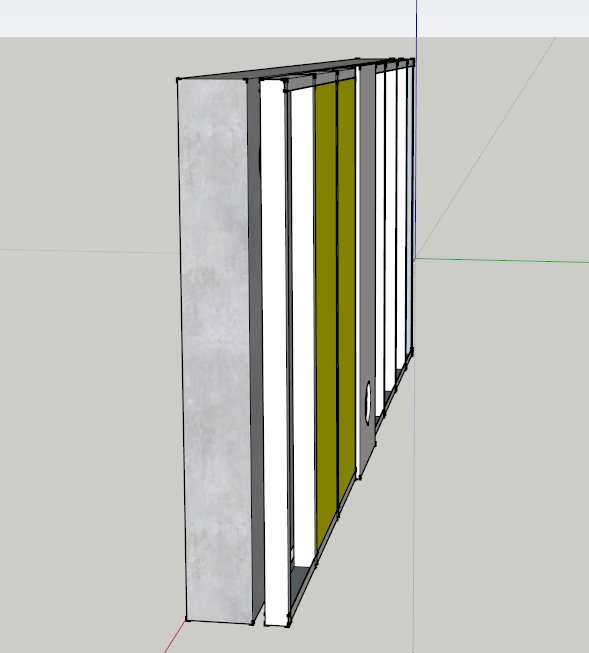
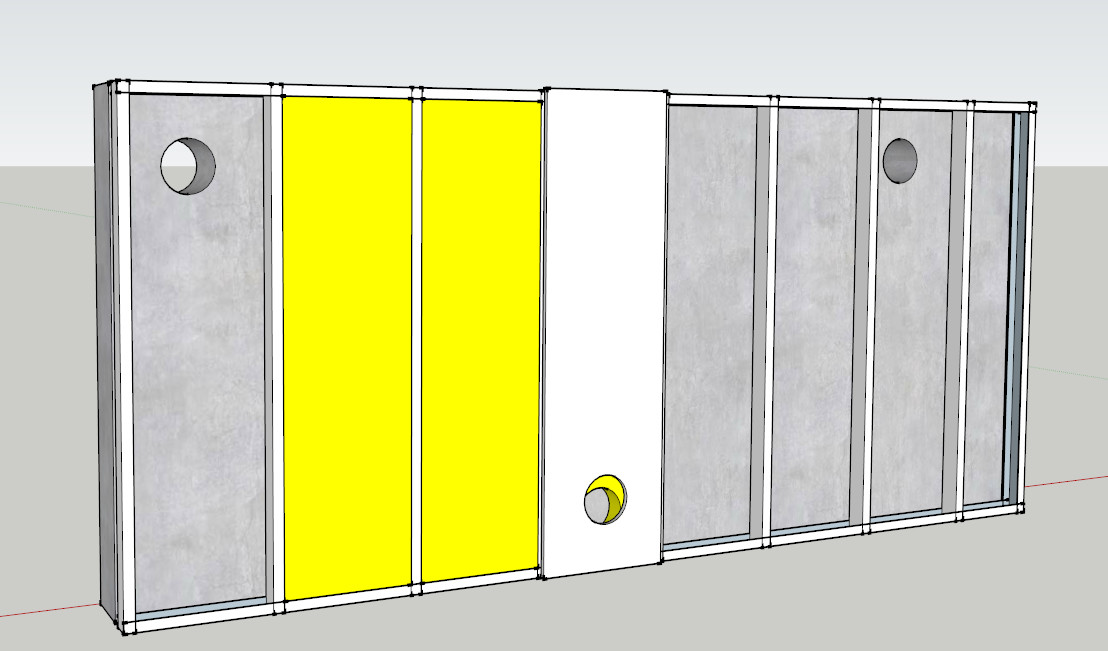
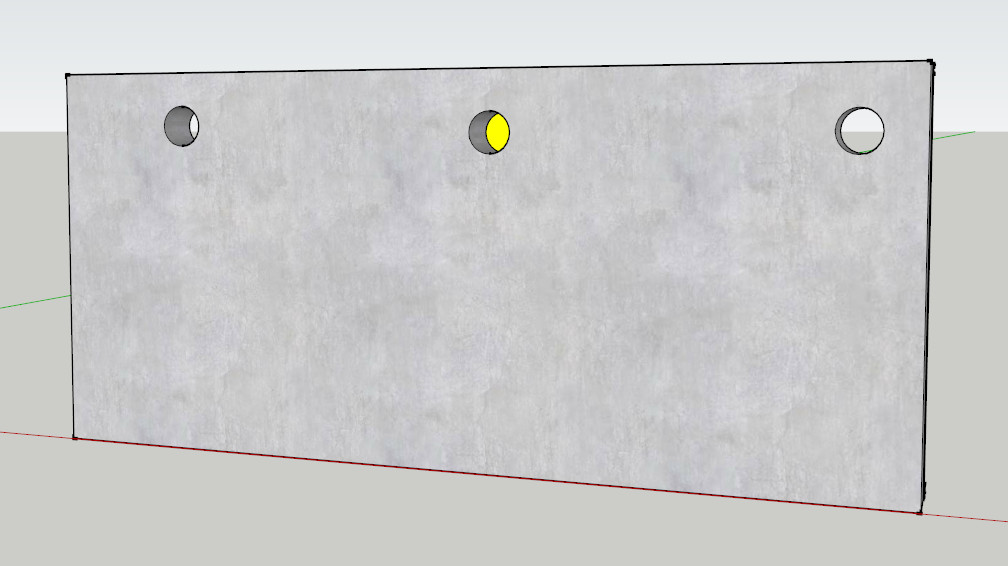
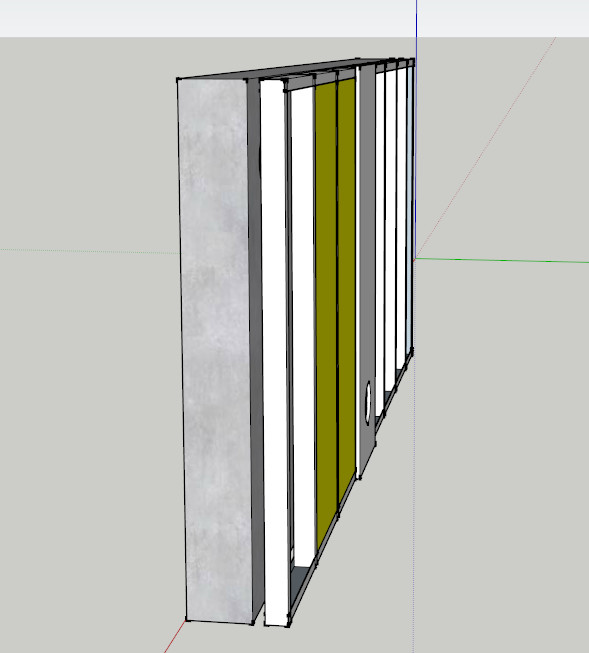
I attach some pictures of how a wall could be insulated. However, this won't be possible on the back wall where it is almost completely underground.
I imagine an air gap of a few centimeters between the concrete wall and the new inner wall. Steel studs, mineral wool, and OSB/gypsum on the inside. Holes near the floor on the inner wall (a couple-three per wall) and holes in the concrete wall at the top. Is this enough to create some ventilation between the walls and avoid moisture problems?
In the future, I can drain, but not currently.
The floor is open! Praise or criticize! ;-) Or completely different ideas are gratefully received!!
Kind regards, // Jörgen
The drawings are NOT to scale but just thrown together to illustrate my thoughts
Your thoughts are good. I don't belong to those who have fallen for the construction industry's mantra that if you redo the drainage and insulate externally, there will be "peace on earth," joking aside, but many experts are so convinced and convincing that it almost sounds religious.
I have nothing against drainage and external insulation; however, I haven't noticed that "peace on earth" part
If a basement gets wet due to lack of drainage or if it has stopped working, then new drainage is needed.
The dilemma is that many basements with functioning drainage, insulated and sealed foundation walls still experience moisture.
Many simply have an uninsulated foundation. Then, more or less ground moisture can enter from below that the drainage cannot remove... At the same time, some basements can be almost completely dry.
If the foundation wall isn't "soaking wet" due to inadequate drainage, there are several things that can be done indoors to improve the climate and affect the energy costs for maintaining the desired temperature.
For my own needs, I have spent considerable time finding effective solutions for my basement. My basement is not used as a garage, but some principles are similar for building parts below ground.
My fundamental view is to start from the conditions that are given in the short or long term. I learned a long time ago to challenge by thinking, "what if it's the opposite." It helps creativity and reduces the risk of following everyone else's solutions regardless of whether they are right for me or not.
I think it's fun to share my experiences, and I learn new things all the time. There are others who have thought, "what if it's the opposite"
I'm not an expert on this, but in areas where I've been considered knowledgeable, I've learned not to give patent solutions or black-and-white advice on areas that aren't black and white.
Your location has its own conditions, and then usually wallet and priorities also steer which solutions are deemed "good enough."
Standard recommendations can be found in many threads.
Before we delve into them, there are a few fundamental parameters I have learned are important to keep my basement healthy and draw as little energy as possible. It will describe a few things that many spontaneously see as obvious. In practice, however, I have visited few basements where these functions are at a "reasonably" secure level. Apart from energy-saving insulation, for example, there is
Keeping it dry, dry materials and dry air consume less energy to heat. If you don't have soaking outer walls, it might be good to "reset" the space to a lower relative humidity. Besides being easier to heat, corrosion/rust decreases, as does unpleasant odor since mold, algae, or other microorganisms do not thrive when it's dry. An old basement often has accumulated more moisture in materials like concrete than is supplied from the ground.
It's usually extremely important in a basement to manage the moisture that your usage introduces. If you increase the heat and bring in moisture from painting products that need to dry, wet or snowy vehicles, that moisture needs to be managed if you choose to insulate internally, even if you use inorganic materials.
"no stagnant air" is another important parameter, I've found.
Fresh air. Sounds like a given but is a rare commodity in many basements and garages due to energy costs. At the same time, fresh air does wonders for both people, houses, and things therein. It doesn't have to be major air turnover, but sufficient for those who are there, and you can choose to have a setting with low fresh air intake when the garage is not used and increase the ventilation when the garage is used but not fully closed, in my view.
Then I have seen some different options for internal insulation that may work from your perspective. You have yourself sketched a possible solution. It gets a bit complicated because you want to maintain a low temperature to increase as needed. Internal insulation and its construction should not become too damp either inside the room or in the air gap. I have some experiences to share there.
I can toss around ideas and alternative solutions if it’s okay with questions?
Some other questions.
Do you have visible moisture problems on any walls?
What level have you set the dehumidifier to?
What type of activities/projects will you engage in in the garage?
Will vehicles and materials or similar go in and out?
Hello! And thanks for a very interesting response!
I will respond more thoroughly tomorrow, but I can quickly answer some of the questions. I'm happy to bounce ideas around and would love to hear about your experiences!
We bought the property with the associated buildings last year. The sellers had lived here for about eight years.
The garage/workshop shows clear signs of a long period without heating/high humidity. One could say that the previous owner let that building "deteriorate" a bit. The paint has peeled off the walls due to moisture. I've improved the ventilation a bit, so it's a little better now. But my initial plan is to get the heating going and set up a dehumidifier to hopefully dry out the walls a bit. So in response to your question about visible moisture problems on the walls, there are indeed signs of previous moisture issues. I haven't measured the moisture content in the concrete.
The plan for the space is to be able to tinker with various things. Machines like a pillar drill, mill, and lathe will be added in the future. Welding, etc. I'm also working with electronics.
We won't drive the cars in there during the winter. However, I will store the snowblower there after use.
Regarding the temperature in the space, the better I can insulate, the warmer I can keep it. But I was thinking of at least 5 to 10 degrees when I'm not there. I want to keep tools and machines free from frost and moisture damage. The dehumidifier ideally needs at least 5 degrees. When I'm there, I want at least 15 degrees.
I am always skeptical about these kinds of observations inside underground..... I would probably rather cut up the concrete floor around the walls and build a layer of siporex or ytong or possibly lecablock on the inside. Possibly with some sort of styrofoam or similar between the old outer wall and the new inner wall.......otherwise just an enclosed air gap......
You mean using the insulating properties of lecablocks or lightweight concrete as a new interior wall? Will it make a sufficient difference compared to just a concrete wall in terms of heating?
Initially, I understood that you don't want to engage in archaeology or build pyramids
Heimlaga makes a valid point that some issues can be solved if you remove the floor, but that presents a different goal and budget. Even interior insulation is not straightforward but everything is a balancing act.
Your description of the moisture doesn't spontaneously sound dramatic for old basements. Especially in basements that are not maintained, the paint peels off the concrete.
I have lightweight concrete with about a 25mm air gap behind it in a space I've determined is only suitable for a machine room It's probably an insult to the machines. There is a lot of equipment and instruments in the machine room but not due to the insulating properties of lightweight concrete. Now I keep it gunpowder-dry and above freezing there. In the machine room, it's most important that it is dry because then corrosion doesn't exist, which machines, electronics, and instruments appreciate.
My suggestion is that we take it based on your conditions. Now we know what you will use the space for. Can you take some pictures and upload them to make the dialogue easier? Also, draw a sketch of the garage with doors, windows, vents, and what is on the other side of the wall. As I understood, not all external walls are entirely below ground.
If you could also draw how you plan to furnish the workshop roughly on the same sketch. The sketch can be hand-drawn on paper and photographed with your phone. You can then upload the image of the sketch here.
There are materials that I think are superior to lightweight concrete as insulation and better than leca if you are not building new walls and need strength. It has been used as interior insulation in most of my basement built in 1945 and I chose it as insulation for a room when it needed renovation. Nothing inside basements below ground is obvious from my limited experience. I will sleep on it and check a parameter to determine if it can be an option for you.
Requirements.
Pictures
Sketch
Is it a condensation dehumidifier?
Start from the outside and ensure that water is directed away from the roof properly.
I have an air source heat pump in my garage and I'm super satisfied.
Dehumidifiers are beneficial.
Keep the floor clean and have everything on wheels.
Good lighting so you can see to clean.
Windows let in light and the sun helps warm the garage.
Many pegboards and avoid shelves and cabinets.
The thick walls and the ground outside help to insulate.
Spend the money on good heating instead of insulation.
The topic has been discussed many times, I've read on various forums.
The circumstances vary a bit.
And of course - it's always best to insulate from the outside. But....
A thought experiment... If at the moment I don't want/can't dig around the garage but want
to insulate from the inside to save on heating costs.
How far away do you estimate the time when you want/can dig up and do it properly might be?
Are you thinking that this will be a temporary solution that will be torn down if/when you redo the outside?
I'm thinking that you should calculate how much heating you save and compare it with the cost of studs, insulation, drywall, screws, etc. It would be unfortunate if you saved only 8 SEK for every 10 SEK invested.
An even more frugal option is to only insulate the parts that are above ground. For the other parts, the earth is also insulating, so the difference will be smaller there.
How is the insulation upwards then? One usually says that a hat is the most important piece of clothing.
You mean using the insulating properties of the lecablock or lightweight concrete as a new inner wall? Will it make a sufficient difference compared to just a concrete wall regarding heating?
Yes, that's what I thought. They don't prevent moisture from drying either outward or inward, but they do insulate.
You may have chosen a solution. I said I would get back to you regarding materials. There is an option called träullit. Wood chips saturated with concrete are available as building elements or panels.
I have heard a lot about the disadvantages of internal insulation, but träullit has existed in my house as internal insulation since 1945 and still going strong. They have fairly good insulation value and, for example, mold does not thrive as long as you don't introduce organic material. During renovation, I had "experts" on site who advised against replacing träullit damaged mechanically during demolition because the current mantra is absolutely not to insulate basement exterior walls below ground. My natural question was, it has worked excellently for 70 years, so how do you justify it?
The justification was the construction industry's mantra to insulate externally as the only option. I asked with a wink, how thick insulation on the outside is needed to achieve a good indoor climate. 100mm, 200mm, 500mm? The dialogue changed a bit. Most say 100mm and I don't see that as a way to achieve a good indoor climate. It reduces the ground temperature's cooling effect on the foundation wall, which is good, but it doesn't work miracles. Ground temperature below frost level doesn't have gigantic variations.
If you want warmth inside a basement, heat is added from inside. I haven't heard of anyone heating from the outside below ground in regular basements
What is important is that the wall becomes as dry as possible, that the dew point does not fall in the wrong place in the construction, to avoid materials that cannot withstand the moisture load from outside and inside and not become tight in the wrong place in the wall.
Träullit is quite open. It can be "blown through," but insulates well and reduces the cooling effect of the foundation wall internally and improves the indoor climate significantly.
Träullit is installed this way in many houses and field tests of 50-70 years carry weight when I choose material. So it was new träullit, and I suspect it will be healthy in 50-70 years
Now my use of the current spaces is different than as a workshop. We have added steel studs and waterproof panels. Ventilated at the bottom and top to allow the small amount of ground moisture introduced. We have very limited ground moisture, but the air gap becomes an extra layer of insulation, in addition to handling the small amount of moisture introduced.
Otherwise, it is quite common to plaster träullit. Hanging on walls, etc., is done right through the träullit, letting the plug "grab" into the basement wall.
The downside of träullit is that they weigh a bit and certainly cost more than, for example, Leca blocks, but for me, Leca doesn't provide much insulation, although there are certainly different Leca and lightweight concrete types. If you choose alternatives, look at the insulation value. Lightweight concrete and I don't get along, but everyone has different tastes.
However, you should probably not invest in internal work around the walls if the foundation "stands in water."
If walls and floors have a "normal moisture level" for a basement, it should be possible to lower energy costs with internal insulation. But as I said, my view is that the wall is "constructed" as a whole based on actual conditions.
Regardless of your choice, check the moisture level in the wall and the floor closest to the wall.
As long as the foundation wall stands directly on the ground and if the floor is uninsulated concrete, more or less moisture will come that way regardless of external insulation and drainage. However, drainage and external insulation do wonders if the wall and foundation are soaked with water from outside.
I believe it would have been evident from your description if you had water-saturated floors, foundation, and foundation wall.
The difficulty in assessing may lie in that previous owners have not "maintained" the space. Without heating and ventilation, concrete becomes unnecessarily damp and can accumulate more moisture than what is a natural level introduced from outside.
Sketches and pictures can be reflected upon. If you want to do a field test, do it before the outdoor temperature drops too much.
Increase heat and create substantial air circulation in the room and set the dehumidifier to a low value. Measure the temperature of the concrete walls before you start. Check the wall temperature daily and empty the dehumidifier. Note how many liters of water you empty from the dehumidifier. It costs energy money but gives you feedback on how much load you have.
To get good speed on this, 25-30 degrees on the air temperature is a level that should show results.
Field tests tend to be educational I can't give a "recipe" but provide an example that should give you knowledge about the room.
Giving a timeframe is difficult, but if you had a really potent dehumidifier, you could extract a lot of moisture in 5-7 days and if you can also measure, you will likely get a decent sense of the conditions. In that timeframe, the amount of water you empty per day should decrease noticeably.
If the dehumidifier gets full, you will need to empty it more often.
Thereafter, you could let the air temperature drop. If it's a condensation dehumidifier, you should probably stay above 15 degrees, preferably higher. Run it for another week and you can get a picture of how much is introduced.
Temperature affects the efficiency of a condensation dehumidifier drastically. Looking at the actual capacity of a condensation dehumidifier, for example at 5 degrees, it is often quite low. If the manufacturer even wants to disclose the capacity at 5 degrees.
For several of the condensation dehumidifiers I have had, the capacity is specified at nearly "tropical" conditions. 30 degrees and 80% relative humidity is hardly a realistic operating environment in many spaces
Hi everyone! Great responses and thoughts! I haven't chosen a solution yet. Right now, I'm focusing on getting the heating started. I think step one will be to properly heat the place and dehumidify, then try to estimate how much energy is needed to heat it up. The place hasn't been thoroughly heated for I don't know how long. So as mentioned... Step one, heat thoroughly and dry up. I hope once it's thoroughly heated, the amount of heat needed to keep it warm can be estimated, and then decide which way to go.
I will update this thread as I work in the garage/workshop!
Sounds good that you're heating and drying. When you're already incurring the cost, do it thoroughly. There's a start-up time to increase the temperature in the concrete parts of the space, so once you've raised the heat, I don't think it's too expensive to maintain the heat for a few extra days. However, it's sluggish=more expensive to redo the procedure.
See if you can measure the temperature of exterior walls in several places. You could, for example, take a regular thermometer and a piece of cellplast in which you cut out a space for the thermometer. The thermometer should in that case be mounted so it lies as close against the concrete as possible. If you place it with cellplast against the wall, you can probably get a decent value if you let it sit for a while.
Besides being able to see a temperature increase in concrete when you now invest in heating and drying, you might also see which walls are hardest to heat up. If the coldest walls could be areas where you don't need to hang tool boards, etc. Is it a "crazy" idea if you have a really=bitingly cold wall to buy the cheapest possible cellplast and nail anchors, and a bag of plastic washers? You can then mount cellplast directly on the wall. It goes fast if you have a decent drill that can handle concrete. Like this: Press the cellplast sheet against the wall. Drill a hole through the cellplast and into the concrete. Push the nail anchor with washer in and tap it. You can do this quickly, and if there are two of you, it goes extremely fast. I would leave a few cm from the floor as my experience is that wall/floor is where most moisture is introduced.
You should be aware that if there is organic material between the cellplast and the wall, it could eventually mold, but as a temporary solution, it should work well. If you think through future "projects," you might be able to reuse the cellplast by being careful during installation.
Another alternative that might be a bit more moisture-proof is to buy the cheapest imitation of Platon mat and place it on the wall followed by cellplast. If the "Platon mat" is open at the bottom and top, it handles some moisture that can migrate upwards.
Alternatively, even though those sheets are a bit more fragile and especially more expensive, you could choose the same type of sheets you plan to use for drainage. The fragile ones I'm thinking of are the type Pordrän or Isodrän, with which no Platon is needed.
As for cellplast, there are different "qualities" and two different variants. The most common is called EPS, white and a bit crumbly to handle, meaning there are openings in the structure allowing it to absorb some water. XPS is more expensive but closed and absorbs minimally or no water. Water in insulation lowers the insulation value.
Search YouTube for XPS and EPS to see some experiments done by, among others, an American.
However, I would personally, if I were to drain and insulate this type of building, use Platon mat and XPS cellplast. Isodrän/Pordrän is many experts' mantra, but XPS and Platon have properties I would prefer for new drainage and external insulation.
I would also use XPS and Platon if I drained my basement. My reasoning is not complex, so ask if you want to know how I thought.
As stated, a few "crazy" thoughts if you have a particular wall surface that will become like an ice pack this winter.
Hello to those following this thread! I've been busy with other stuff but have got the water-based heating going in the garage and the electric boiler. Right now I'm maintaining about 10 degrees in the garage and it hasn't been that cold outside yet. I've connected a separate electric meter to the boiler so I get that consumption separately. The dehumidifier has been working and the air is much better now. Currently, it's around 70% relative humidity at 10 degrees. The walls on the inside are at varying temperatures. In some places, the walls are about 8 degrees and in some spots down to 4-5 degrees. I'm measuring with one of those "laser-point-measure" gadgets! IR thermometer is what it's called, I realized now
Below is some data on consumption and temperatures.
The temperature is the daily average temp, and in the parentheses are the min/max values. The garage is about 70m2 and the ceiling height is just over 2.10 (low ceiling).
I would like to reduce consumption, but it might be quite normal? It ends up being anywhere between 600-900 kronor extra per month with the current consumption.
I’ll measure the walls a bit more thoroughly, and on places that are much colder than the inside temperature, I'm considering putting up some polystyrene (as Kalle_A described above). If the walls are, for example, 4 degrees in some places, that's quite a significant cooling there.
I'm thinking of logging wall temperatures, etc., and adding it to the table above. Then maybe one could get a sense of outside temp/inside wall temp, etc.
With that type of meter, it is probably quite simple to mark a number of points to identify which wall surfaces cool the most. You don't seem worried about numbers, and measurements help you learn more about the garage. I have often found that the obvious or probable is not always correct. Measurements with IR/Laser usually go quickly.
Regarding the dehumidifier, make a column in the table where you write down how many liters you empty at each drainage. This should give a good indication of how much moisture is being introduced and also how much "accumulated" moisture has been in the floor and walls.
Your positive experience at RH70% indicates that the level was likely significantly higher before. If the ventilation doesn't consume a lot of energy, I would suggest you try setting the dehumidifier at 60% and see what happens. I suspect you have a kondensavfuktare, and even if its "efficiency" as a power source might be lower than your electric heater, it's probably not an expensive experiment.
One way to see it is if you notice if it gets expensive based on the amount of water the dehumidifier removes. The dilemma can be that kondensavfuktares capacity usually drops significantly with decreasing temperatures. 10 degrees is a bit low for a kondensavfuktare in my eyes, but as with all tools and machines, I tend to use the stuff I have.
How is the garage ventilated?
Fresh air is beneficial for buildings, but overdosing consumes energy.
Seals in doors and windows contribute positively.
If you have old windows, they can be "cooling elements."
Dehumidifying with heat and ventilating out the moisture is more expensive than with a good dehumidifier.
---------------- A bit about what I've done in my garage.
I have single-pane windows in my garage doors for some extraordinary reason. The previous owner had cut foamed plastics which he pressed in. My garage is otherwise reasonably well-insulated and is a wooden structure on a concrete slab. Fixing the windows has been on the "to-do list" for many years now, and I threw out the foamed plastic pieces The same doors have fairly large elongated vents at the bottom where the vent opening is adjustable with a metal plate. Basically a cooling plate Good for fresh air, but the area was probably 10-15 times too large. Easy to insulate and let a reasonable vent area remain.
I still managed to reduce energy consumption significantly by drying an already dry garage really dry, and then a dehumidifier takes care of the moisture that comes in with, for example, the snow blower. If I bring in a snowy vehicle or tool, I usually go out to the garage an hour later and scrape out the snow and water or scrape it into the drain. This saves a lot of energy. What isn't scraped out is left for the dehumidifier to handle. Warming something damp requires more energy than if the same thing is dry. The concrete slab was dry and is dry, but the previous owner couldn't get paint to stick to the concrete.
Probably because they always parked the car in the garage, and even if you're careful, it ends up being quite a bit of water that the concrete absorbs on the surface. The entire floor then becomes like an "ice pack" that "garage heat" can't dry out and ventilate. I bought in May, painted the floor over the summer, and the paint is still holding except where it's been exposed to wear and tear from various hobby projects.
The floor paint is not waterproof but still prevents larger amounts of water from being absorbed by the slab. I chose a dehumidifier with high capacity at the temperature I have in the garage during winter, i.e., about 12 degrees. I determined that too low capacity could take days to remove moisture if a snowy vehicle was brought in, and that included my visit an hour later to brush/scrape out snow/ice/water. There would still be quite a few liters left. As it's dimensioned now, it would be possible to bring in a snowy car in the evening that is dry by morning, and by dry, I mean that the humidity in the garage is down to about 50%. Higher RH% can be maintained, but at RH50%, there is virtually no rust. Naturally, a car doesn't become that dry in all nooks and crannies overnight, but I keep RH50% to keep tools and machines free from corrosion. There's not often room for the car in the garage as I usually have some hobby project going on, and they have higher priority
The dehumidifier’s energy consumption in the garage is quite limited and practically only runs a lot if I've brought in something that adds water. Many have said it will be expensive, but I dried really dry during the warm season, and it has worked excellently since. I know those who've said it will be expensive haven't run dry at any time; their dehumidifiers kick in when it's low temperature in the garage and wet things, snow/ice/water come in, and then it "never gets dry." I'm not saying this works in all buildings because some foundational structures and ground conditions introduce a lot of moisture. Even if this garage is built on an uninsulated slab on gravel, which is not an optimal solution from a moisture perspective, and the land around the house is not "kind," it works surprisingly well.
Last edited:
Click here to reply
Vi vill skicka notiser för ämnen du bevakar och händelser som berör dig.

 Praise or criticize! ;-) Or completely different ideas are gratefully received!!