Building plastic and foam may not be the weapon of choice for someone who seems to be inclined towards building conservation.
If you want to make a dry-stone foundation draught-free, it works well to seal it with lime mortar.
Construction plastic and foam sealant might not be the weapon of choice for someone leaning towards building conservation. If you want to make a stone foundation draft-free, it works well to seal with lime mortar.
The OP's starting point was foam glass. Doesn't feel entirely building conservation-friendly either.
The original poster's starting point was foam glass. It doesn't exactly feel like it aligns with building conservation either.
You're right about that! However, building conservation is quite a broad concept. If one means an antiquarian or museal approach, foam glass naturally has no place in the building. However, I believe most in modern building conservation allow some modern materials, as long as the materials broadly relate to concepts like reused, reusable, environmentally friendly, moisture buffering, or nature-based products. Neither foam sealant, building plastic, nor mineral wool are materials that can be used more than once. In contrast, timber in houses can be reused for a long time, clay as well. Even leca products should be able to be reused repeatedly, and now foam glass, which I don't see any obstacle to reusing it in another house if the need arises. Plastic products are also in most cases completely airtight, which means using a completely different concept for the ventilation of the house. This, in turn, can lead to other follow-up problems. One can split this hair a little more, but I think you understand what I mean
I wonder what you mean, that it can cause moisture and odor if one fills up the foundation? In an unventilated crawlspace, it shouldn't make a difference for humidity whether the space between the ground and floorboards is filled with air or Hasopor.
If you don't have radon problems, you shouldn't get any concentration of radon either if you run a dehumidifier? Here, you are also talking about a thermal suction force going in the opposite direction of the diffusion mentioned later (the example with humidity differences). Is that correct? I'm a bit confused about which direction the movements really are. If radon and odor are supposed to penetrate the house, it presumably involves air movements, or have I misunderstood?
This can't be right. Houses have been built for hundreds of years without plastic sheeting. It sounds good what you are saying but makes me a bit skeptical when you so confidently recommend plastic and dehumidifiers for houses that have functioned for 100-200 years without.
You don't happen to sell such things?
Real North wrote The problem, however, is that the house is built using older methods and that the foundation is therefore as it is. Filling up the foundation can lead to problems with both moisture and rising unpleasant odors, which are problematic enough and difficult to address without having to empty the foundation of about 36 cubic meters of HASopor and then still having to arrange some form of ventilation and dehumidification.
I wonder what you mean, that it can cause moisture and odor if one fills up the foundation? In an unventilated crawlspace, it shouldn't make a difference for humidity whether the space between the ground and floorboards is filled with air or Hasopor.
Answer: A crawlspace is normally equipped with so-called "cat windows," i.e., openings that were closed during winters in the past. At the same time, there was indoor heating with wood stoves/fireplaces, which helped to warm and dry out the crawlspace. A bit away from the house, the ground was frozen, which meant moisture migration to the ground under the house was minimal. Additionally, houses in the past were not particularly insulated or airtight, which meant they were fairly well ventilated, so problems with moisture or radon were rare. Moisture in crawlspaces is largest in summer, while radon is mainly a winter problem due to thermal forces (natural law) making the house like a balloon, to exaggerate a bit, but warm air rises just like moist air does (otherwise, we would have no clouds in the sky).
I read many years ago, in the mid-eighties, about how crawl space moisture problems were solved by installing balloon sections in the foundation space. The balloons were made of diffusion-tight flexible material that sealed in all directions. If you needed to access the space for any reason, it was just a matter of letting out the air in the balloon or balloons blocking the space you needed access to.
Then it went silent, and I've never heard anything more about it.
A potential problem that I flagged for when filling up a foundation with anything is that you risk getting radon gas into the house if there is any leak in the climate shell (floor). HASopor itself is moisture-safe, but it doesn't prevent water vapor from diffusing upwards (there is always free air between the HASopor material), which then diffuses further into the subfloor and floor construction. By definition, the ground always has 100% relative humidity, but it can vary if the house is on solid rock, for instance.
Every house is unique and has unique conditions, which is why it's impossible to make definite statements about what can be done or not.
But ultimately, one comes to more legal aspects such as—who takes responsibility for the solution chosen. Should serious moisture problems, odor problems, or radon problems, or all three, arise later, who bears the cost of fixing these issues?
I think one should start by calling their insurance company and asking if they accept the solution you are considering to implement. If they say no, you should factor this into the calculation. If you intended to do all the work yourself, you must understand what it entails in terms of both cost and labor.
Alternatively, make sure to get an OK from the contractor you might be thinking of hiring, preferably in writing from the contractor's insurance company. (Make sure the insurance is valid for the project even if the company happens to go out of business.)
(One should be aware that what Boverket, GVK, or BKR writes is only recommendations, not compulsory legal texts, which means that insurance companies may have different requirements for things. However, you should always visit the websites of Boverket, GVK, or BKR and read as much as you can about various recommendations for various things.)
Real North wrote If you seal the vents in a crawlspace and run a simple type of dehumidifier more efficiently, you will likely, over time, have quite high radon levels in the foundation and probably an unpleasant smell, even if the ground is properly covered with plastic sheeting. During the winter months, when it's warmer indoors than outdoors, a thermal suction force occurs in the house that risks drawing both radon gas and odor into the house if there are leaks, and there often are.
"If you don't have radon problems, you shouldn't get any concentration of radon either if you run a dehumidifier? Here, you are also talking about a thermal suction force going in the opposite direction of the diffusion you mentioned later (the example with humidity differences). Is that correct? I'm a bit confused about which direction the movements really are. If radon and odor are supposed to penetrate the house, it presumably involves air movements, or have I misunderstood?"
Answer: When it comes to radon, one thing is certain, and that is that there is Uranium, more or less everywhere in our country. Radon is a decay product from Uranium that eventually ends as lead.
Not having had any radon problems earlier is great, but now it's about changing the house's crawlspace and floor construction and perhaps adding insulation to the walls and ceiling, which creates a completely different situation than previously.
Old houses were often leaky (=good ventilation) and were heated with wood stoves and fireplaces that warmed both foundation spaces and attics. The cat windows in the foundation were closed, and snow was often piled against the foundation to reduce draft and cold floors. Outside, the ground was frozen, preventing moisture migration to the ground under the house, allowing it to dry out.
What stops radon gas best is tight clayey soils, but even then, radon will accumulate in a sealed crawlspace, i.e., the concentration will increase over time.
Moisture is water vapor, and radon is a gas, and these have completely different characteristics. While moisture diffuses (determined by the vapor contents in each space), it's a slow process. If, however, there are leaks in the climate shell, in this case, the floor, it's a matter of convection, and then moisture can occur much faster if "air draft" leads to a colder space.
If you have warmer temperatures in the house than outside during winter (and in the foundation), the house becomes like a "hot air balloon" (exaggerated, but still), which makes warm air rise upwards. Air will then seep out where there are leaks in the climate shell. The air that seeps out creates a suction for replacement air, which often gets sucked up through leaks in the floor structure. The air then sucked into the house can likely be contaminated with odor (if you're unlucky) and radon gas/radon daughters. If it isn't, you're very lucky.
Real North wrote As for any moisture in the foundation, one should always lay out a durable diffusion-tight (vapor-tight) plastic sheet against the ground in the foundation, sealing as tightly as possible (any earth and organic materials should, of course, be removed first, and if there’s a gravel base, to protect the plastic, a drainage cloth can be laid out before the plastic). One secures the plastic sheet a bit up on the foundation wall with special tape and special adhesive if being really meticulous.
This can’t be right. Houses have been built for hundreds of years without plastic sheeting. It sounds good what you are saying but makes me a bit skeptical when you so confidently recommend plastic and dehumidifiers for houses that have functioned for 100-200 years without.
Answer: Houses were heated with wood stoves (later with oil boilers), were leaky, and had entirely different prerequisites than they have today. See my previous answers, which explain much of your inquiries.
Real North wrote Finally, one installs an efficient sorption dehumidifier like ACETEC.
You don't happen to sell such things? Skånelänga from 1659/1830. Timber frame, clay tiles, Falun red panel. Many holes to plug with money!
Answer: I sell no products whatsoever. I am 100% independent. I am retired and now only sell consultancy hours to those interested. I have a background as an engineer and energy specialist. I have also been involved in desalinization of seawater through special magnesium oxide crystals that adsorbed, i.e., chemically bound, water molecules and could then be regenerated, i.e., compelled to release the bound water through heating the crystals. We also developed a prototype of a simple dehumidifier for caravans and crawlspaces with modified crystals, which absorbed (not adsorbed) water vapor from the air and was also regenerated with heat. Unfortunately, we were forced to close the company due to liquidity issues, but the insight and experiences from my time with this research meant I knew what I was looking for, and one day, I finally found a sorption dehumidifier, a Swedish-developed one, that not only dehumidified but also circulated large amounts of air and also ventilated the space (where the vents were sealed and caulked with construction foam (plastic bag first in the hole), which then created a vacuum in the foundation space. I have not managed to find any other on the market, and I have also searched quite a lot on the American market.
Anyone starting to look for a sorption dehumidifier with the characteristics I recommend will eventually find the type that I recommend in my text. There seems to be no other on the market!
I wonder, how long do construction plastic and foam sealant last in the foundation? Does anyone know?
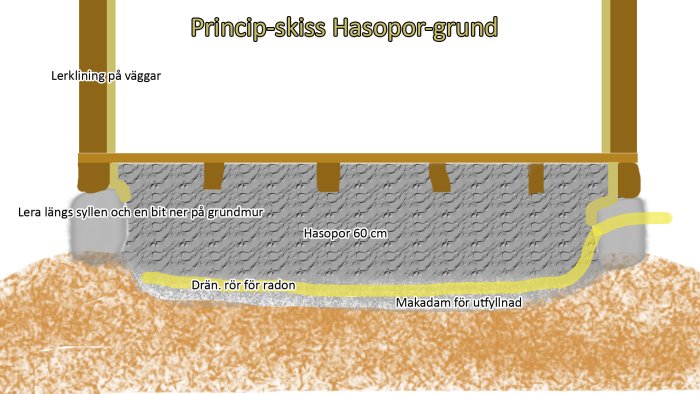
I'm considering a solution with a drainage pipe in the foundation as a backup in case there is radon. The question is whether it's enough to connect the pipes to the chimney through natural draft, or if it's better to connect them to a hole in the foundation which can be equipped with a fan if needed and otherwise sealed.
The question is also whether you need a plastic sheet over the pipe to prevent radon from rising, or if the fan is sufficient on its own. How close should the pipe be? Does it need an incoming air channel, or can it just start in the middle of the foundation, so to speak? I imagine that moisture from the ground will also be extracted when using the pipe. Note that this is a backup which I guess will not be needed...
I will be burning wood in the stove and tiled stove all winter. It will be a water jacketed stove as the main heating source and I'm leaning towards a Wamsler K148. So the foundation will surely be heated by it as well, at least close to the chimney. Regarding odors from the foundation, I must say it smells surprisingly little down there, so it will hardly be a problem.
On Monday, I will call Hasopor to discuss these ideas once more. We'll see what they say...
I wonder, how long do construction plastic and foam last in the foundation? Does anyone know?
I’m considering a solution with a drainage hose in the foundation as a backup if radon is detected. The question is whether it’s enough to connect the hoses to the chimney using natural ventilation or if it’s better to connect it to a hole in the foundation that can be equipped with a fan if needed and otherwise sealed.
The question is also whether a plastic sheet is necessary over the hose to prevent radon from rising, or if the fan alone will suffice? How tightly should the hose be laid? Should it have an incoming air channel, or can it just start in the middle of the foundation, so to speak? I imagine that ground moisture will also be expelled when using the hose. Note that this is a backup that I guess won't be needed.
I will be using a wood stove and tiled stove all winter. It will be a water-jacketed stove as the main heating source, likely a Wamsler K148. So the foundation will surely be heated by it as well, at least near the chimney. As for odors from the foundation, I must say it surprisingly smells very little down there, so it shouldn't be a problem.
On Monday, I will call Hasopor to go through the ideas once again. We'll see what they say...
Answer:
Radon drainage pipes should always be laid under the ground plastic and if you can connect them to a chimney flue, then that's OK. Since you plan to burn wood, the chimney will be warm, creating natural ventilation. Ensure everything is sealed. Drainage pipes within the foundation for water drainage are not normally used, and if they are, they should be laid under the ground plastic. Typically, the foundation space is sloped slightly towards where the incoming water and sewer pipe is laid. There, the plastic is often punctured with a few holes so that any free water (from condensation, external penetrating surface water during downpour, or a water leak in the house) can be absorbed by the underlying soil. However, radon may leak here, which is normally not a problem if you have a compatible solution.
It's quite an undertaking to drain water from clay soil. If you have clay soil, surface water intrusion during heavy rain is a more common issue, especially if the ground is sloping.
I myself had issues with surface water many years ago and therefore drained with Nophadrain (a subsidiary of American Wick Drain Corporation). Rolls of 50 meters, about 3 cm thick and 120 cm high, encased with drainage fabric, now provide full drainage from the surface down 120 cm. Very convenient and easy to lay out.
As mentioned, if you plan to fill your foundation with HASopor or some other material, you need to prepare a lot for it to function for many years. Or you can hope for good luck.
Building foam is available for purchase in different qualities, and its durability depends on many factors such as temperatures, moisture loads, movements. No variant can withstand sunlight exposure. I have used building foam in various contexts, for example, when sealing foundation vents by first inserting a plastic bag from inside and then filling with foam. This avoids messiness and allows for easy restoration if needed. Likewise, I've used building foam when installing additional insulation on the inside of a house wall (God forbid, but sometimes you have to). With interior insulation, all thermal bridges and the whole wall become colder (just as with a foundation wall when insulating the foundation space), so you must ensure no water pipes are in the wall structure, and there are absolutely no air leaks causing convection and thus condensation. First, you insulate, then carefully install a diffusion barrier, and then insulate/seal all corners, edges, and any joints extra with building foam. All this is to avoid moisture damage in the wall structure.
I must clarify that what I've previously highlighted does not necessarily mean it will not work with HASopor. I only want to point out the risk factors. I have been in foundations that should have been completely ruined but were completely problem-free. A major difference is that older houses were often built with heartwood and not wood of today's quality.
Regarding wood, the amount of hygroscopic stored moisture can be read in what is known as equilibrium moisture content curves for different materials (Moisture content kg/m³). Moisture at equilibrium with the surrounding air is often indicated as moisture ratio = mass of water in relation to the corresponding mass of dry material (dry weight). Wood can store about 50 kg/m³ even with a relative humidity of 50%!
Air can only hold a few grams of water (in Sweden, generally between 0.1 g/m³ at -30 C and 13.3 g/m³ at 50% RH) at a given relative humidity of 50%, while specially wood can hold up to 50 kg of water by comparison!
Another very interesting phenomenon to consider, which occurs during water intake and release in wood, is that wood which is already moist and drying out contains more moisture at equilibrium than if the material had been drier and was in the process of absorbing moisture. This effect is called Hysteresis (from Latin meaning delay). Wood thus resists and does not release moisture as easily as it absorbs it.
This also explains why, for instance, it's so difficult to dry out a dampened subfloor and floor construction in a crawl space.
Answer:
Radon drainpipes should always be laid under the ground plastic, and if you can connect them to a chimney, that's fine. Since you intend to burn, the chimney will get warm and create natural draft. Make sure everything is sealed tightly.. Drainpipes inside the foundation for water drainage are not typically used, and if you were to have them, they should be laid under the ground plastic. What is usually done is to ensure the foundation space slopes slightly towards where the incoming water and sewage are laid. There, holes are often made in the plastic so that any free water (from condensation, externally intruding surface water during heavy rainfall, or a water leak in the house) can be absorbed by the underlying ground. However, radon is likely to leak here, which is not typically a problem if you have a matching solution.
It's quite challenging to drain water from clay soil. If you have clay soil, surface water intrusion during heavy rainfall is a more common issue, especially if the ground slopes.
I personally had problems with surface water many years ago and therefore drained with Nophadrain (a subsidiary of American Wick Drain Corporation). Rolls of 50 meters, about 3 cm thick and 120 cm high enclosed with drainage fabric allow me to have full drainage from the surface and 120 cm down. Very convenient and easy to lay out.
As mentioned, if you plan to fill your foundation with HASopor or something else, you need to prepare quite a bit for it to function for many years to come. Or you can rely on luck.
Building foam is available for purchase in various qualities, and its durability depends on many factors such as temperatures, moisture loads, movements. No variant can withstand exposure to sunlight. I have used building foam in several contexts, e.g., for sealing foundation vents and have first pushed in a plastic bag from inside and then filled with foam. This avoids messiness and makes it easy to restore everything if necessary. Similarly, I have used building foam when insulating a house wall from the inside (God forbid, but sometimes you have to). When insulating from the inside, all thermal bridges and the entire wall become colder (just like what happens to a foundation wall if you insulate the foundation space), and you must be very careful that there are no water pipes in the wall construction and that there is absolutely no leakage causing air convection and thus condensation, so first you insulate, then carefully mount a diffusion barrier plastic, and thereafter foam insulate/seal all corners, edges, and any joints extra with building foam. All this is to avoid moisture damage in the wall construction.
I need to clarify by saying that what I have highlighted so far does not necessarily mean it will not work with HASopor, I only want to point out the risk factors. I have been down in foundations that should have been completely ruined, but have been problem-free. A significant difference, however, is that older houses were often built with heartwood and not with today's quality wood.
When it comes to timber, the amount of hygroscopically stored moisture can be read in so-called moisture equilibrium curves for different materials
(Moisture content kg/cbm). Moisture at equilibrium with the surrounding air is often referred to as moisture ratio = the mass of water in relation to the corresponding mass of dry material (dry weight). -Wood can store about 50 kg/cbm even at a RH of 50%!
Air can only hold a few grams of water (in Sweden, normally between 0.1 g/cbm at -30 C and 13.3 g/cbm at RH 50%) at a given Relative Humidity of 50%, while particularly Wood can hold up to 50 kg of water as a comparison!
Another very interesting phenomenon to consider, which occurs during the absorption and release of water in wood, is that wood that is already moist and is drying out contains more moisture at equilibrium than if the material had previously been drier and is wetting up. This effect is called Hysteresis (Latin for delay). Wood thus resists and does not release moisture as easily as it absorbs moisture.
This also explains why, for example, it is so difficult to dry out a soaked subfloor and floor construction in a crawlspace.
Complementary answer:
I want to supplement my previous post/answer by mentioning that any potential radon drainage pipes (drainpipes covered with drainage fabric) according to your idea must be placed a bit down in the soil beneath the construction plastic and should only be placed inside the foundation walls. If the radon drainage pipes are laid directly under the plastic, there is a risk that your chimney connection draws cold air into the foundation, cooling down the soil and the entire space, which is obviously not good in winter or summer. During the summer months, a colder foundation means that any incoming air condenses more water than at a higher temperature.
Diffusion-tight covering plastic is available in various qualities with lifespans of up to 50 years. The factor that most negatively affects plastic is UV light.
I have been reasoning quite a bit, including with Hasopor. Of course, they do not want to guarantee that my method will work, but they thought it sounded like a good idea. Others I have spoken to also agree that it should work well.
I also talked with Radea Radonservice regarding my radon concerns, and according to him, it would suffice to run a simple drain pipe across the foundation and out through, for example, a ventilation channel that can be opened and connected to a fan if necessary. The hose should be sealed at the other end to prevent too much air/radon from being sucked in there, as the idea is that there should be suction in all the small holes. He also said that plastic was not needed in my case and that it was very difficult to make it tight enough in existing foundations and especially old crawl spaces.
This is what the plan looks like right now, see picture.
No, I've never heard anything about that. Why would it be necessary? The hasopor shouldn't be damp anyway.
Well, I've received that advice from two different sources. I don't really know why. Maybe it has something to do with condensation? Warm room air meeting cold hasopor? Or rising ground moisture? Just guessing... Anyway, I was told that the floors of the old type that were directly in a bed of sand (so-called Skånegrund) have fared best if there was air between the filling and the floor, and that I should absolutely make sure my new floor is the same way (with hasopor instead of sand). Did you get any advice from Hasopor regarding this?
No, I haven't received anything from Hasopor regarding this. However, I will attend a course soon and then I will ask all these things from the instructor who has extensive experience in similar constructions. But it sounds reasonable as you say anyway. And it can hardly be a disadvantage to have a small air gap.
No, I haven't received anything from Hasopor regarding this. However, I'm going to a course soon, and I will ask all these things to the instructor who has great experience with similar constructions. But it sounds reasonable as you say anyway. And it can hardly be a disadvantage to have a small air gap.
As long as you make it tight against the walls so that the air can't move, you've got a variant of a mullbänk Otherwise, perhaps a layer of linisolering between hasopor and floorboards could be something if you don't want them to have direct contact. I've built a mullbänk with peat and used that method. Hasopor, however, is not organic, so for that reason, it's not needed, but my other thought is to have the insulation a bit in "tension" so that it's airtight even if the material below settles a bit.
Vi vill skicka notiser för ämnen du bevakar och händelser som berör dig.