4,985 views ·
30 replies
5k views
30 replies
Frame interior wall with 34mm studs
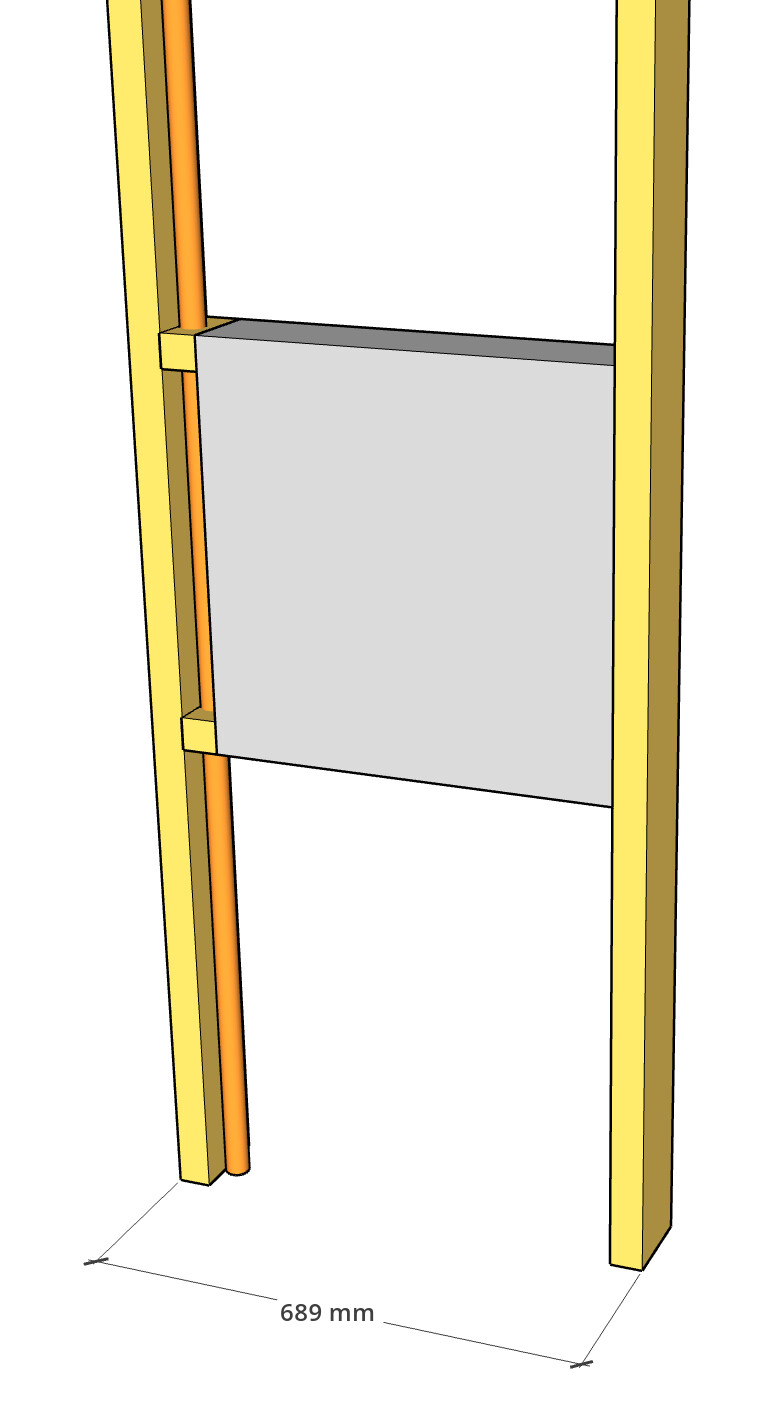
I am going to build a stud wall and I'm wondering if 34mm thick studs are enough? The reason is that I need to fit in two sections in as little width as possible, one where the distribution cabinet will be placed and one where incoming electricity will be routed, followed by an interior door. If I use 34mm instead of 45mm, I save 3 cm in width, which actually makes a bit of difference. What do you think, is it possible? Any disadvantages besides it being harder to hit the stud when attaching the OSB?

Okay, I need to clarify a bit. This is how the construction will be from left to right: Beam - distribution cabinet (55 cm) - beam - conduit for incoming electricity (32 mm) - beam - interior door. I want to get the door as far to the left as possible. With 45 beams, it's 722 mm, with 34 beams 689 mm.useless said:

Self-builder
· Stockholm
· 8 592 posts
I absolutely believe so: The inner wall should only support itself, and if you put up OSB/plywood before the gypsum wall, it will also stabilize it. You just need to be a bit more precise when screwing up the boards 
Does it have to be two compartments?M MPilen said:Okay, I should probably clarify a bit. This is how the construction will be from left to right
Stud - distribution cabinet (55 cm) - stud - conduit for incoming electricity (32mm) - stud - inner door.
I want to get the door as far to the left as possible. With 45-studs it will be 722mm, with 34-studs 689mm.
You might be able to put a 20 mm stud closest to the wall on the left, then distribution box 550, 45 stud, conduit 32, and finally 45 stud.M MPilen said:Okay, I should probably clarify a bit. The construction from left to right will be like this:
Stud - distribution box (55 cm) - stud - incoming electrical conduit (32mm) - stud - interior door.
I want to get the door as far to the left as possible. With 45-studs it becomes 722mm, with 34-studs 689mm.
That would give you a width of 692 before the door comes in.
Or split the studs down to 40 and save another 10 mm so you get 682.
Maybe. But why is it important with 45 studs?Lexington said:
If you're going to have a wet room or tiled surface on the other side of the wall, there may be requirements/need for 'beefier' wall studs, but if it's a regular room with double-layered walls, I'm fairly sure it will be sturdy enough the way you've planned. Maybe you could even replace one of the 34mm studs with a board if the wall starts against another wall and the 'stud' is just there for screwing the sheets into.
Self-builder
· Stockholm
· 8 592 posts
You could also, if concerned, add noggings to provide extra support. You might even be able to use 22mm timber, probably, if you add enough noggings, although possibly more studs would be needed then. Another option is to use more than 60cc (e.g., 45cc) if reducing thickness? But as mentioned, you should address any bending as well with noggings or panels.F fribygg said:If you're going to have a wet room or tiled surface on the other side of the wall, there may be requirements/need for 'sturdier' wall studs, but if it's a regular room with double-layered walls, I'm quite sure it will be solid enough the way you have in mind. Maybe you could even replace one of the 34mm studs with a plank if the wall begins against another wall and the 'stud' is only there for screwing the panels into.