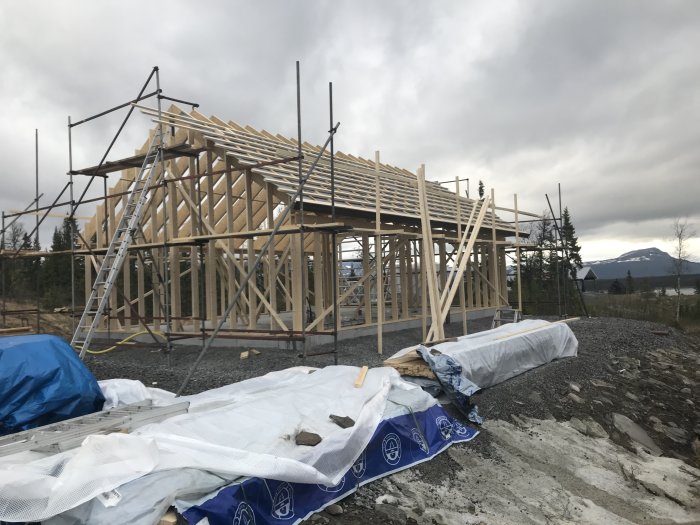
In about 1 month, I will start building a garage. I'm currently contemplating how to frame the structure. I saw my neighbor's carpenter framing the gable wall with long studs that went over the roof trusses, which he later cut at the same angle flush with the truss. The truss is then inside the gable wall. I'm considering doing something similar. It looked very convenient when they raised the trusses, as they could just press the truss against the studs on the gable wall.
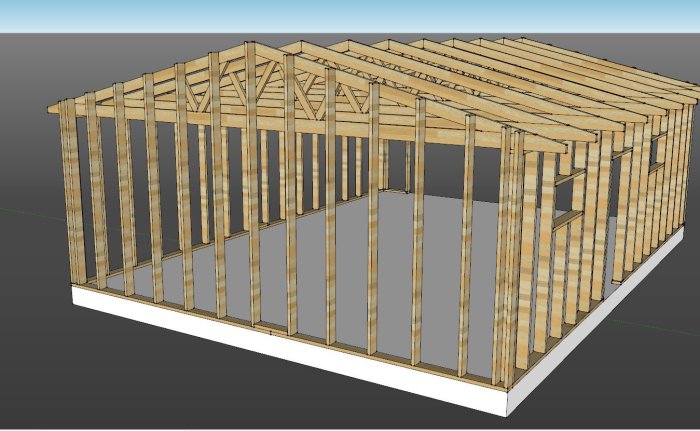
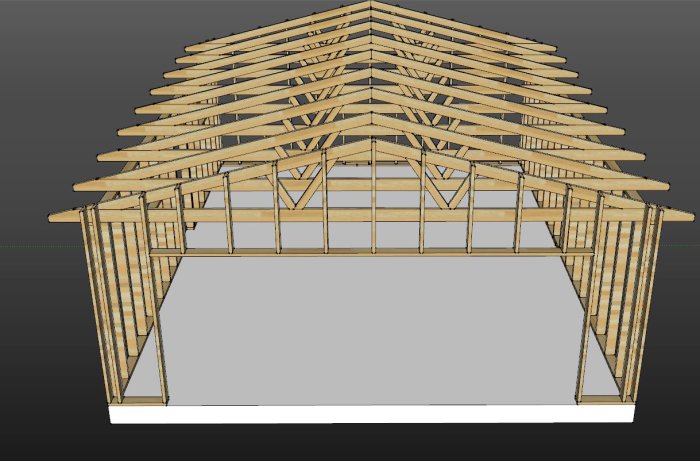
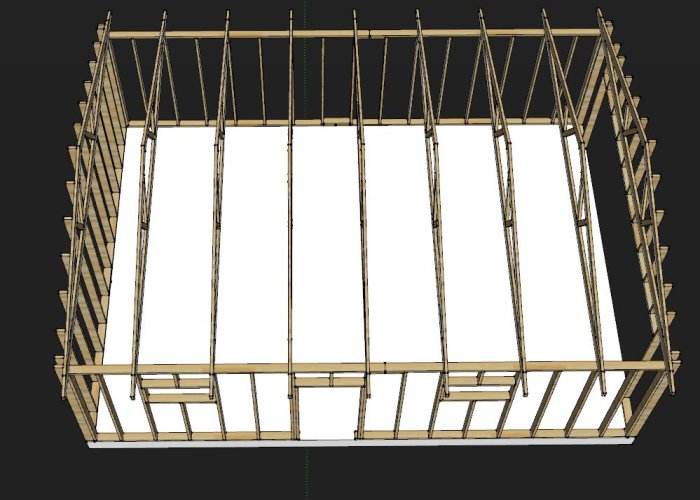
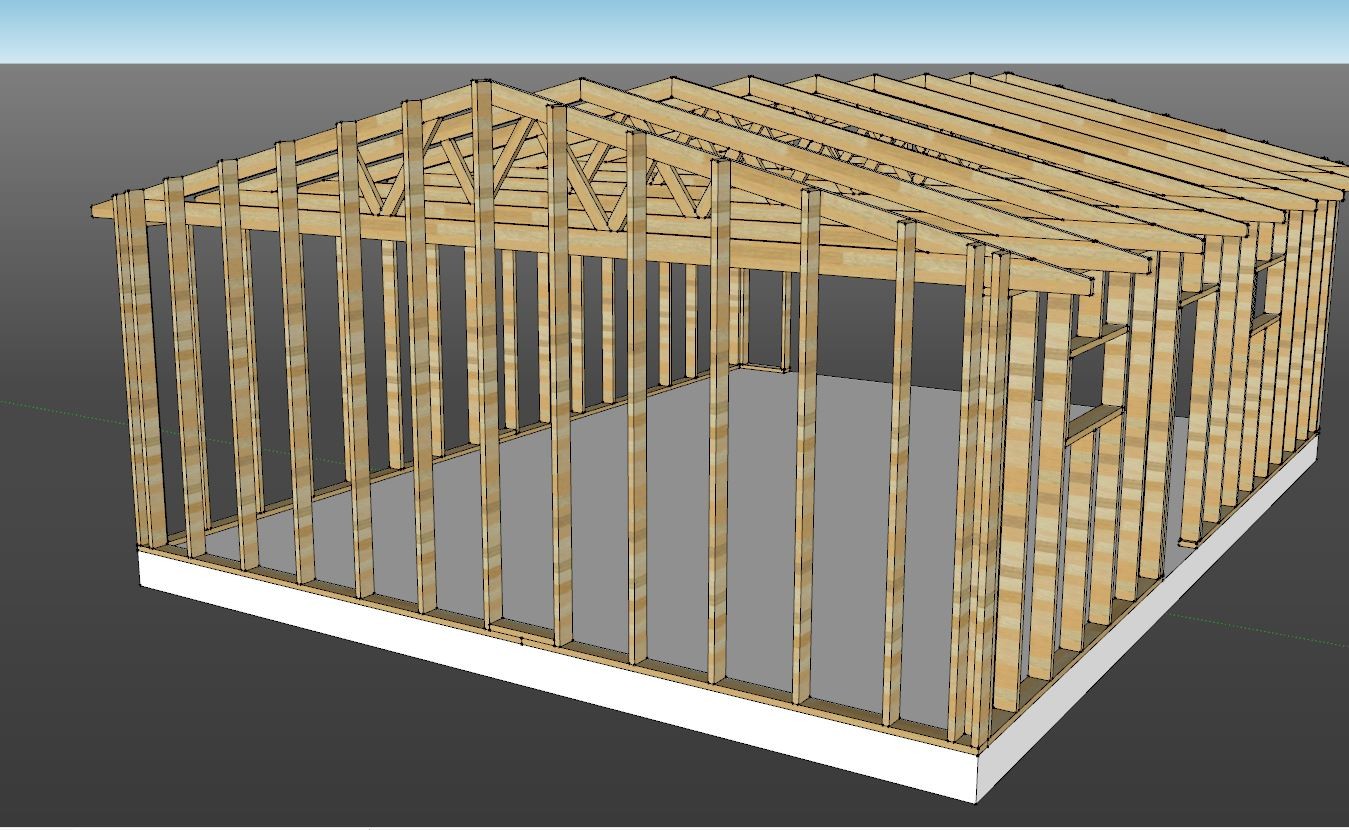
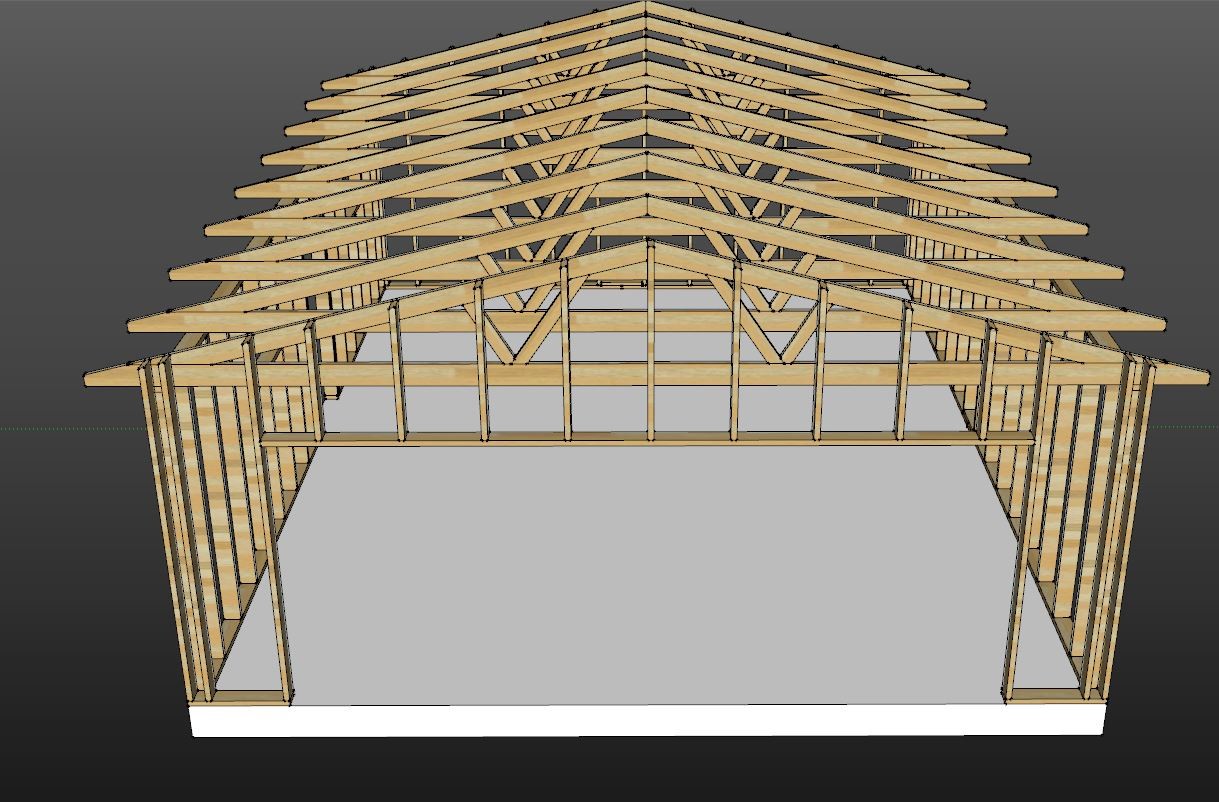
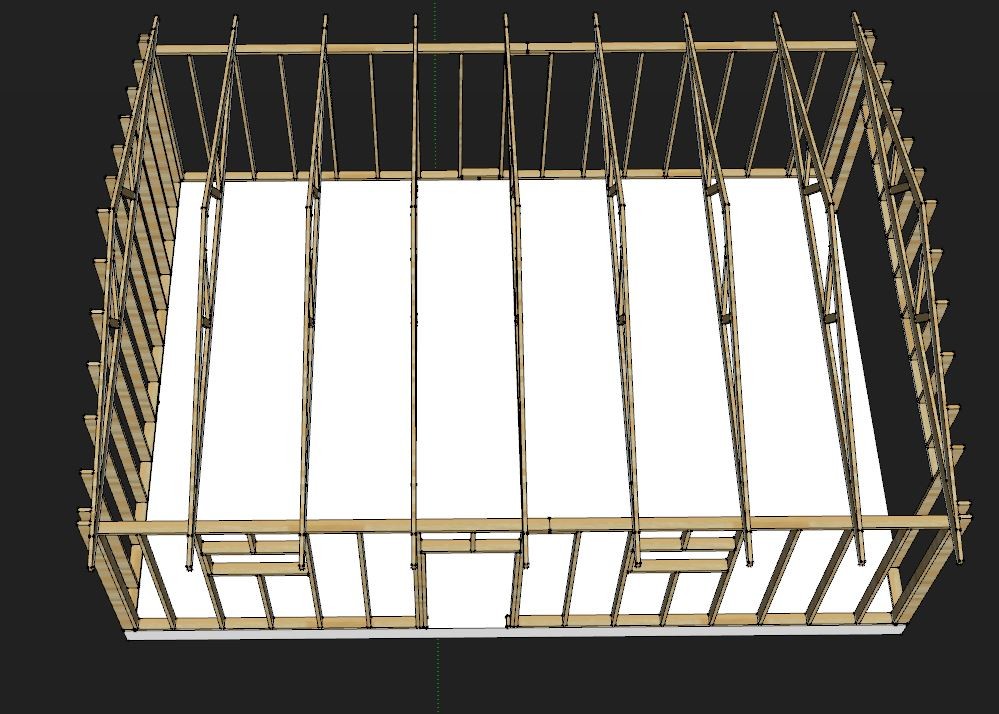
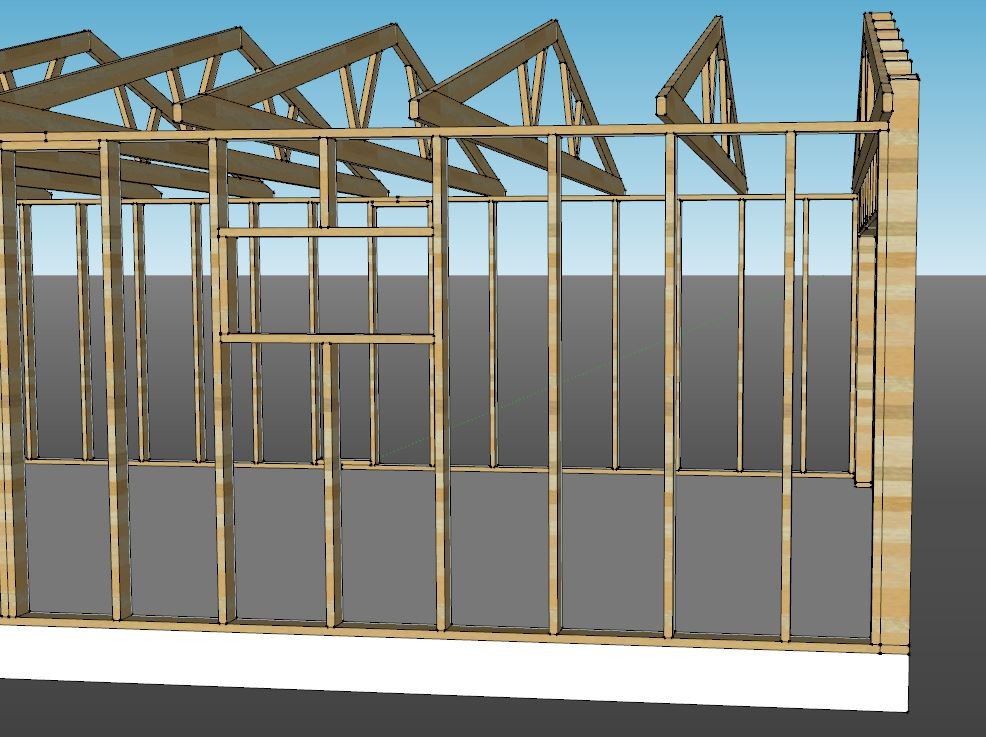
I have made a model in SketchUp for this, see the images below. What do you think about doing it this way? Are there any disadvantages that I'm not considering? Also, what does the construction solution look like around the garage door?
I build so that the trusses are placed directly above the standing studs. Then there is no need for an inset/standing top plate if that's what you mean?
Exactly right, if they are on the standing studs, it works fine. I wrote a bit faster than I looked.
But regarding the idea of extending the studs on the gables up to the rafters, has anyone built like this before and can provide some practical tips?
I'm planning to nail the walls for the long sides while they're lying down and then raise the whole thing. However, I can't do the same with the gables, so I have to toenail the stud down into the sill and brace it carefully, because I don't have a top plate holding the sheathing on the studs sideways.
So, tips, videos, or pictures on how to practically handle the gables are welcome
But regarding drawing the studs on the gables up to the rafters, has anyone built like that before and can provide some practical tips?
I'm thinking of nailing the walls for the long sides lying down and then raising the whole thing. However, I can't do that with the gables, so there I have to toe-nail the stud down into the sill and brace this carefully, as I don't have a top plate to hold the studs laterally.
So tips, videos, or pictures on how to practically do the gables are welcome
Can't you just screw a stud on the outside of the studs temporarily when you raise the wall, which you then remove when the rafter is fastened?
Can't you just temporarily screw a board onto the studs when you raise the wall, which you then dismantle when the roof truss is attached?
Yes, that's a great idea! Then I can raise the gables in the same way. So then I can just remove it later when the roof truss is screwed into all the studs.
I usually build exactly as you have drawn, i.e., the standing studs on the gables extend up outside the two outermost rafters. It's convenient, quick, and sturdy.
Example from the latest build, though it was purlins instead of rafters but the principle is the same.
I usually build just like you've drawn, meaning the vertical studs on the gables extend beyond the two outermost rafters. It's efficient, quick, and sturdy.
Example from the latest construction, although it was roof purlins instead of rafters, but the principle is the same.
[image]
Looks great! I'm going to do it like that, only see advantages with it.
I'll probably start by erecting both gables by attaching a temporary stud on the outside, which I'll remove when the rafters are in place. Then I'll erect the long sides. I'll let the sill on the gable extend all the way to the concrete, and the sill on the long sides will be inside the gables. See the image below for how I envision a corner.
It's easy with the rafters when I've braced the walls properly, just lay them up and then flip them up and fasten the outermost against the gable wall. Then you know they'll be in the right place and probably stand straight.
I don't see any direct advantage in doing this compared to just having a regular wall with a top plate. It would be so only IF you plan to have a warm/insulated attic or an open ridge so that you want to extend the wall insulation all the way up. Or possibly to counteract the minor thermal bridge that a top plate provides.
But as mentioned earlier, it's perfectly fine to screw some temporary studs outside the wall if you want something to prevent the roof truss from tipping out. I erected a modular garage where the gable peaks came pre-paneled, and it was quite a few kilos to hoist up, which you then wanted to secure properly before they were anchored.
Don't see any direct advantage in doing so compared to just having a regular wall with a top plate. That would be if you're planning to have a warm/insulated attic or open to the ridge so you want to be able to continue with the wall insulation all the way up. Or to counteract the small thermal bridge that a top plate gives.
But as I said earlier, it's perfectly fine to screw a few temporary studs on the outside of the wall if you want something to prevent the roof truss from tipping out. I erected a modular garage where the gable peaks came pre-paneled and it was quite a few kilos to hoist up and then you wanted to secure them properly before they were anchored
You're absolutely right that it's just as good to erect a "regular" wall with a top plate and then screw studs on it as support for the roof truss during assembly.
One thing I realized now that you mentioned it is that it will be open from the attic down into the spaces between the studs since there's no top plate there. I'm planning to spray insulate the attic with loose-fill insulation and that insulation will find its way down into the spaces between the studs. I'll have to make sure the walls are insulated and sealed with a vapor barrier before insulating the roof then.
Vi vill skicka notiser för ämnen du bevakar och händelser som berör dig.



FlugfiskarniJämtland said: