
7,257 views ·
46 replies
7k views
46 replies
Questions about passive houses?
Yes, those double front doors were very common in the past. Or not double front doors, but an inner door right inside the front door. In the summer, the door leaf was unhooked and put away.
The foyer should also make a comeback. A closed but unheated room that functions as an airlock. Especially useful because low-energy houses often have an open floor plan. If someone is careless with the front door in winter, the whole house can fill with icy air, which then takes quite a while to heat up. Of course, the foyer also reduces heat losses even when the door is closed.
The foyer should also make a comeback. A closed but unheated room that functions as an airlock. Especially useful because low-energy houses often have an open floor plan. If someone is careless with the front door in winter, the whole house can fill with icy air, which then takes quite a while to heat up. Of course, the foyer also reduces heat losses even when the door is closed.

Yes. It's essentially the same question then as it is now. Back then, it took a lot of firewood that you had to chop by hand, today it's the electricity that's expensive.
If you look at older houses, they have the chimney in the middle of the house, which is exactly right so that the heat spreads in all directions. Generally, they are 1.5 or two stories to take advantage of the heat from below and thereby get more space that is cheap to heat.
If one were to build a 1920s house with modern materials and techniques, you would probably get a very "energy-efficient" house.
If you look at older houses, they have the chimney in the middle of the house, which is exactly right so that the heat spreads in all directions. Generally, they are 1.5 or two stories to take advantage of the heat from below and thereby get more space that is cheap to heat.
If one were to build a 1920s house with modern materials and techniques, you would probably get a very "energy-efficient" house.
I believe that you can have a wood stove in a passive house for decoration and coziness without it being counted as heating, although you can complement with it when needed.
But then it’s not the same anymore since you don’t have a centralized heat source like the chimney flue you had before.
Then you might consider that if you’re going to build an energy-efficient house and you already have solar heating, you need an accumulator tank, and it doesn’t hurt to install a water-jacketed wood stove/living room boiler, so you have heating fixed even in a power outage, and then you get direct heat from the stove and can get hot water etc., and also heat the house from the stored energy in the tank.
But of course, you can do a lot to reduce energy losses like energy-efficient windows and adding an extra glass outside for 4-glass windows and installing a vestibule with a door and then double doors; you can significantly lower energy losses there. I can imagine you could get close to a 0.4 U-value on doors and maybe down to 0.6-0.7 on windows, but it gets expensive to custom order such windows. However, it could probably be achieved by doing what was done with double windows before where one was on the outside, and the other on the inside, and then you can use cheap 2-glass windows as inner windows and a modern window as the outer window.
So I believe the future will be a combination of old and new designs with new materials and innovative ways of heating.
But then it’s not the same anymore since you don’t have a centralized heat source like the chimney flue you had before.
Then you might consider that if you’re going to build an energy-efficient house and you already have solar heating, you need an accumulator tank, and it doesn’t hurt to install a water-jacketed wood stove/living room boiler, so you have heating fixed even in a power outage, and then you get direct heat from the stove and can get hot water etc., and also heat the house from the stored energy in the tank.
But of course, you can do a lot to reduce energy losses like energy-efficient windows and adding an extra glass outside for 4-glass windows and installing a vestibule with a door and then double doors; you can significantly lower energy losses there. I can imagine you could get close to a 0.4 U-value on doors and maybe down to 0.6-0.7 on windows, but it gets expensive to custom order such windows. However, it could probably be achieved by doing what was done with double windows before where one was on the outside, and the other on the inside, and then you can use cheap 2-glass windows as inner windows and a modern window as the outer window.
So I believe the future will be a combination of old and new designs with new materials and innovative ways of heating.
No load-bearing frame: plywood+foam+plywood. (found a couple of pictures)miry said:I can imagine having a load-bearing frame in those walls, like a wooden frame, but then you would get good stiffness by making sandwich elements with PU foam bonded between two plywood sheets on each side.
What I was referring to was where they set up a tent or shell and spray foam from one side only, but I haven't seen such constructions in Sweden, and here when used, there is a load-bearing construction that is then insulated, giving very few cold bridges.
(now I promise, no more O/T from me).
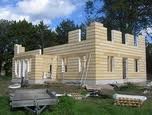
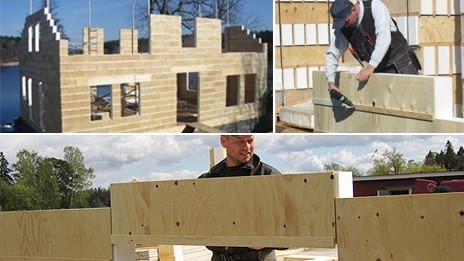
It's a shame they're redesigning the website. But I googled this one: http://bestabyggteknik.hemsidadirekt.se/detaljbilder.html (there you can see they use glulam beams). I think besta has been mentioned on the forum before as well.
I don't think that one is 'passive house.' However, I read on their website about half a year ago that they had started with 'low-energy houses,' and that they were making the walls thicker (more foam plastic).
edit: Or am I completely stupid? It says they are also placing a framework on the inside (70mm or 95mm depending on wall thickness; maybe it has some load-bearing function... I'm hedging my bets...)
I don't think that one is 'passive house.' However, I read on their website about half a year ago that they had started with 'low-energy houses,' and that they were making the walls thicker (more foam plastic).
edit: Or am I completely stupid? It says they are also placing a framework on the inside (70mm or 95mm depending on wall thickness; maybe it has some load-bearing function... I'm hedging my bets...)
Last edited:
hello
we have a couple of good friends who are building a low-energy house in Germany. They have an air exchanger system in the house with an awful lot of pipes under the floors and reuse heat from hot water etc etc. They have some kind of heater on the air system that they can use when needed. It can get quite cold even there. I believe that's the right approach instead of an air heat pump as it doesn't activate automatically in the same way.
They also have a large wood stove centrally in the house with an awful lot of stone in the chimney that stores heat.
we have a couple of good friends who are building a low-energy house in Germany. They have an air exchanger system in the house with an awful lot of pipes under the floors and reuse heat from hot water etc etc. They have some kind of heater on the air system that they can use when needed. It can get quite cold even there. I believe that's the right approach instead of an air heat pump as it doesn't activate automatically in the same way.
They also have a large wood stove centrally in the house with an awful lot of stone in the chimney that stores heat.
hi..!
This is quite an old thread but it would be interesting to talk to someone who has built Passive houses or has a lot of knowledge about this..
since there are many question marks about Passive houses, some questions can be answered here:
http://www.passivhuscentrum.se/
I'm planning to build a new house myself but am considering waiting a bit longer, it feels like very few small houses have been built as Passive houses and there aren't many catalog houses to choose from today..!
I am thinking of building a house with living space of 80-100 sqm, FTX ventilation, water-jacketed fireplace connected to water heater and solar panels that heat water in summer.
Is there anyone who has built Passive houses around Östergötland..?
It's hard to find house firms that have many references regarding Passive houses..
regards /daniel
This is quite an old thread but it would be interesting to talk to someone who has built Passive houses or has a lot of knowledge about this..
since there are many question marks about Passive houses, some questions can be answered here:
http://www.passivhuscentrum.se/
I'm planning to build a new house myself but am considering waiting a bit longer, it feels like very few small houses have been built as Passive houses and there aren't many catalog houses to choose from today..!
I am thinking of building a house with living space of 80-100 sqm, FTX ventilation, water-jacketed fireplace connected to water heater and solar panels that heat water in summer.
Is there anyone who has built Passive houses around Östergötland..?
It's hard to find house firms that have many references regarding Passive houses..
regards /daniel
I believe it is difficult to achieve a unanimous answer since there are so many different ways to look at the problems and how to go about them. However, I think the biggest issue as to why there are so few catalog houses that are passive is that it requires a lot to succeed with a truly passive house that also works for all types of living situations. There can be a difference in heat gain up to 10 times depending on the situation, and then what heating needs are required for different parts of the country and different times of the year. This makes it hard to manufacture a passive house that could maintain the heat with a lone occupant who is there only around 10 hours a day and doesn’t cook or do laundry, etc., when it's -20C outside for an extended period.
As I’ve said before, I don’t believe passive houses are the right way to go because a house designed for two adults and three teenagers being there almost all the time won’t be able to keep the heat with one person who isn't home much, unless all electronic devices are on to heat the house. This results in an energy consumption that might even be higher than with a large family present.
But the idea of storing energy in floors and walls and insulating so that not much heating is needed is definitely the right approach in my view. It would be easier if we moved away from building wooden houses and started using stone materials more extensively. There are some, although not widely known, who have solutions with prefab concrete houses. Hopefully, more will follow and it will become more common, but currently most house manufacturers make wooden houses instead of stone houses because they are easier to make and handle. However, I don’t think it would be too hard or expensive to make concrete houses if the factory is adapted for it.
What I mean by concrete or stone houses are well-insulated elements joined together, and a homogeneous wall with different layers of various materials will be tight since there is no air flow through concrete or cellular plastic. Only the joints between the elements need to be sealed properly, which is probably easier with concrete elements than with the wooden elements used today.
So it all depends on the purpose, but as I see it, if you want to build a little out in the countryside or have access to cheap wood and can heat with wood where you plan to build, and the goal is to have it cheap and simple, I would advocate for a wood-heated house that is well-insulated. If it's sufficiently well-insulated, a water-jacketed stove and a large hot water tank assisted by a solar coil will take care of most things that consume a lot of electricity in the house, resulting in low operating costs. The only downside is the need to occasionally or perhaps quite frequently burn wood during winter if a lot of hot water is used.
As I’ve said before, I don’t believe passive houses are the right way to go because a house designed for two adults and three teenagers being there almost all the time won’t be able to keep the heat with one person who isn't home much, unless all electronic devices are on to heat the house. This results in an energy consumption that might even be higher than with a large family present.
But the idea of storing energy in floors and walls and insulating so that not much heating is needed is definitely the right approach in my view. It would be easier if we moved away from building wooden houses and started using stone materials more extensively. There are some, although not widely known, who have solutions with prefab concrete houses. Hopefully, more will follow and it will become more common, but currently most house manufacturers make wooden houses instead of stone houses because they are easier to make and handle. However, I don’t think it would be too hard or expensive to make concrete houses if the factory is adapted for it.
What I mean by concrete or stone houses are well-insulated elements joined together, and a homogeneous wall with different layers of various materials will be tight since there is no air flow through concrete or cellular plastic. Only the joints between the elements need to be sealed properly, which is probably easier with concrete elements than with the wooden elements used today.
So it all depends on the purpose, but as I see it, if you want to build a little out in the countryside or have access to cheap wood and can heat with wood where you plan to build, and the goal is to have it cheap and simple, I would advocate for a wood-heated house that is well-insulated. If it's sufficiently well-insulated, a water-jacketed stove and a large hot water tank assisted by a solar coil will take care of most things that consume a lot of electricity in the house, resulting in low operating costs. The only downside is the need to occasionally or perhaps quite frequently burn wood during winter if a lot of hot water is used.
kamilenski was it me you wrote to?
the only one I've seen who follows my way of thinking in optimizing is these
www.resaro.se
but they are not big or known in house building but people choose what they can get many references on and if not many houses are built then it becomes difficult
what is it that really is unclear with passive houses?
the only one I've seen who follows my way of thinking in optimizing is these
www.resaro.se
but they are not big or known in house building but people choose what they can get many references on and if not many houses are built then it becomes difficult
what is it that really is unclear with passive houses?
Last edited:
miry, you seem to think it's prohibited to have secondary heat sources in passive houses. Firstly, all passive houses have a heating system for hot water, and secondly, a secondary heat source, usually an electric coil connected to the ventilation, which is of course heat exchanged.
The reason an electric coil is sufficient is that the building materials have a low specific heat capacity and are protected by a well-insulated layer, meaning it heats up quickly.
A passive house is a definition and not a building standard.
If you want to build a passive house in concrete that can be heated at 10w/m2, that's great, but so far it's only been done for multi-family houses. Concrete has different properties and imposes different requirements to be energy-efficient.
Conclusion, being opposed to passive houses is the same as being opposed to energy-efficient houses. It doesn't say anywhere that you have to be a family with teenage children to have a passive house. Anyone can.
The reason an electric coil is sufficient is that the building materials have a low specific heat capacity and are protected by a well-insulated layer, meaning it heats up quickly.
A passive house is a definition and not a building standard.
If you want to build a passive house in concrete that can be heated at 10w/m2, that's great, but so far it's only been done for multi-family houses. Concrete has different properties and imposes different requirements to be energy-efficient.
Conclusion, being opposed to passive houses is the same as being opposed to energy-efficient houses. It doesn't say anywhere that you have to be a family with teenage children to have a passive house. Anyone can.
ludlan
it is precisely that definition that one should not need additional heating in the house except in emergencies and as you yourself wrote, the energy supplied for heating must not exceed 10W/sqm and that it is often in direct electricity then and the same thing when it comes to hot water so what I oppose is that you should heat the whole house with direct electricity and that it is a house where you expect a family with a certain appearance instead of making it energy-efficient with great flexibility
so what I find more logical is to build houses with good thermal insulation but at the same time not rely on the heat generated in the house as everything is becoming more and more energy-efficient now and with that gives off less heat so I don't think it is appropriate to base the house's function with our current electricity consumption and that the children should not move out after a number of years
while installing heating via some form of heat pump, you get about 3 times as much heat and then both for hot water and heating and with that keeping electricity costs down below what they would be with a passive house and then also suitable for more people to live in such houses as it does not require that you are a whole family living there to keep the heat up
As for concrete, it has quite a few advantages such as good strength and good heat storage but has some weaknesses like it becomes very heavy and can be quite expensive or cumbersome to build and requires precision not to get noticeable thermal bridges, but if everything is done correctly, I am convinced that it is the material best suited for house constructions when trying to keep energy consumption down in the house
(I know that concrete requires quite a bit of energy to produce, but so do glass and rock wool used in wooden houses, so one should probably look at the energy the house requires once it is in place and not to build)
it is precisely that definition that one should not need additional heating in the house except in emergencies and as you yourself wrote, the energy supplied for heating must not exceed 10W/sqm and that it is often in direct electricity then and the same thing when it comes to hot water so what I oppose is that you should heat the whole house with direct electricity and that it is a house where you expect a family with a certain appearance instead of making it energy-efficient with great flexibility
so what I find more logical is to build houses with good thermal insulation but at the same time not rely on the heat generated in the house as everything is becoming more and more energy-efficient now and with that gives off less heat so I don't think it is appropriate to base the house's function with our current electricity consumption and that the children should not move out after a number of years
while installing heating via some form of heat pump, you get about 3 times as much heat and then both for hot water and heating and with that keeping electricity costs down below what they would be with a passive house and then also suitable for more people to live in such houses as it does not require that you are a whole family living there to keep the heat up
As for concrete, it has quite a few advantages such as good strength and good heat storage but has some weaknesses like it becomes very heavy and can be quite expensive or cumbersome to build and requires precision not to get noticeable thermal bridges, but if everything is done correctly, I am convinced that it is the material best suited for house constructions when trying to keep energy consumption down in the house
(I know that concrete requires quite a bit of energy to produce, but so do glass and rock wool used in wooden houses, so one should probably look at the energy the house requires once it is in place and not to build)