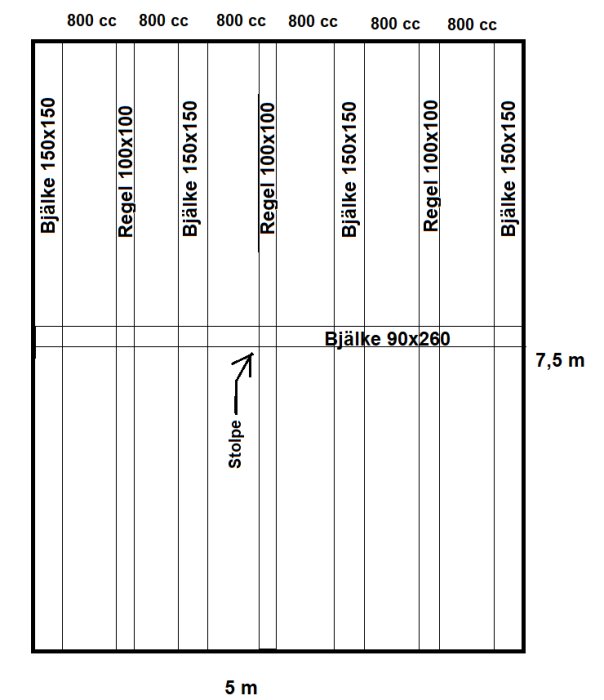
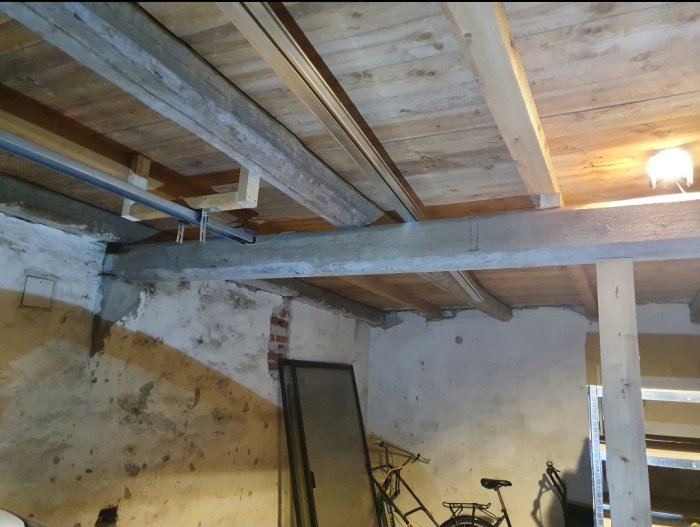
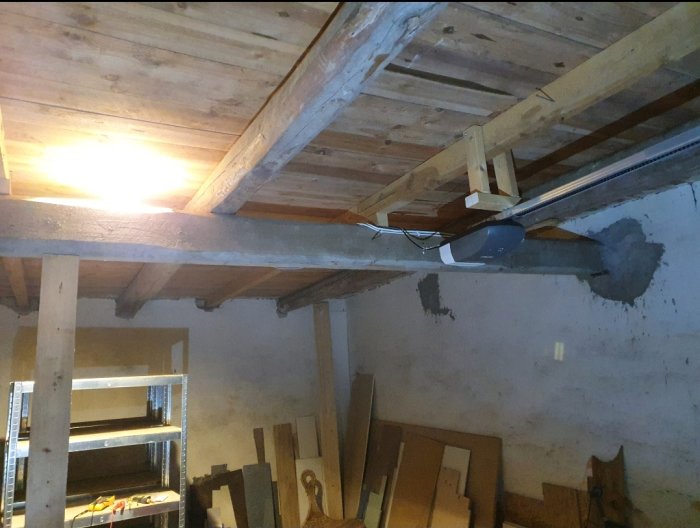
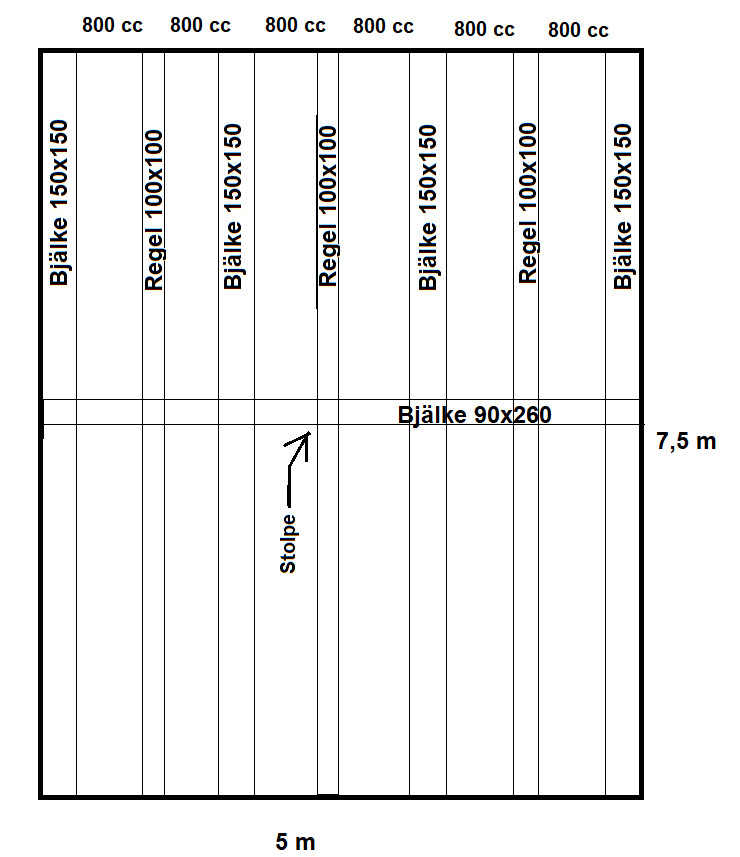
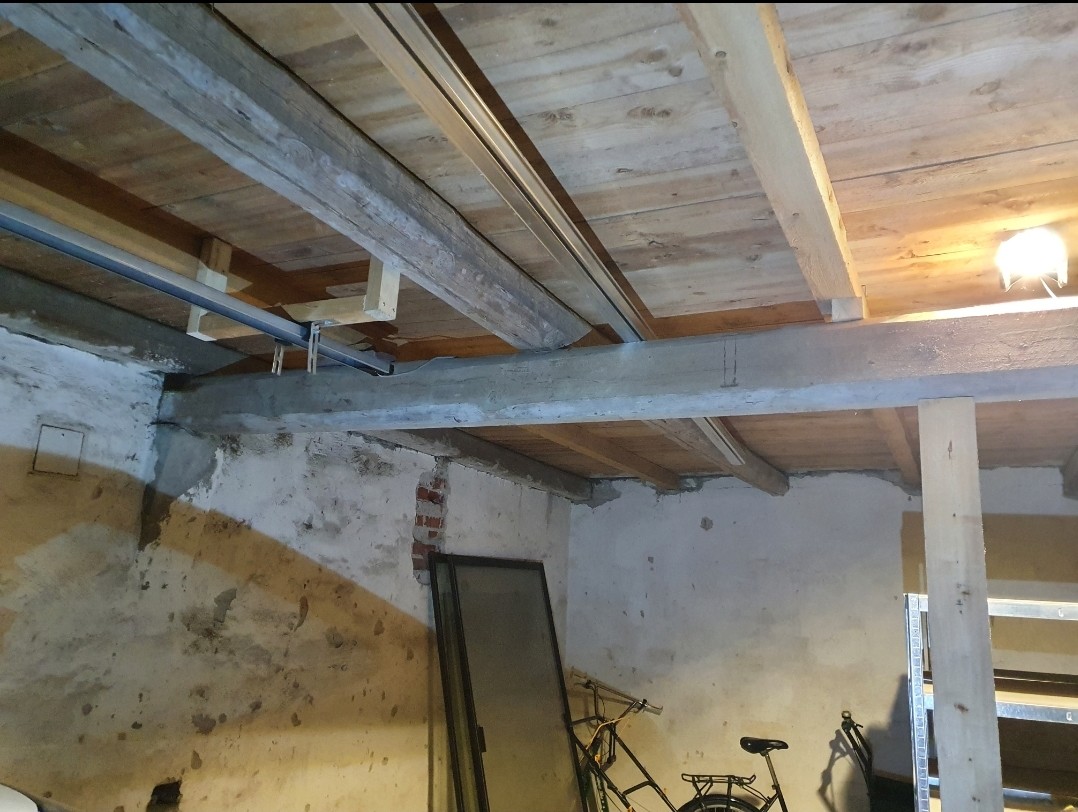
There is an old beam structure in a barn. The loft has worked well for storage, even heavier items, for 60-70 years, but it's now going to be a gym above and I need to reinforce it to reduce the bounce. The walls supporting the beam structure are masonry. The area is 5x7.5 m and a beam in the middle makes the span about 3.7 m. The beam is 5 m long and 90x260 mm. Not laminated wood exactly, but quite stable. A post was placed in the middle beneath the beam which helped somewhat, but not enough.
On cc 800, every other old beam is 150x150 mm and every other modern joist is 100x100.
The question is whether to invest in adding more joists parallel so it becomes cc 400 or if the beam in the middle is too weak despite the post in the middle?
The floor itself is quite thick tongue-and-groove boards, probably over 30 mm.
Certainly, that floor is strong as heck.
But removing the bounce requires significantly more.
However, I'll let the experts talk about how it should be reinforced
Fantastic that you have such spaces, congratulations.
Yes, I'm not worried about it collapsing. But I'm a bit surprised that it didn't become more stable than it actually did when I supported it with the post in the middle. That's why I suspect that the big beam in the middle is too weak despite being 90x260 mm and only 2.5 m in span (if you count the post).
You might be able to place a thicker post in the middle and braces angled out from each side of the post to support a bit further from the middle as well, instead of three posts?
It cannot be like that in the long run since cars are parked there. But as a simple test, it's a good idea.
Thanks!
Would it become rigid with three posts, it may be appropriate to bolt two 9” planks (45*220) on each side of the support beam. Through thread rod, washer, and nut, then there will be strength in both the construction and practitioner!
(Still with one post in the middle)
A post under the central beam should suffice. However, 150x150 is too weak for a span of 3.75 m (and obviously 100x100). The best option would be to screw and glue on height so that the beam dimension becomes 150x180. The alternative is to do it on the width. Then you need to go up to about 250x150. Additionally, old timber can be a bit tricky. Partly concerning the strength class, and partly because it may have been exposed to moisture, which can reduce stiffness.
Also a good idea. There's plenty of space in height, so it's no problem to screw-glue something underneath. The alternative of adding joists to make it 400 cc requires just as much timber but more work with wall attachments.
Which option is best? I would prefer to stick to 800 cc...
If the central beam is sturdy enough with a post in the middle, it should feel solid if you walk on the loft directly over the central beam. I just need to clear away some things so I can walk freely up there.
Then I can reinforce a quarter of the joist area first to test the result.
Shortening the c/c distance has a more limited effect. It is the beams' moment of inertia (bxh^3/12) that is decisive. With 30 mm floorboards, 800 mm is sufficient.
Given the small surface area and ample ceiling height, I would have preferred to build a solid frame on the old floor. If you use plenty of closely spaced studs and then screw them securely into the base, and then add a good finish for training, I believe the problem is solved.
There is good ceiling height on the ground floor, so I want to reinforce from below. I would prefer not to raise the loft's floor. Plus, I think the old plank floor in the loft can turn out very nice after sanding.
It will involve trying screw-gluing joists below existing joists and beams.
How about using standing 45x95 mm? That would make it 195 and 245 mm in height on joists/beams.