
8,870 views ·
15 replies
9k views
15 replies
Reinforce joists 6m span
Hello,
I am planning to reinforce a floor in a room that measures 6200 x 7200mm. The current beams are approximately 270x200 and are spaced at 1000cc. The floor is made of tongue-and-groove boards about 40mm, but it sags severely. Deflection is about 50mm in the middle compared to the edges.
What complicates the project is that there is a really fine ceiling painting in the plastered ceiling of the room below, so the utmost care needs to be taken to avoid cracks.
I can go up about 20mm above the existing beams and still make it look nice with a new tongue-and-groove floor. I am considering glue-laminated timber 270x90, but 270x115 in the middle. The new beams would then be placed 10-20mm above the existing ceiling to allow for some deflection. Reinforcement would be along the existing beams as well as cross beams.
Am I on the right track? Do you see any other options? I realize it will be costly with so much glue-laminated timber, but pillars are not an option.
Best regards
I am planning to reinforce a floor in a room that measures 6200 x 7200mm. The current beams are approximately 270x200 and are spaced at 1000cc. The floor is made of tongue-and-groove boards about 40mm, but it sags severely. Deflection is about 50mm in the middle compared to the edges.
What complicates the project is that there is a really fine ceiling painting in the plastered ceiling of the room below, so the utmost care needs to be taken to avoid cracks.
I can go up about 20mm above the existing beams and still make it look nice with a new tongue-and-groove floor. I am considering glue-laminated timber 270x90, but 270x115 in the middle. The new beams would then be placed 10-20mm above the existing ceiling to allow for some deflection. Reinforcement would be along the existing beams as well as cross beams.
Am I on the right track? Do you see any other options? I realize it will be costly with so much glue-laminated timber, but pillars are not an option.
Best regards
Best answer

Your existing floor joists probably have permanent deformations for some reason that is not obvious to me. In fact, that dimension should handle the span of 6.2 meters, but they have been subjected to extra large loads for a long time. The best solution is to keep these floor joists and insert new glulam beams in between them. The dimension of these beams should be slightly larger than what you mention. Suggestively 165x270 mm (width first). To achieve a reasonable c/c distance for your floorboards, I also suggest that you screw in new battens on the side of your old floor joists. These battens, which don’t need to be taller than necessary to screw in, should be leveled so they align with the glulam beams. On top of this, you can either lay new floorboards or combine a screw-glued chipboard with thinner floorboards. The latter option provides a stiffer floor.
Thank you very much Justus. Sounds like a very good solution, and also saves a bit on glue-laminated wood which I realized today costs quite a lot.
The studs that are screwed onto existing beams, is it worth buying 45x220 finger-jointed so that it becomes full lengths, one on each side of the existing beam or does it work just as well to splice regular 45x170 for example? I'm thinking if it can help create a stiffer beam structure
Best regards, Johan
The studs that are screwed onto existing beams, is it worth buying 45x220 finger-jointed so that it becomes full lengths, one on each side of the existing beam or does it work just as well to splice regular 45x170 for example? I'm thinking if it can help create a stiffer beam structure
Best regards, Johan
One advantage of full lengths is that it can be easier to align the floor. Of course, it also helps to stiffen it up. Do you have any explanation for why the old floor joists look the way they do? Is the timber quality bad? (Which would surprise me a lot) Do you have any photo of how it looks today, or is the floor still intact?
I actually don't know why they are so bad, there are rumors that the housewarming party's dance took place there, so it might have been a heck of a strain during one evening? The room hasn't been used for anything other than storage for 125 years.
As a reference, I have a bunch of window bows leaning against a wall; when I walk across the room, the glasses rattle so much you'd think they were going to shatter.
I've only torn up 2 boards so far, will tear up the rest over the weekend and will return with pictures then.
As a reference, I have a bunch of window bows leaning against a wall; when I walk across the room, the glasses rattle so much you'd think they were going to shatter.
I've only torn up 2 boards so far, will tear up the rest over the weekend and will return with pictures then.
Long-term loads are much worse than a dance with too many participants. I'm looking forward to the pictures.
Can probably confirm long-term load, as you can see in the pictures there is a beam along the joists. On these rest boards and logs. On top, there was over 10cm of lime plaster mixed with reeds, and finally coal and gravel. We've probably shoveled out a ton and are not done yet..J justusandersson said:

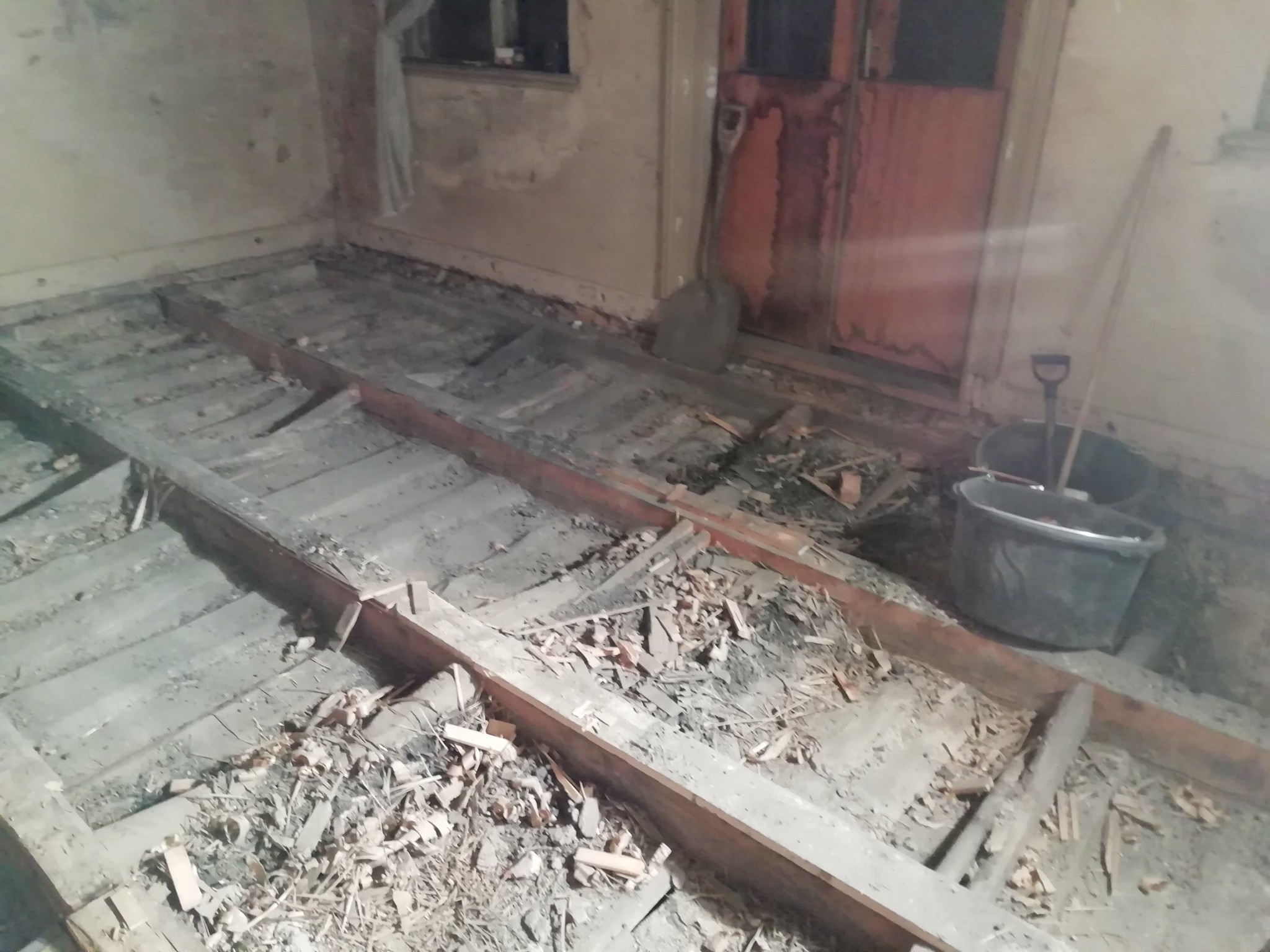
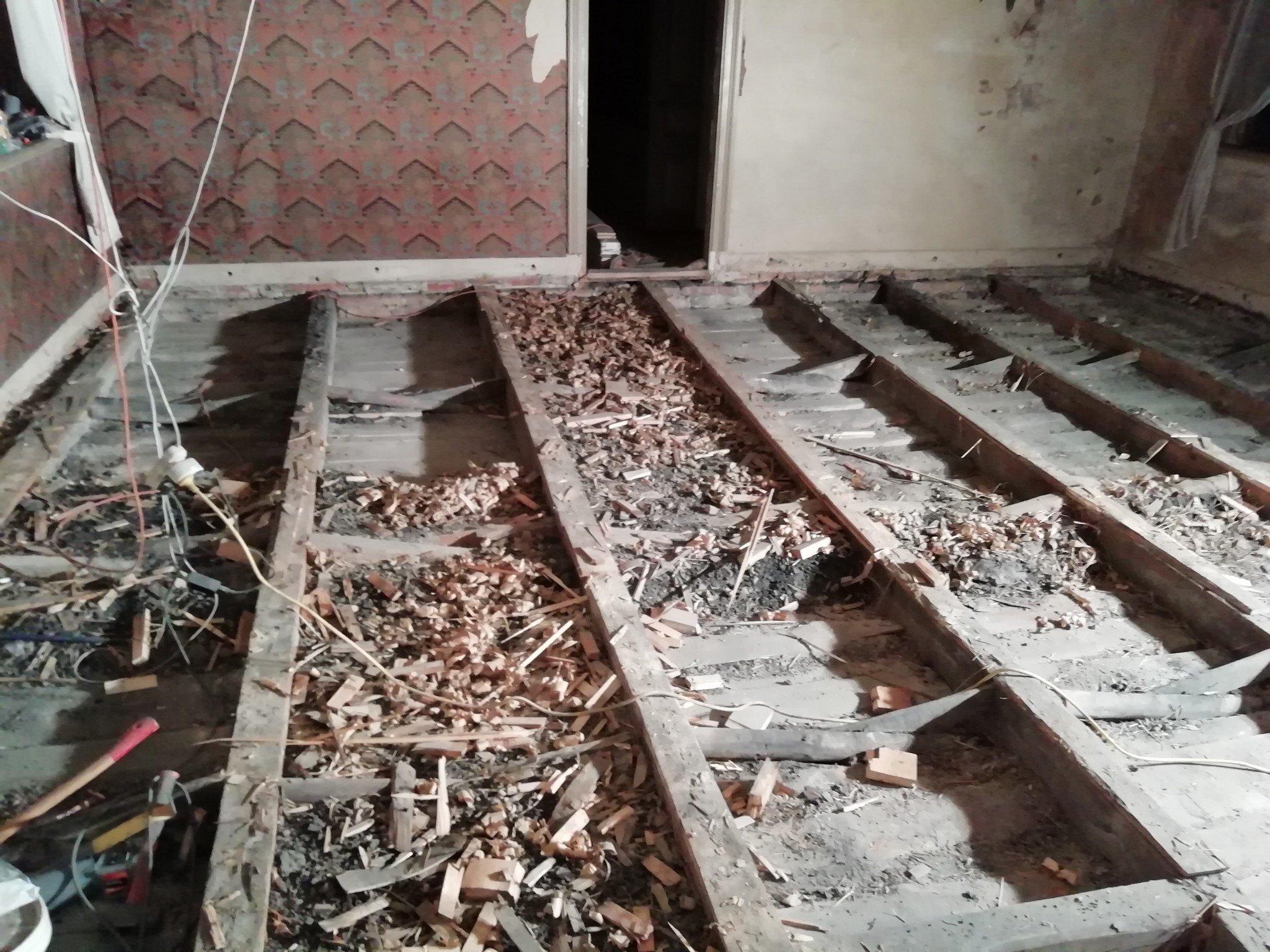
I do not envy the work, but it seems to be an interesting building. The cracked panel on the underside of the beams, which is most clearly visible in image 1, suggests that the ceiling in the floor below consists of plaster on a reed mat. You must be careful with that. The diligently done cross bracing was intended to limit the floor's deflection but has had no effect on the excessive loads.
That's correct, there are some cracks in the ceiling but overall it is in good condition with a beautiful ceiling painting in the hall below, so the work is carried out with great caution.J justusandersson said:I do not envy the work but it seems to be an interesting building. The cracked panel on the underside of the beams, most clearly visible in image 1, suggests that the ceiling in the floor below consists of plaster on "rörning" (reed mat). You must be careful with that. The diligently made cross bracing was intended to limit the floor's deflection but hasn't had any effect on the excessive loads.
I will likely adopt your suggestion and use screw-glued floorboard to make it as stiff as possible. I can reduce the thickness of the new floorboards to match the existing floors.
Thank you very much for all the help.
Just as justusandersson says, long-term load is much worse than short-term load. Another culprit, especially in combination with long-term load, is moisture. If the house has been unused for so long, I guess it has been unheated. The strength properties decrease with increased moisture content, and so-called creep occurs in the material.
Thank you for all your input, truly appreciated. It ended up with 140x270 laminated timber in the spaces between existing beams and new 45x220 on both sides. The floor flexes a few mm but feels very solid with the floor chipboard on now.
In the middle, it differed by 9cm compared to the first and last beam. Most importantly, the ceiling below made it through!
In the middle, it differed by 9cm compared to the first and last beam. Most importantly, the ceiling below made it through!


If you are going to have glulam beams that need to span 6200 mm, a 90x270 is not sufficient.J Johan_86 said:Hello,
I am reinforcing a floor in a room measuring 6200 x 7200mm. The current beams are about 270x200 and are placed at 1000cc. The floor consists of tongue-and-groove boards about 40mm, but it is sagging significantly. Deflection is about 50mm in the middle compared to the edges.
The project is made difficult by the fact that there is a really nice ceiling painting in the plastered ceiling in the room below, so utmost care is needed to avoid cracks.
I can go up about 20mm above the existing beams, and still achieve a nice look with a new tongue-and-groove floor. I am considering glulam 270x90, but 270x115 in the middle. The new beams will be placed 10-20mm above the existing ceiling to allow for some deflection. Reinforcement will occur along the existing beams and with noggings.
Am I on the right track? Do you see any other options? I realize it will be costly with so much glulam, but columns are not an option.
Best regards
At least a 90x315 mm GL30C or 115x270 mm gl30C is necessary and will handle the span on the condition that they are placed at 600cc and that you have glued chipboard flooring.
EDIT: I see that you have already started and chose a 140x270. That's great as such a beam can handle 6680 mm with glued chipboard flooring at 600 cc, so that's perfect.
Good that you increased the size.
Completely off topic, but it would be interesting to see a picture of the ceiling painting!J Johan_86 said:
Us regular Svenssons aren't so spoiled with things like that...
How nice it is to receive some feedback! I really wonder what kind of fancy building this is? A photo of the exterior would be appreciated as well.

Check among his pictures and you will see pictures of the ceiling in the dining room, which it suggests is what is meant.KnockOnWood said: