
7,733 views ·
17 replies
8k views
17 replies
Preparations joists tiles
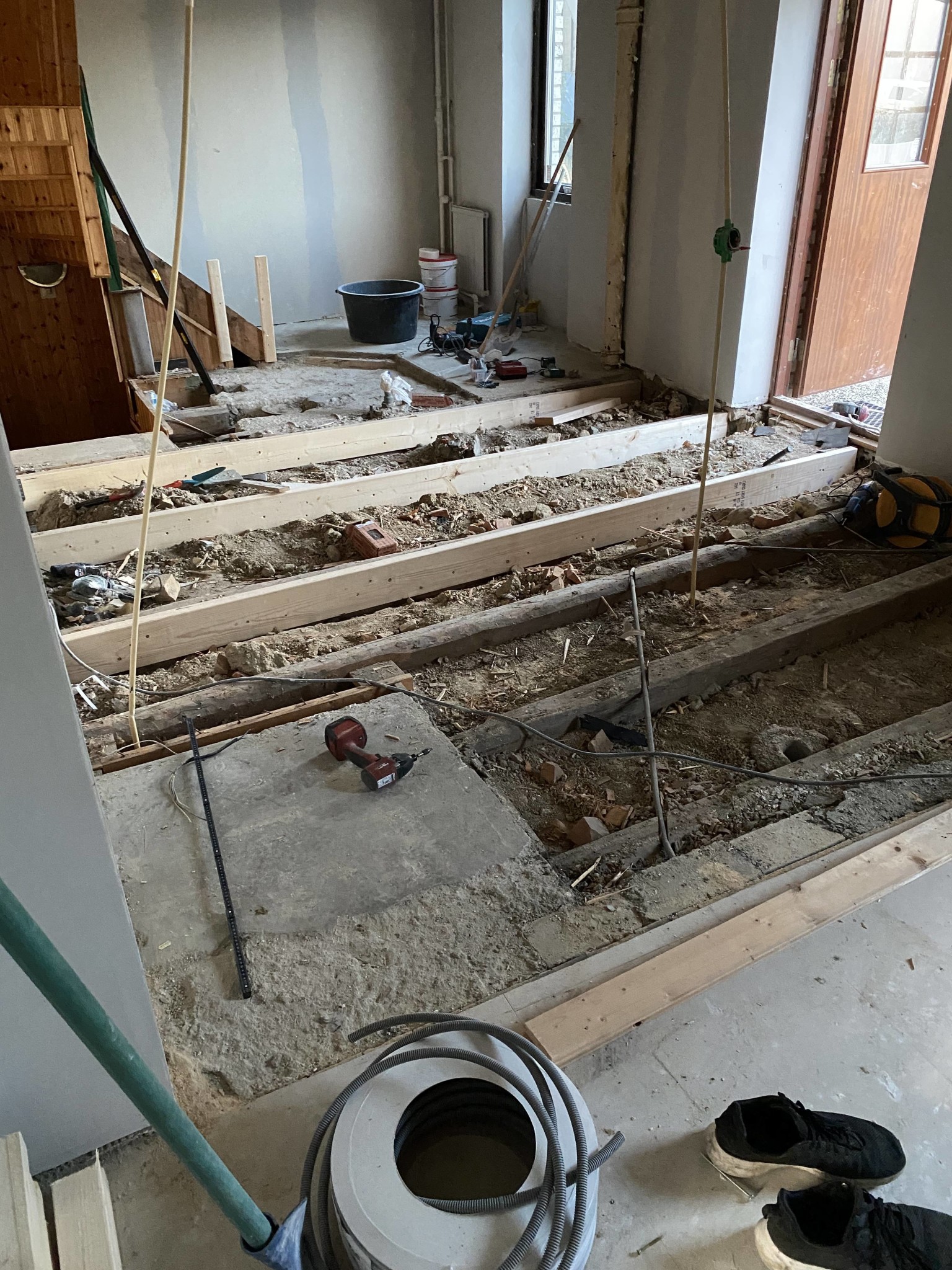
Hi, I was thinking of laying tiles floating over the entire surface. On the part with wooden joists, I plan to use 170x45 joists at cc45 + 22mm chipboard, then floor gypsum and leveling compound. On the part with concrete joists, only leveling compound over the floor loops. I'm worried it will crack at the transition between the wooden and concrete joist. Is this risk significant?

I think the risk is minimal. You're pouring a new layer over both wooden and concrete floor structures.O Olofolofolof said:Hi, I'm planning to lay floating tiles over the entire area. For the part with a wooden floor structure, I plan to use 170x45 joists cc45 + 22mm flooring chipboard, then floor gypsum and self-leveling compound. For the part with concrete floor structure, only self-level over the floor loops. I'm worried about cracking at the transition between the wooden floor structure and the poured concrete. Is this risk significant?
I would remove the floor gypsum if you're keeping 45cc.
Thanks for the reply, I gladly welcome others' opinions.

What will be the span for the 45x170 joists?
45x170 is an entirely too weak dimension for floor joists with that span, even at c/c 450. The deflection will be too great. Even though the leveling compound evens out some point loads, it is especially important to have a rigid subfloor when installing tiles. Go up to 45x220 C24.
I don't have space for thicker joists than 45*170 to avoid being higher than the adjacent room. Every other joist will be screwed into the original floor structure, which is of a thicker dimension with a spacing of about 900mm. Then there will be a 22mm chipboard floor and floor gypsum. However, I'm worried that it might crack at the transition between the concrete floor and the new one.
Construction veteran
· Stockholm
· 340 posts
Looks like you've attached new joists to the old ones? Given that the old is stiff enough, it should work, but alone 45x170 is too weak.
I probably would have invested in EPS and reinforced leveling.
https://www.gvk.se/branschregler/golv/forstarka-trabjalklag/lattfyllnadsmassa/
I probably would have invested in EPS and reinforced leveling.
https://www.gvk.se/branschregler/golv/forstarka-trabjalklag/lattfyllnadsmassa/
The old beams are estimated to be 5x7 inches and if so, they will suffice. It is better to glue-screw 2 pieces of 45x170 and place them separately than to screw them together with the old ones.
Construction veteran
· Stockholm
· 340 posts
Curious as a cat, you are obviously both knowledgeable and helpful Justus; why is it better?J justusandersson said:
It's about reducing the deflection. In that case, the beam's moment of inertia (b*h^3/12) is crucial. If you cannot increase the height, you have to go for the width. The old beams do not need to be reinforced.
Construction veteran
· Stockholm
· 340 posts
On board with that, but if we assume that the old ones can manage on their own and the new ones are only meant to straighten up?
The beams will be sparsely placed. Floor particleboard cannot be laid on c/c 900.
Construction veteran
· Stockholm
· 340 posts
Yes, partly that's why I suggested eps
I still believe that 450 mm is an appropriate c/c distance with respect to deflection conditions. Then, of course, it's good if what lies on the beams is as rigid as possible.