
7,991 views ·
15 replies
8k views
15 replies
Floor structure strength
Member
· Stockholms län
· 65 posts
Hello!
First, I want to thank all the knowledgeable people who answer our less experienced questions on this forum around the clock. It is incredibly educational and inspiring to read.
Now to my dilemma: We currently have an open fireplace, but we are considering taking more energy advantage of the wonderful feeling an open fire provides. Simply put, we are thinking of replacing the open fireplace with a masonry stove with a lift door. The catch is that these weigh between 250 and 350 kg in the sizes we are interested in. Our quiet question is now how we can find out if our floor can handle that load?
The house is a 2-story functionalist villa with a split-level basement (or however that is spelled), meaning a basement plus two additional floors. The masonry stove is intended to be on the middle floor, the floor above the basement. Unfortunately, the drawings we have do not reveal how the joists actually look in this part of the house (built in 1938, concrete slab on ground) Is there possibly an authority that should have copies of more complete drawings of our house with structural calculations? (We have such for the house extension done in '75, which states that floor 1 should withstand 150kg/sqm and floor 2 200 kg/sqm if I interpret them correctly, but unfortunately nothing for the original house). Is it possible to secure by, so to speak, potentially installing supporting beams under the specific area where the stove is to be placed? (underneath is fairly easy to access and minimally furnished, and the floor is the direct concrete slab that constitutes the foundation of the house)
I realize it may be difficult to answer with such inadequate info, but any tips and advice would be appreciated...
First, I want to thank all the knowledgeable people who answer our less experienced questions on this forum around the clock. It is incredibly educational and inspiring to read.
Now to my dilemma: We currently have an open fireplace, but we are considering taking more energy advantage of the wonderful feeling an open fire provides. Simply put, we are thinking of replacing the open fireplace with a masonry stove with a lift door. The catch is that these weigh between 250 and 350 kg in the sizes we are interested in. Our quiet question is now how we can find out if our floor can handle that load?
The house is a 2-story functionalist villa with a split-level basement (or however that is spelled), meaning a basement plus two additional floors. The masonry stove is intended to be on the middle floor, the floor above the basement. Unfortunately, the drawings we have do not reveal how the joists actually look in this part of the house (built in 1938, concrete slab on ground)
Is there possibly an authority that should have copies of more complete drawings of our house with structural calculations? (We have such for the house extension done in '75, which states that floor 1 should withstand 150kg/sqm and floor 2 200 kg/sqm if I interpret them correctly, but unfortunately nothing for the original house). Is it possible to secure by, so to speak, potentially installing supporting beams under the specific area where the stove is to be placed? (underneath is fairly easy to access and minimally furnished, and the floor is the direct concrete slab that constitutes the foundation of the house)I realize it may be difficult to answer with such inadequate info, but any tips and advice would be appreciated...
The city planning office (or the equivalent in your municipality) should have drawings. Structural calculations are less common. Someone here can probably help you with the load-bearing capacity later.
A small comment: It was VERY unusual in 1938 to build split-level houses with slab-on-grade. The most common method was to have basement walls founded on spread footings. The basement floor then usually became just that, a fairly thin layer over the ground with limited load-bearing capacity.
A small comment: It was VERY unusual in 1938 to build split-level houses with slab-on-grade. The most common method was to have basement walls founded on spread footings. The basement floor then usually became just that, a fairly thin layer over the ground with limited load-bearing capacity.
Member
· Stockholms län
· 65 posts
Hello and thank you for your response. Contacted the municipality and out of the blue, they emailed over what they had... Great service but unfortunately, they didn't have much more than what we already had at home... No structural calculations, no direct description of the floor structure either... I am attaching a cross-section of the house along with "Basement Plan" and "Ground Floor Plan" (what I call the middle floor).
In all the descriptions we've seen, this house is called "Slab on Grade" (even by the inspector) but now when I look at the cross-section drawing, I might lean towards agreeing with you that this perhaps isn't the case, or?
I am also attaching a drawing where I have primitively and crudely drawn a red rectangle approximately where the fireplace is intended to be (yes, we plan to remove the wall between the two rooms where the red rectangle is located). What do you think, does this work and if not, what can be done to solve this?
Another question we can't quite figure out from these drawings is: which interior wall(s) are actually load-bearing on these two floors?
Many questions, hoping for answers
In all the descriptions we've seen, this house is called "Slab on Grade" (even by the inspector) but now when I look at the cross-section drawing, I might lean towards agreeing with you that this perhaps isn't the case, or?
I am also attaching a drawing where I have primitively and crudely drawn a red rectangle approximately where the fireplace is intended to be (yes, we plan to remove the wall between the two rooms where the red rectangle is located). What do you think, does this work and if not, what can be done to solve this?
Another question we can't quite figure out from these drawings is: which interior wall(s) are actually load-bearing on these two floors?
Many questions, hoping for answers
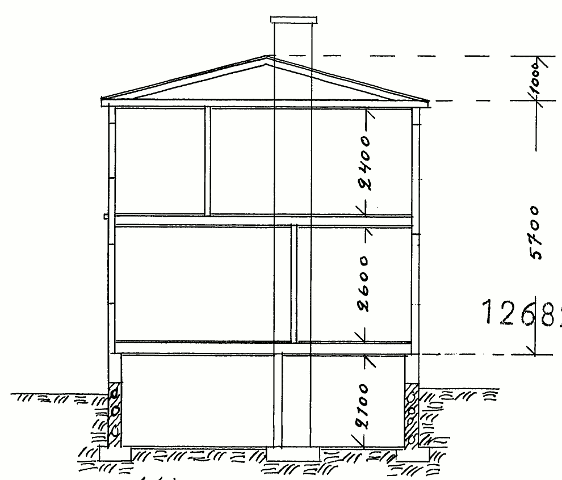
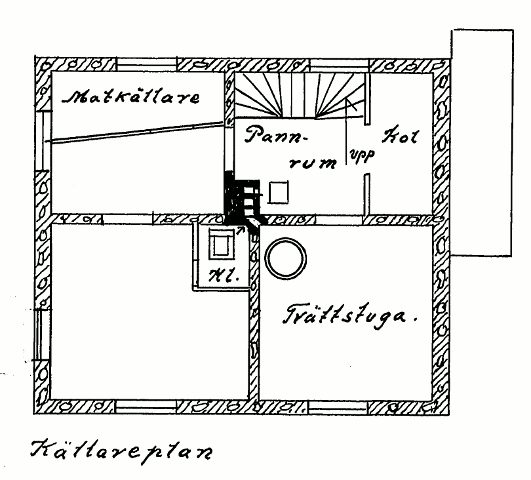
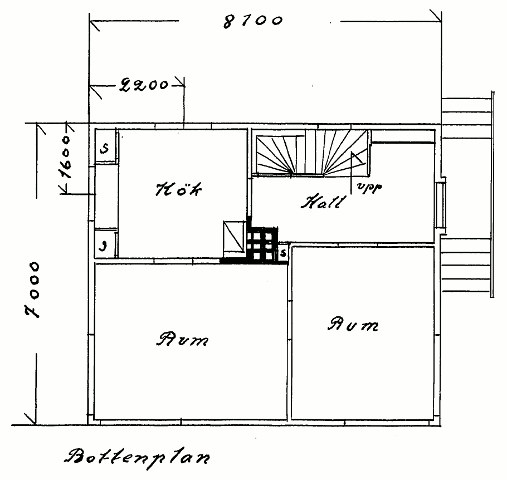
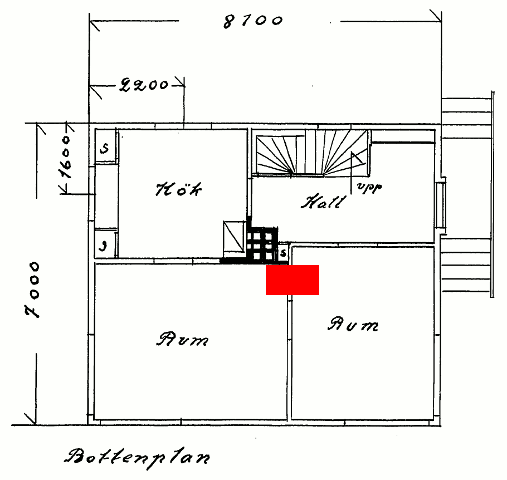
You are quite right not to have "platta på mark." It only shows the low level of certain real estate agents!!
From the section you received, it seems that the floor structure is a wooden joist construction. There were probably no structural calculations at the time. They often used known sizes for the beams, maybe from a table (just like many do today!).
To check the load-bearing capacity, you should open the floor structure from underneath, from the basement, to measure the dimensions. Then it is relatively easy to determine the load-bearing capacity.
Any support from underneath can also be calculated then.
Which walls are load-bearing cannot be determined from these drawings. It is likely that at least two of them are load-bearing. Most likely, those between the kitchen and the room and between the hall and the room are load-bearing. You have to investigate in which direction the beams lie to make an accurate determination.
From the section you received, it seems that the floor structure is a wooden joist construction. There were probably no structural calculations at the time. They often used known sizes for the beams, maybe from a table (just like many do today!).
To check the load-bearing capacity, you should open the floor structure from underneath, from the basement, to measure the dimensions. Then it is relatively easy to determine the load-bearing capacity.
Any support from underneath can also be calculated then.
Which walls are load-bearing cannot be determined from these drawings. It is likely that at least two of them are load-bearing. Most likely, those between the kitchen and the room and between the hall and the room are load-bearing. You have to investigate in which direction the beams lie to make an accurate determination.
Member
· Stockholms län
· 65 posts
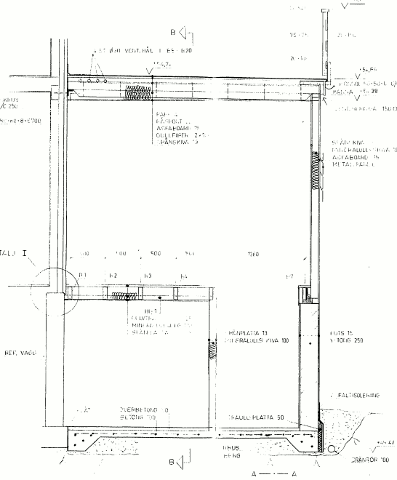
Hmm... Well, one expects realtors to have no clue, but home inspectors should at least be knowledgeable... (2 independently of each other, no less) I'm attaching here part of the drawing for the extension that was done in 1975, it looks more like a regular concrete slab, or am I misunderstanding it? Maybe that's why they think the house is that way? (even though the extension is about half the size of the original house)
A question that arises then is: What do you call the type of foundation our house has? Basement foundation? It's not a crawl space foundation... or have I completely misunderstood it?
As soon as I get home, I will see if I can find an opening to the joist space (or alternatively a good place to make a viewing hole)...
A question that arises then is: What do you call the type of foundation our house has? Basement foundation? It's not a crawl space foundation... or have I completely misunderstood it?
As soon as I get home, I will see if I can find an opening to the joist space (or alternatively a good place to make a viewing hole)...
Member
· Stockholms län
· 65 posts
Hello again and thank you for all your help so far. I have now started to delve a little into the house mystery and I began by looking at the joists from underneath, where I took two pictures of the tongue and groove that is hidden (or not hidden just in the space where the picture is taken) in the ceiling. Behind it, there seems to be chipboard or something similar.
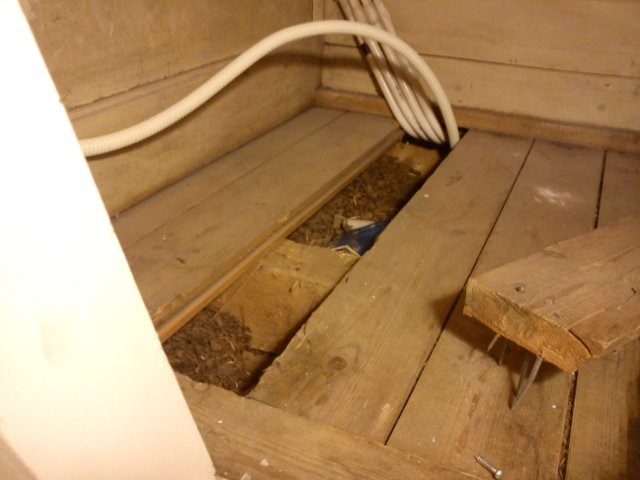
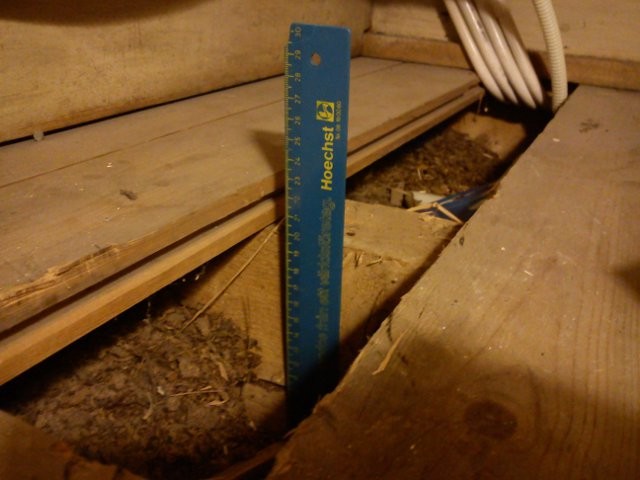
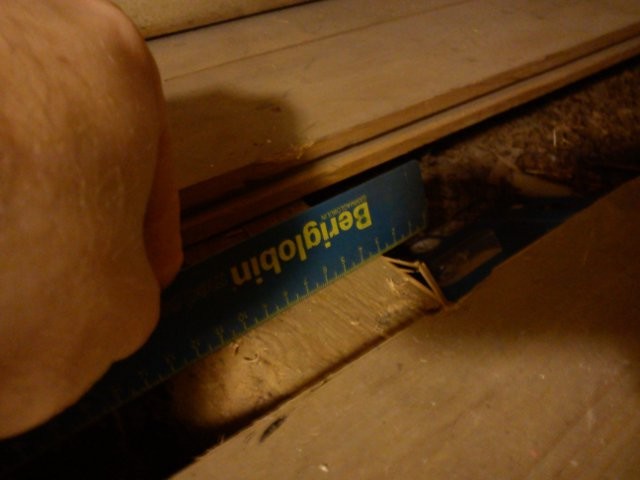
To avoid dismantling more of the house than necessary, I thought a little and realized that we actually have a curious little space under the stairs to the top floor that can be accessed via a hatch. I opened it and there you can access the joists from above, but there is no real floor for natural reasons, only tongue and groove. One of the planks was also slightly pried open, so I completed the job and removed the loose plank, revealing the wooden beam you see in the pictures. From what I could determine, this beam is 195mm high and 75mm wide. Can we assume that the other beams in the joists have the same dimensions, and if so, how do we calculate the maximum load capacity for this type of beam?
Thank you so much once again for all your help so far; it's incredibly exciting to explore one's own house in this way!
Best regards, Magnus
To avoid dismantling more of the house than necessary, I thought a little and realized that we actually have a curious little space under the stairs to the top floor that can be accessed via a hatch. I opened it and there you can access the joists from above, but there is no real floor for natural reasons, only tongue and groove. One of the planks was also slightly pried open, so I completed the job and removed the loose plank, revealing the wooden beam you see in the pictures. From what I could determine, this beam is 195mm high and 75mm wide. Can we assume that the other beams in the joists have the same dimensions, and if so, how do we calculate the maximum load capacity for this type of beam?
Thank you so much once again for all your help so far; it's incredibly exciting to explore one's own house in this way!
Best regards, Magnus

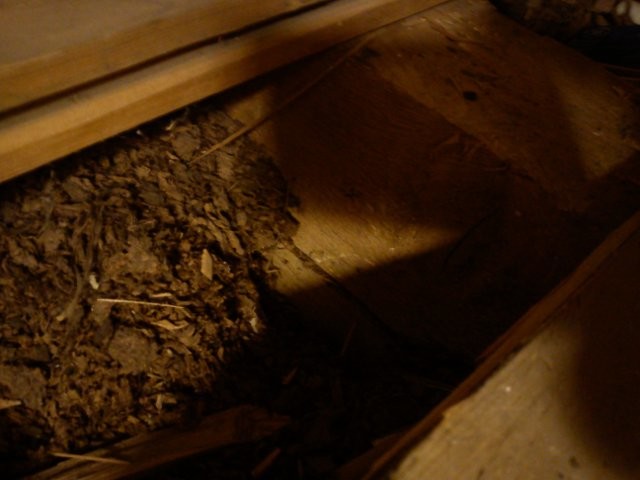
The next thing to measure is the center distance between the beams! You can probably do this by checking how close the nails are in the raw planks. That is, perpendicular to the beams. A common measurement is 60 cm.
Member
· Stockholms län
· 65 posts
Okay, I have now checked the center distance both by measuring to the next beam in the small space under the stairs, and by checking the nail distance in the raw planking: both say 60cm. So, what might be the next step?
The next step is to find out in which direction the beams are located in the two rooms affected by the new stove.
I think you will see it most easily from below.
The rough boards in the basement ceiling run perpendicular to the beams.
I think you will see it most easily from below.
The rough boards in the basement ceiling run perpendicular to the beams.
Member
· Stockholms län
· 65 posts
Hello again!
Okay, in one of the rooms, I have tried to illustrate the direction the beams should go, kind of perpendicular to the length of the house, you could say. In the picture, the beams are primitively drawn with a gray color as a mostly striped pattern. This is consistent with both the direction of the two beams I can see (in the space under the stairs) and with the fact that the wood paneling is perpendicular to this direction.
NOTE! In the picture, it is certainly not exactly cc 60, I know that, but everything suggests that it is cc 60 that applies in the house.
Okay, in one of the rooms, I have tried to illustrate the direction the beams should go, kind of perpendicular to the length of the house, you could say. In the picture, the beams are primitively drawn with a gray color as a mostly striped pattern. This is consistent with both the direction of the two beams I can see (in the space under the stairs) and with the fact that the wood paneling is perpendicular to this direction.
NOTE! In the picture, it is certainly not exactly cc 60, I know that, but everything suggests that it is cc 60 that applies in the house.

I have now done a verification calculation on the left room.
The construction is on the verge of what is allowed.
That means it should be possible to install the stove.
If you want to be absolutely sure, I would recommend a pillar as support under the stove in the basement.
The construction is on the verge of what is allowed.
That means it should be possible to install the stove.
If you want to be absolutely sure, I would recommend a pillar as support under the stove in the basement.
Member
· Stockholms län
· 65 posts
Okay, big thanks!
On the edge even for one around 350kg or "only" 250 (which the slightly smaller ones weigh)? Does it matter if the stove's center will end up almost exactly above the inner wall in the basement? (as it probably will) I assume that wall is not directly load-bearing, but maybe it affects the load capacity somewhat?
And finally regarding the pillar in the basement if one installs it: Should it "stand" on the concrete floor or should you drill down under it and anchor it in the ground? And should the pillar support up against the roof decking in the basement ceiling or up against one of the beams above the roof decking? And is a wooden pillar the most suitable or something else?
Hopefully, these are my last questions regarding this topic
On the edge even for one around 350kg or "only" 250 (which the slightly smaller ones weigh)? Does it matter if the stove's center will end up almost exactly above the inner wall in the basement? (as it probably will) I assume that wall is not directly load-bearing, but maybe it affects the load capacity somewhat?
And finally regarding the pillar in the basement if one installs it: Should it "stand" on the concrete floor or should you drill down under it and anchor it in the ground? And should the pillar support up against the roof decking in the basement ceiling or up against one of the beams above the roof decking? And is a wooden pillar the most suitable or something else?
Hopefully, these are my last questions regarding this topic
I calculated that 350 kg is solely on the floor in the left room. If the stove weighs 350 kg and is partially in both rooms, also over the wall in the basement, then it's perfectly fine. The exact placement of the stove's center doesn't matter. No pillar is needed, it meets the approved structural strength values.Glad Amatör 76 said:Okay, thank you very much!
Even borderline for one about 350kg or "just" 250kg (which the smaller ones weigh)? Does it matter if the middle of the stove ends up almost exactly above the interior wall in the basement? (as it probably will) I assume that wall is not exactly load-bearing but maybe it affects the load-bearing capacity somewhat anyway?
Member
· Stockholms län
· 65 posts
Lovely, it seems I have finally run out of questions for this time. I just want to thank you once again for the help! d^_^b