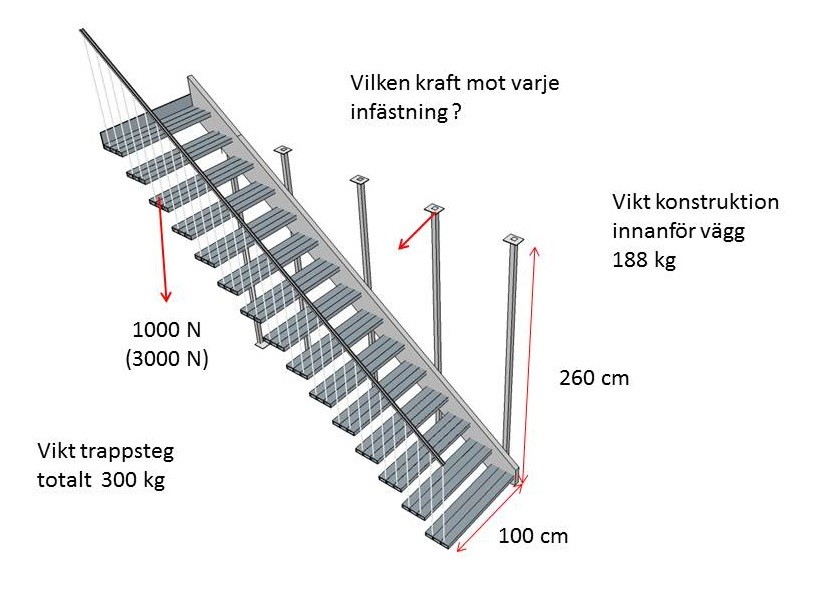
I am planning to build a so-called floating staircase for our new build.
It will consist of a steel construction in the wall with steps covered in oak.
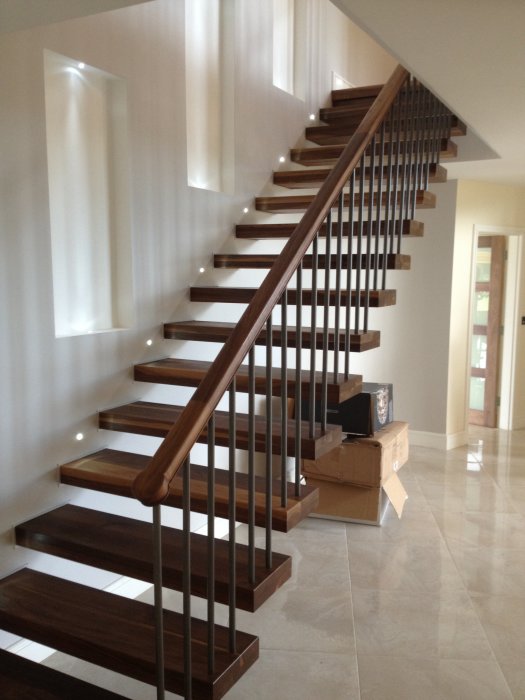
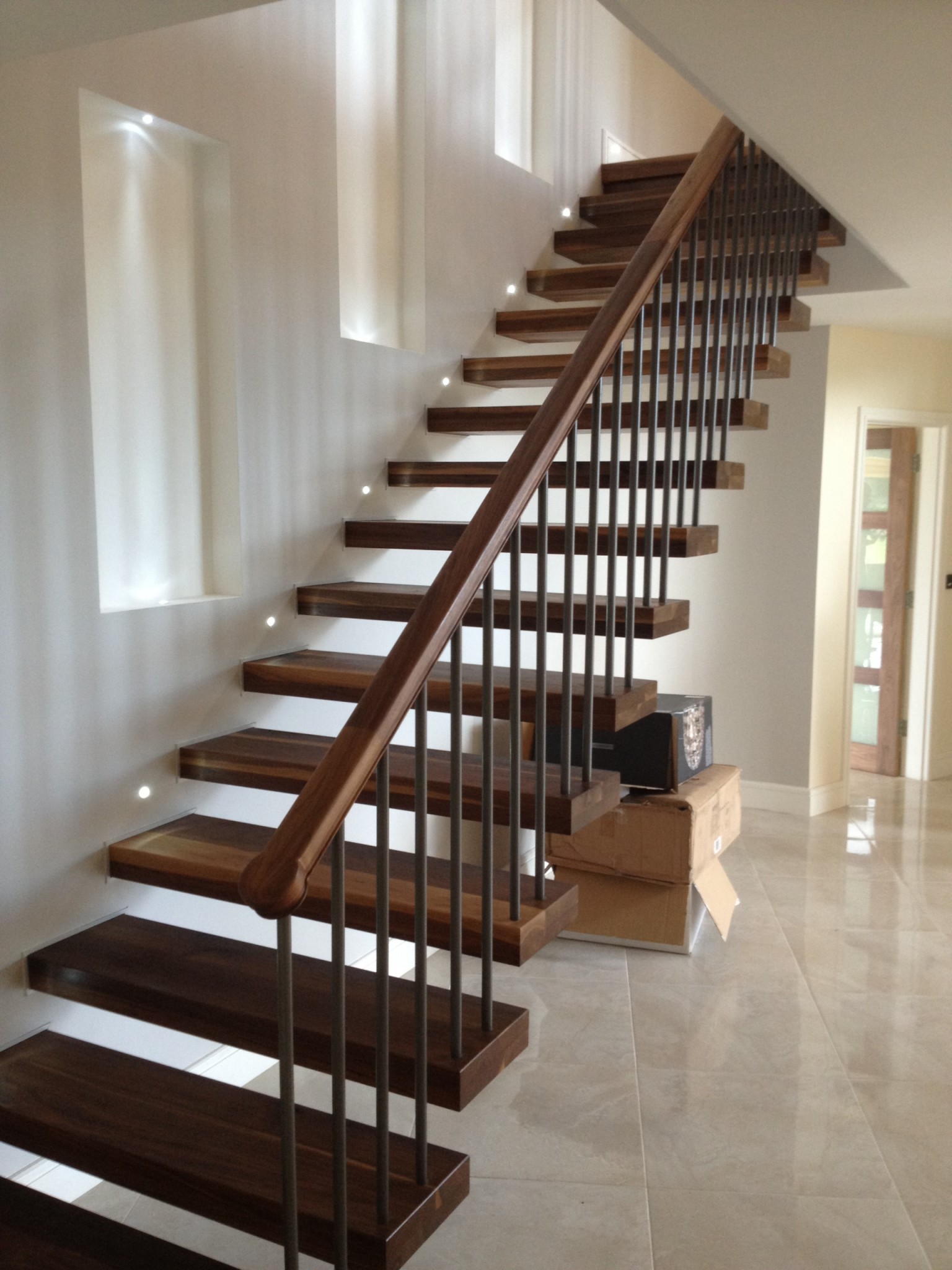
This is roughly how the staircase is intended to look when it's finished
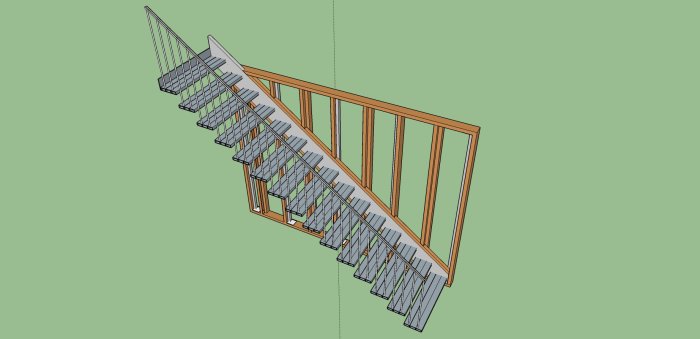
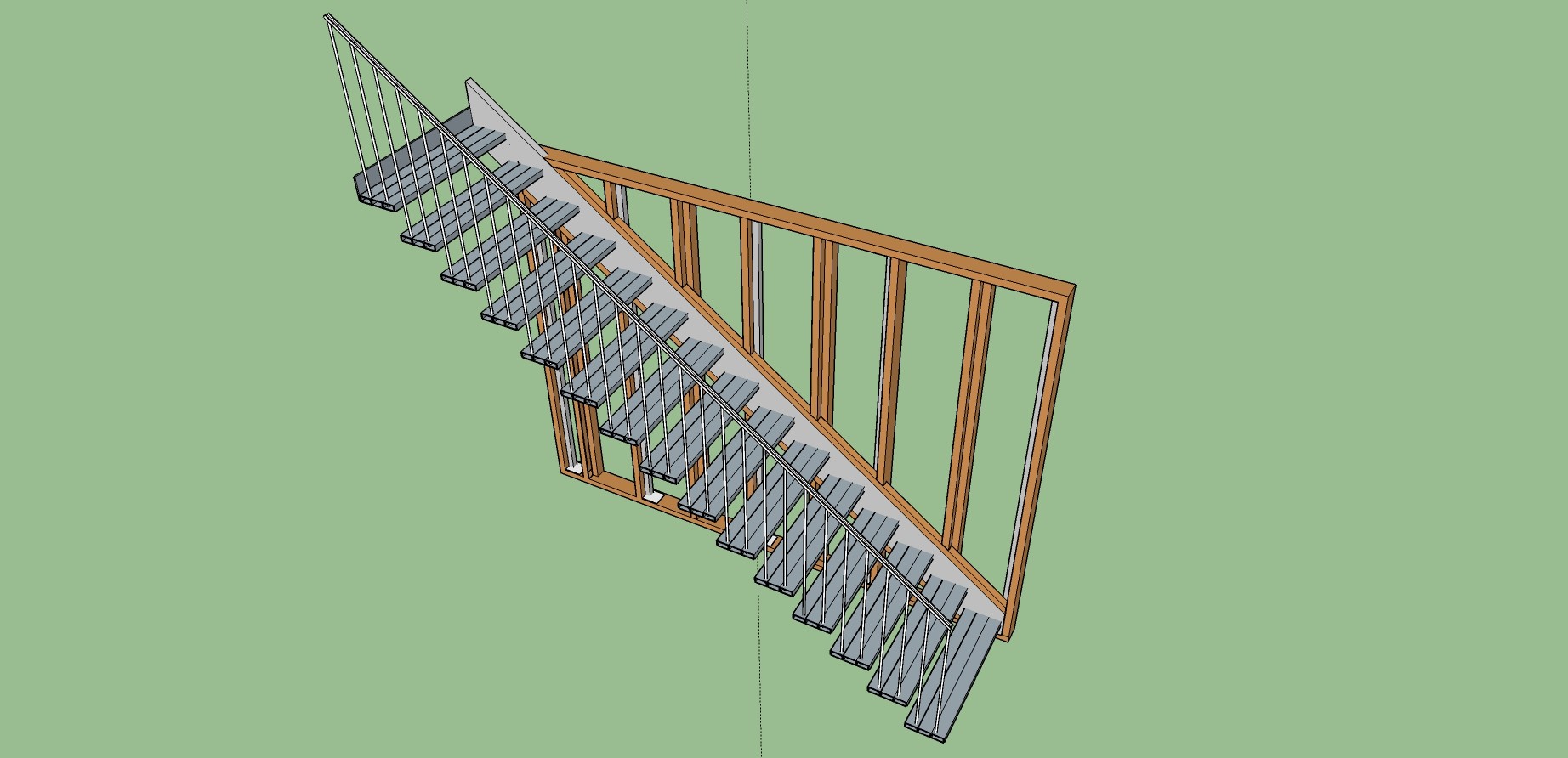
As I've planned now:
Each step will consist of 3 pieces of VKR 80x40x5 mm
The steps will protrude from a VKR 300x50x5 mm
I plan to weld by letting the steps go through the 300-beam and welding on the front and back.
In the wall, I'm thinking of 5 standing VKR 40x40x5 between the floor and ceiling.
The top step will have a metal plate at the back that screws to the wooden beam.
Each step will connect at the outer edge through double 16 mm round bars, screwed together with a U-bar 30x15x4x4.5 at the railing. The round bar will later be covered with a 20 mm stainless steel pipe.
The wall is non-load-bearing with a stud dimension of 120x45 mm.
Is it possible to attach the standing metal studs to the "sill board" as I've done, or is it better to try to attach it directly to the concrete slab?
Should I attach the standing metal beams to the wooden studs, or should I try to keep the metal construction separate from the wooden wall?
Unfortunately, there will be a bathroom on the other side of the wall, which I'm a bit worried about.
That's why I'm thinking perhaps it should be attached only to the ceiling and floor?
Is there a risk of creaking noises? How can they be avoided?
Feels like a really sturdy construction, how many kg can those steps handle? Must be fine with thinner material in them. Without personal experience, I would attach the stair construction separately to the floor and ceiling, so there's no leverage effect on the bathroom wall with waterproofing that could crack.
Feels like a really solid construction, how many kg can those steps handle? Must work with thinner material in them. Without personal experience, I would attach the construction of the stairs separately to the floor and ceiling, so there's no lever effect on the bathroom wall with waterproofing that might crack.
I'm not very familiar with how to calculate the construction. But I have checked post #6 in this thread. Apparently, 2 pieces of VKR 80x40x5 are considered insufficient for deflection.
But the entire construction will weigh about 600 kg, so it feels like it will be too heavy...
It consisted of about the same number of steps. The frame built into the wall was made of 100x100x8VKR, if I remember correctly. The stringer stood on a pillar of the same size.
On the stringer, there were plates measuring b120xL400xt20mm. Welded with a couple of 4-5 passes in V-groove.
Then it was built into the wall, with wooden studs and drywall, and the steps were put on. The steps had been milled out in some way so they were hollow?, maybe they made two parts and glued them together afterward.
I didn't design it myself, but got a drawing from the office that I followed. They probably also hadn't run any program on the construction but took what felt good.
That staircase became completely solid to walk on. It was just in the concrete. And the wall was properly framed to handle the outward movement.
I also just remembered that I split the stringer and used a bolt group to tie the parts together because we had to install it high up in a loft apartment in the middle of Sthlm. And there was no elevator. It was insanely heavy (to be carried by 2 guys).
It consisted of roughly as many steps. The frame built into the wall was 100x100x8VKR if I remember correctly. The stringer stood on a pillar of the same size.
On the stringer, there were plates measuring b120xL400xt20mm. Welded with a couple of 4-5 strands in a V-groove.
Then it was built into the wall, with wooden studs and plaster, and the steps were threaded on. They had milled the steps in some way so they were hollow?, maybe they had made two parts and glued them together afterward.
I didn't design it myself, but I received a drawing from the office that I followed. They probably hadn't used any program for the design either but went with what felt right.
That staircase was completely rigid to walk on. Only attached to the concrete. And the wall was properly framed to handle the outward movement.
I also just remembered that I split the stringer and used a bolt group to bind the parts together because we had to install it high up in a loft apartment in the middle of Stockholm. And there was no elevator. It was insanely heavy (to be carried by 2 guys)
Sounds like a solid construction as well.
Was it screwed into the concrete floor and ceiling?
Should I worry about the weight of the construction?
From what I understand, the deflection should be somewhere around 1/450 of the length?
1 pc VKR 80x40x4 mm results in approximately 7.1 mm deflection at 1000 N.
3 pcs would then result in about 2.4 mm, so quite close to 1/450.
But I'm not sure if that's how the calculation is done.
The light gray one is a VKR 300x50x5 mm, which I think the steps are welded to.
Loads are how many and where your forces act.
You know the deflection you want, around 2 mm. Then it's just a matter of calculating which moment of inertia is needed for this. You are well on your way. Maybe have 2 pieces and 5mm material?
Keep in mind that every step becomes a siphon that wants to twist your hidden chassis, and if there's the slightest flex or twist in the chassis, it will be felt significantly at the edge of the step.
So weld thoroughly in each pillar to minimize twisting.
What I am most worried about is whether the stairs will create too much force against the mountings that will be in the ceiling and floor?
So that there will be problems with the house's wooden frame.
Do you find it difficult to do by hand? Strong reinforcements will be required in the floor and ceiling, and I believe a 40*40 won't be sufficient. A 100*40 is likely needed.