
7,909 views ·
7 replies
8k views
7 replies
Find load-bearing wall from drawing

Hi! I've seen some posts about this before, but since not all houses look the same, I have to ask the question again!
I live in a townhouse, built in 1983, and got the plans from the municipality.
I would like to know if the walls circled in red are load-bearing or not. The point is that the wall in the hallway (blue color) has been removed, but they have left a pillar in the middle of the hallway/kitchen, which makes me uncertain.
We would preferably like to get rid of this pillar and the small wall next to it.
Grateful for any answers!
Best regards, Tomas
I live in a townhouse, built in 1983, and got the plans from the municipality.
I would like to know if the walls circled in red are load-bearing or not. The point is that the wall in the hallway (blue color) has been removed, but they have left a pillar in the middle of the hallway/kitchen, which makes me uncertain.
We would preferably like to get rid of this pillar and the small wall next to it.
Grateful for any answers!
Best regards, Tomas
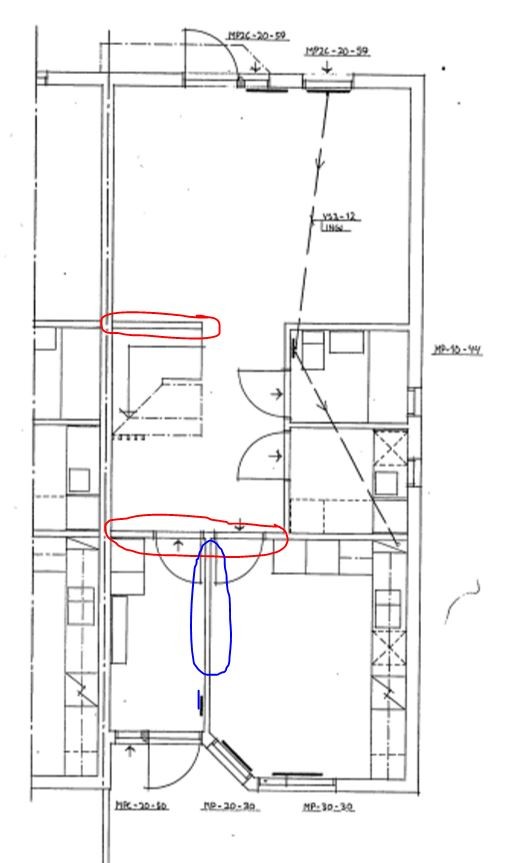

It is not uncommon for one of the transverse walls to be load-bearing. Are all the walls equally thick?
I have lived in a house built in '89 where the living room wall (and the equivalent wall on the upper floor) was thicker than all other walls.
But really, you need other drawings that should be in the building permit documents. If the municipality doesn't have them digitally stored, you should be able to go to the building office and find them in the archive.
Regarding the circled wall towards the living room, the staircase is probably attached to it, and if you want to replace the wall with a staircase railing, you would likely need to replace the staircase with one that is differently constructed.
I have lived in a house built in '89 where the living room wall (and the equivalent wall on the upper floor) was thicker than all other walls.
But really, you need other drawings that should be in the building permit documents. If the municipality doesn't have them digitally stored, you should be able to go to the building office and find them in the archive.
Regarding the circled wall towards the living room, the staircase is probably attached to it, and if you want to replace the wall with a staircase railing, you would likely need to replace the staircase with one that is differently constructed.

I am quite sure that both of the transverse, red-marked, walls are load-bearing. Even though the drawing isn't dimensioned, I guess that the depth of the house is around 10 meters, and then two supports for the floor joists are required. The house is 1 1/2 - 2 stories high, and there is a finished floor above the current one which contributes to the joist load. The type of building and the year also provide certain external conditions.
All the walls are equally thick! No difference in "bounce" when you knock on them either.BirgitS said:
It is not uncommon for one of the cross-sectional walls to be load-bearing. Are all the walls equally thick?
I have lived in a house built in -89 where the living room wall (and the equivalent wall on the upper floor) was thicker than all other walls.
But actually, other drawings are needed which should exist in the building permit documents. If the municipality does not have them digitally stored, you should be able to go to the building office and find them in the archive.
Regarding the circled wall towards the living room, the stairs are probably attached to it, and if you want to replace the wall with a staircase railing, you will probably need to replace the stairs with one of a different construction.
The stairs are not attached to the wall towards the living room; they are only attached to the wall towards the neighbor, but yes, some form of railing will need to be arranged on that side.
Yes, about 10 meters would be correct, maybe even a meter more. It's true that there's an upper floor with bedrooms, bathroom, etc.J justusandersson said:I am quite sure that both of the transverse, red-marked, walls are load-bearing. Even though the drawing is not dimensioned, I guess that the house's depth is around 10 meters, and then two supports are required for the floor joists. The house is 11/2 - 2 stories and then there is a furnished floor above the current one which provides a floor load. The building type and year also provide certain external conditions.
Provided that it is a timber joist floor between the levels (and I don't think it is), my assessment remains that the red-marked walls are load-bearing.
Click here to reply
Similar threads
-
Can you tell if the wall is load-bearing?
Building Materials and Construction Technology -
Beam for load-bearing wall?
Building Materials and Construction Technology -
Hitta gamla elledning i väggar o tak
El -
Intyg om bärande vägg, hitta bra aktör/bra pris?
Referenser Hantverkare & Entreprenörer -
Intervention in load-bearing wall in housing cooperative - how to find a structural engineer?
Building Physics