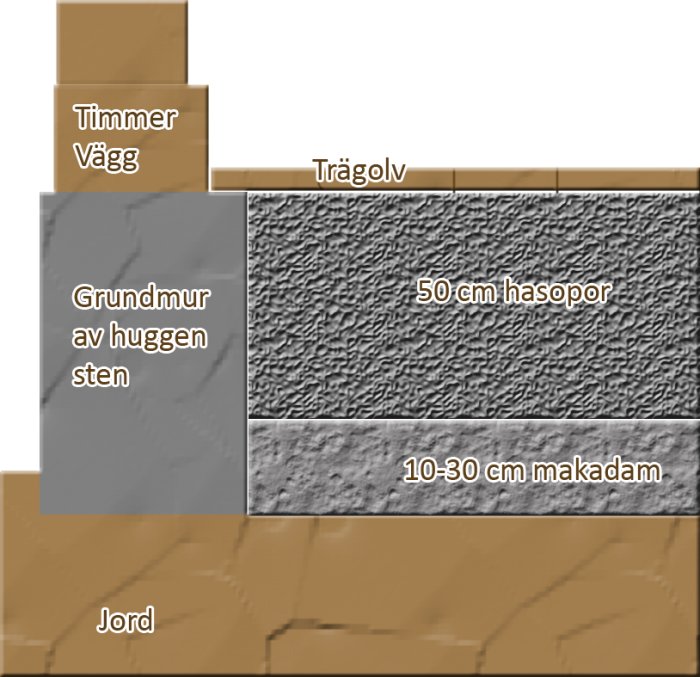
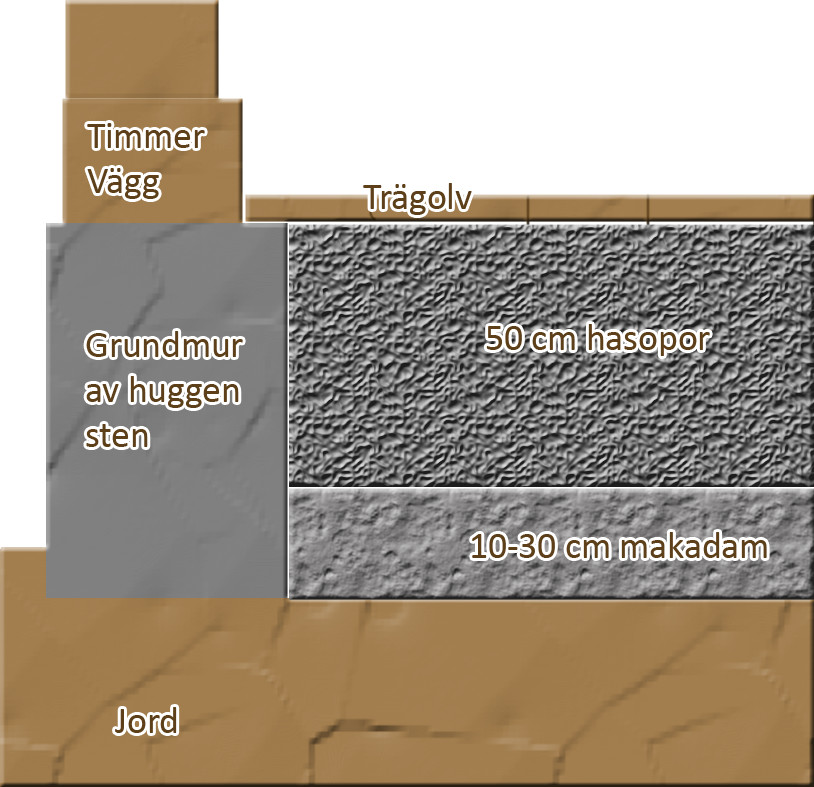
I am renovating a log house with a crawl space foundation and considering the best solution. At first, I was thinking of just renovating the joist area and insulating it, but I've come across people who have used Hasopor to fill the foundation. As I understand, you can do it like this (see image):
But I also wonder what happens to ground moisture in such a construction?
The biggest advantage is that you avoid building joist areas throughout the house. The material foam glass is also durable and nothing for mice to build in.
I also wonder if I need to remove the current load-bearing beams to reduce the risk of moisture problems? And I wonder if it's even possible to remove them considering the construction. They are recessed into the walls of the house, which might indicate that they hold the house together in some way. My feeling is that they should remain. I still need something to nail the floors into, right?
Another concern is also radon. As I understand it, radon can "come and go" in periods. In this way, it seems safest to prevent it with a radon barrier at the base. What should be used for this? Does regular building paste work, or must it be a special product? Anyone have any ideas?
How is it usually done? Why are there radon membranes if regular construction plastic works? Opinions on the rest of the foundation layout are gratefully received.
Another consideration is also radon. As I understand it, radon can "come and go" in periods. In this way, it seems safest to prevent with a radon barrier at the bottom of the foundation. What should one use for this? Does regular construction plastic work, or does it have to be a special product? Anyone have any ideas?
Finally, it should be mentioned that construction plastic is not fully airtight but more to be seen as a vapor barrier. If you want a tighter layer in a crawl space that corresponds to a moisture barrier and gas barrier, radon mat must be installed. Also read about radon in crawl spaces. However, purchasing a mat against radon, which can consist of aluminum foil double-sided laminated with construction plastic-like layers, involves entirely different costs.
The cost is 600 SEK/cubic meter if you order in bulk. The price includes shipping and excludes VAT, and applies to large orders in the range of 30-40 cubic meters. For smaller quantities, it will naturally be more expensive. Call them and ask.
How do people usually do it? Why are radon mats available if regular construction plastic works? Feedback on the rest of the foundation setup is gratefully received.
If you want to handle the issue of moisture in the crawl space, you usually lay down construction plastic.
If you have major problems with radon (do you have any problems at all with radon?) it might be worth considering a radon mat, but that seems like a completely different project than what you're working on. Additionally, if you use construction plastic and ensure it is SEALED at the joints and against walls, etc., you will definitely reduce radon levels enough that you don't need to consider an expensive radon mat. IF it turns out this cheap measure isn't enough, then prepare for a small radon fan by laying a drainage pipe under the plastic where you can create a slight negative pressure with a fan. Then you've got yourself a radon-secured solution cheaply.
...but, before you even consider radon - do a measurement. If you don't have radon, go back to sleep and do a new measurement in a few years.
Exactly, no, I don't even know if I have radon but I had the idea that the problems could occur in flare-ups. I don't know if it's something I've just dreamed about??
How do I make it airtight in an old crawl space with cut stone? Feels impossible. Partly because of all the uneven stones and then around the entire chimney base too.... But otherwise a good tip to lay drainage pipes as a backup so to speak.
I haven't found any prices on radonduk, how much does it cost?
I think the best method, which I have done a few times, is to cast a new slab. Excavate to a suitable depth. 20cm of macadam, leveled with a laser. Foam insulation of any thickness with durable plastic in between. Against the foundation wall and chimney base, insulate with lecakulor. Then pour a slab about 10cm thick.
This way, you have an insulated ground-level slab in an old house. No mice will get in, and you can have underfloor heating. It's a proven good construction. If there's a risk of radon, you can secure it with radon pipes in the macadam. You don't have to worry about joists or trossbotten getting mold growth.
If you're worried that the walls might get pushed out if you remove the joists, you can drill down heavy-duty angle irons into the concrete, which you can attach to the log wall.
I see the advantages of the foam plastic slab, but I am more curious about the Hasopor method. Hasopor, which is made from recycled glass, is supposed to save about 40% of the total energy in production compared to a foam plastic slab. Hasopor also has an almost infinite lifespan. Underfloor heating can be placed directly on the Hasopor, which we will only do in the bathroom and hall. It essentially becomes similar to a slab but without concrete.
I don't know how to handle the waterproofing layer. Building plastic at the base stops some ground moisture from seeping up, but what happens underneath the plastic? Could there not be other problems with that? Does it matter if the ground moisture rises as it wants? Here I need your thoughts to help!
How long does the foam plastic last? How do you replace it when it becomes unusable? How does the cost compare? The Hasopor I am ordering will be about 30 cubic meters, i.e., 22,500 SEK including VAT and shipping.
I guess that material costs, crushed stone, foam, Leca balls, and concrete are around 600-750kr/sqm. Then there's the labor cost, but maybe you'll do it yourself.
Regarding how long foam will last, you probably don't need to worry about that during your lifetime.
I would say no, you won't encounter other problems when using plastic in the foundation. As long as there's no biodegradable material underneath. Why would you want ground moisture to enter the living area?
Vi vill skicka notiser för ämnen du bevakar och händelser som berör dig.