I have a question about the possibility of attaching fiberglass to the ceiling without drilling.
I live in an apartment where one of the rooms is to be turned into a music studio. As a result, the room needs to be acoustically treated. One of the steps is to mount absorbing material in the front part of the ceiling, 30 cm deep. This would not have been a problem if I could drill into the ceiling, but I am not allowed to do that.
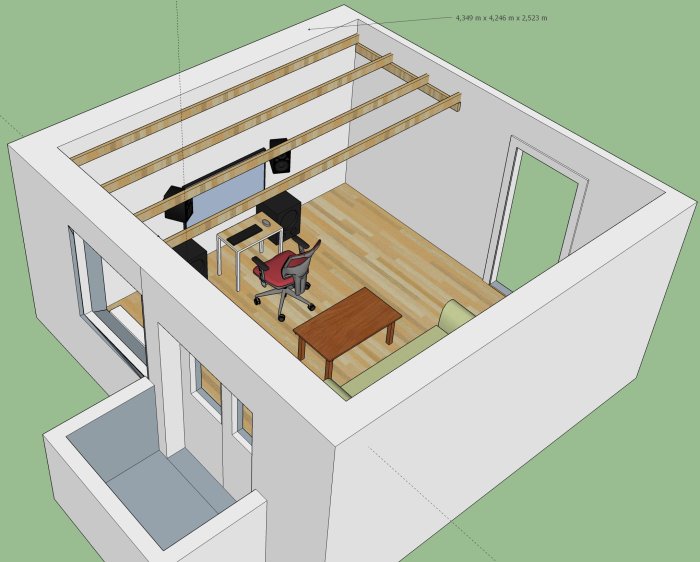
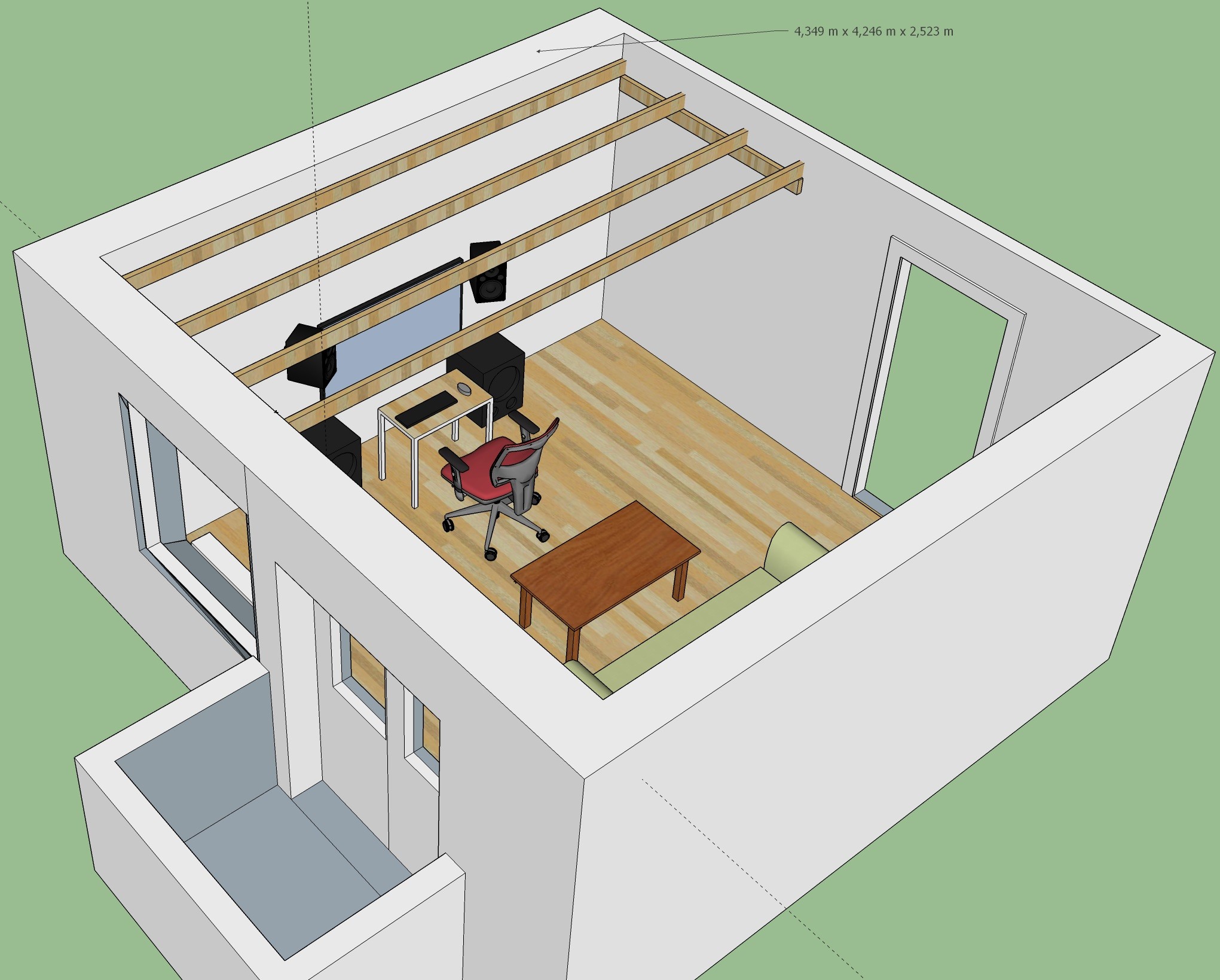
Can this be solved by attaching a batten to the wall and then laying cross battens on it? See image:
Do you think this would hold? According to the acoustician I have been in contact with, the fiberglass plus battens will weigh around 10 kg per square meter. The width of the room is 4.246 meters.
If this won’t work, is there any other way to install this "ceiling" without drilling into the actual ceiling? I can drill into the walls as much as I want.
If you place the c/c 600 studs in the other direction, you can add a stiffening plywood as a stopper on the outermost bearer or alternatively a strong stud there considering the span.
Thanks for the reply! What do you mean, Björn? I'm not quite savvy with carpentry terminology. Do you mean that you have a stronger beam on the outside between the walls and then attach the beams to the front wall and to the strong beam?
Exactly, in this way only one beam needs to be sized for the span of +4000 mm. The most convenient and neatest way is probably to build in the following order:
Frame it, insulate, apply fabric, and then finish with a painted divider (MDF or Plyfa) which also serves as stiffening for the load-bearing beam. Before you put the divider in place, you can use a prop as support.
To remove as much disturbing noise as possible, you build a new room within the room, think box, self-contained, only in contact with the floor, which will also function as a resonance box.
If you don't want angry neighbors all the time, I recommend not attaching studs to the existing ceiling or wall!
Build a self-contained box that you sit in, it costs but works better.
Hello again!
Pagno: I just want to treat the acoustics. The sound transmission itself is already okay as it is. But thanks for the tip!
Björn: What do you mean by an off switch? Where is it situated in the construction? Also, what do you think I need for a load-bearing beam? Dimensions?
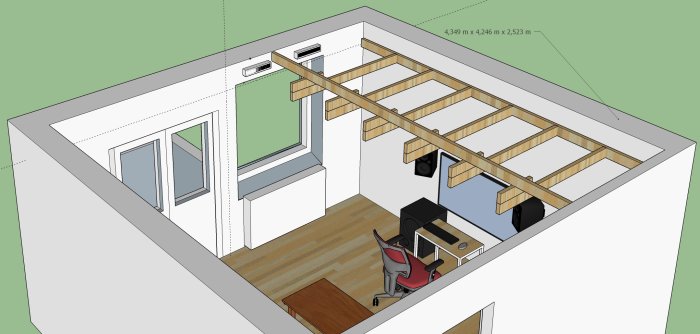
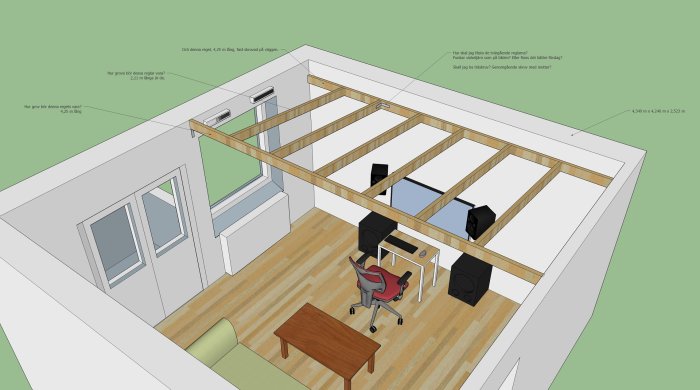
However, there is a window on the other side which means a beam spanning between the side walls cannot be attached. Is it possible to attach the load-bearing beam above the window and then hang the beams below it? Something like this: (The white boxes are ventilation)
It can probably be solved in a more efficient way but this is what I came up with.
What I'm wondering is whether the studs above the window have the same strength since they don't go down to the floor but rest on the window, so to speak. Do they support a beam across the room? And is it possible to attach studs under the crossbeam? (The suggestion in the image can certainly be improved)
It's guaranteed to be fine, I'm now referring to a typical support structure for ceiling tiles. They just screw it into the wall with small screws, like 30mm long, then we electricians come and place heavy fixtures and other stuff. I think you can relax
Ok, more questions. If I am going to have a beam across the room 4.25 meters long, how thick should it be to be stable? 2x6? 2x7? 2x8? Are there even joists 4.25 meters long? Or do I need to splice two pieces together then? How do I make it hold in that case? How should I attach the joists between the beams? With some angle brackets? Should I use wood screws or through bolts with nuts? What holds best?