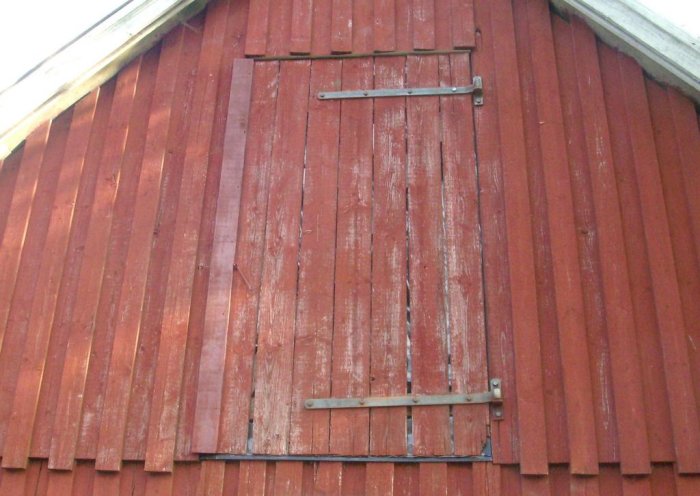
This is what it looks like in my stable:
[image]
'[image]
It's a simple outward-opening door/hatch, mounted on regular gate hinges. It's level with the outer panel, and not a drop of rainwater has come in since it was installed. The "lock," called a varvel in the boating world, is a very clever and simple construction that used to be found on all boats.
PS
Before the door was there, the wasps built this enormous nest:
[image]
Some of the wasps had apparently moved out, because there were some small nests around.
Thanks for the pictures! It doesn't need to be complicated, just got the idea that it might rain/drip in.
btw, not so pleasant to stick your head in there on a summer day
Thanks for the pictures! It doesn't have to be that advanced, I just thought it might rain/drip in.
I imagine that since the door is flush with the exterior panel, the 28 mm air gap is there behind, so a little rain won't get that far. Additionally, we have the hatch facing NE, and that's not where the rain showers usually come from.
Byggare_Bubbis said:
btw, not so pleasant to stick your head in there on a summer day
We exterminated them before we installed the door. I don't like wasps since I got an anaphylactic shock on Gotland half a decade ago
But by closing it off, we unfortunately also closed the door for some barn swallows, who had built a nest and lived deep in the attic. I do like swallows a lot, even if they make a mess
I imagine that since the door is flush with the outer panel, there's the 28 mm air gap behind it, so a little rain doesn't get that far. Additionally, we have the hatch facing NE, and that's not typically where the rain showers come from.
We eliminated them before putting up the door. I don't like wasps since I had an anaphylactic shock in Gotland half a decade ago
But by closing it off, we unfortunately also shut the door for a few barn swallows that had built a nest and lived deep in the attic. I like swallows a lot, even if they make quite a mess
Then it's smart to have, like you have, a "door frame" for extra support and a bit of rain protection.
then it's smart to have as you do an "door frame" extra support and some rain protection
Yes, it's good to have something to close against.
But as the keen-eyed observer can see, the door seems a bit crooked.
That's because when it has been left open, and blown against the fascia board, the upper hinge has bent a bit.
Easy to fix, just take it off and put it on the vise...
Yes, it's good to have something to close against.
But as the clear-eyed can see, the door seems to be a bit crooked.
This is because when it has been left open and blown up against the wind board, the upper hinge has bent a little.
Easy to fix as long as you remove it and put it on the vise...
The hinges are probably these:
[bild]
[link]
you can also use a diagonal brace but it's a bit advanced for a hatch that isn't opened often.
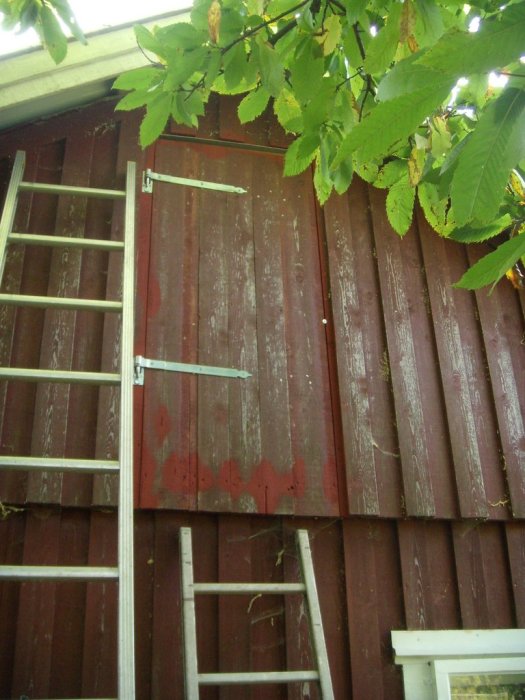
Made an external attic hatch. Seems to work excellently.
The painting leaves something to be desired and will be addressed in due time, but it’s not at the top of the priority list...
If you paint the hinges the same color as the facade, they become less visible.
What is crucial for the construction, as already partially mentioned, is whether the hatch is situated in the prevailing wind direction or not.
If heavy rain is common, the construction must withstand it, i.e., not let water into the attic. Also, note that the wind pushes water everywhere if the hatch is on the windward side of the house.
This hatch is indeed northwest, but relatively sheltered by the chestnut tree.
I have another such loft door that is unsheltered in the southwest, and there I have had to place sheet metal both above and below the door, and staple building plastic on the inside that extends all the way to the door frame and is clamped there, + a cover/moulding board over the joint between the door and the facade on the "opening side" (not the hinge side) + a sealing strip under the cover board as neither it nor the facade board is completely straight. (Okay, the painting might need some refreshing here too...)
I have a similar construction project ahead of me at the ridge of my shed. My father-in-law insists that the hinges should be on top whereas I want them on the left, but he gets nearly angry and firmly says they should be on top when it comes up. It's my shed, so I decide, but my wifeyn trusts her dad's word blindly...
Is there any advantage to having the hinges on top? I still have no idea how he plans to keep the hatch open with the hinges on top.
Sounds really crazy with a hatch hanging at the top.
Right?? On their own house, it hangs at the top, and I get scared every time I see the guy putting up a bracket to hold the hatch up. It's heavy as hell too, probably 50x100cm.
I have a large hatch/door on the garage gable facing southwest. That is the side where most of the driving rain pours every year. The door has regular facade paneling with large gaps between the boards in places. Initially, there were no metal flashing either above or below.
When I started thinking a few years ago about insulating the space and using it as a shed, I noticed the floorboards inside the door were a bit worn and discolored by water leakage. The space had previously been used as a hayloft.
I temporarily installed construction plastic on the inside of the door to seal the gaps without making the door heavier than it already is. Then a metal flashing was nailed up at the top of the door and one at the bottom to lead water away from the facade. After that, it was watertight. I also applied a layer of raw linseed oil on the floorboards inside the door in the area that was discolored. It's now noticeably darker than the rest of the floor, but that's typical with raw linseed oil. It darkens and can get discolored and sometimes develop mold spots too. Here, it's evenly dark, so I think it's just discoloration. Anyway, I haven't seen any signs of water leakage since.
So, my conclusion is that if a large hatch/door (about 0.8 x 1.9 m), obviously hinged on the side, exposed to frequent heavy driving rain and snow/slushy snow can keep out water with these measures, then any attic hatches built/sealed/protected in the same way can handle it. Regardless of direction or location in the country.
I can add that the door is screwed into place with long farmer screws. This is to ensure the door is always closed and doesn't blow open in a storm. Additionally, it prevents any gap on the opening side that fastening with a hasp creates. (If you don't live on an old farm like we do, you can use some nicer/discreet screws , though fairly large washers are recommended for storm-proofing.)
Edit: Clarification: the screws act as a lock on the locking side. The door is hung on sturdy hinges.

KnockOnWood said:
This is what it looks like in my stable:

Byggare_Bubbis said: