
12,581 views ·
23 replies
13k views
23 replies
Exterior wall construction? Garage
Page 1 of 2

For my garage, I was thinking like this, am I on the right track or is something missing?
Lockläkt 22x45, panel 22x145, papp, regel 45x45, isolering, regel 170, isolering, förhydringspapp, osb, gips
Tried to find a blueprint or construction drawing for this particular type of wall but haven't found anyone who's seen anything similar?
This one was really good for seeing how the wall can look
http://www.moelven.com/se/Inspiration/Fasadguiden/
Lockläkt 22x45, panel 22x145, papp, regel 45x45, isolering, regel 170, isolering, förhydringspapp, osb, gips
Tried to find a blueprint or construction drawing for this particular type of wall but haven't found anyone who's seen anything similar?
This one was really good for seeing how the wall can look
http://www.moelven.com/se/Inspiration/Fasadguiden/

Correct, insulated slab and underfloor heating, I won't be building up with Leca as the foundation will be high and nice and I will never use the garage as a wash bay, so it seemed unnecessary to build up with Leca in the end.Mikael_L said:
I am no carpenter, so you'll have to explain further where it should be and what dimension.

Please fit it here.
One more question. I am also preparing the part that will be a carport with underfloor heating in case I ever want to make this into a heated part as well.
So I want to do the same setup on the outer wall so that I later within can insulate with studs and finish it off.
Uninsulated outer wall in carport section
Batten 22x45, panel 22x145, spikläkt 28x70, masonitebit, felt, stud 45x45, insulation,
But I can't leave open insulation here, so what can I finish with to get a nicer inner wall in my carport which might always be an unheated carport (unless I win the lottery)
Like this?
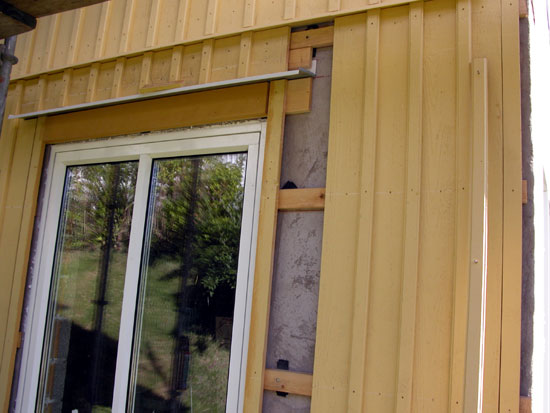
Last edited:
So you mean to panel the carport, that's what you mean by "But I can't leave open insulation here, so what can I finish with to get a nicer interior wall in my carport, which might always be an unheated carport (unless I win the lottery)"?
Not so easy to follow when I have everything clear in my own mind only.Mikael_L said:
Exactly. This part outside to the right at 7x8.5m will be a carport.
The front will be one big opening without a door, but the side and back will be panel and construction just like the rest of the building. If I want to close off this part and make it heated, it should be possible to do so.
A small floor plan.
To the left, there will be a large door about 5m wide x 3m high. To the right, there will be a large opening into the carport, just over 6.5m wide.

28x70 nail batten I now understand is completely overkill in my case.
All I need is a little air between the panel and my 45x45 stud that I will attach the panel to. So either I split something myself or buy something pre-made. What could a pre-made option be?
10mm x 20mm or something, what would that be in standard dim?
All I need is a little air between the panel and my 45x45 stud that I will attach the panel to. So either I split something myself or buy something pre-made. What could a pre-made option be?
10mm x 20mm or something, what would that be in standard dim?
I would build the walls like this:
Panel
Spikläkt 28*70
Asfaboard
Vertical studs 45x145 (or possibly 45x170) insulated in the garage uninsulated in the carport.
In the garage part, diffusion-tight plastic
In the garage part, horizontal stud 45x45 with insulation.
The electricity is run here before the walls are closed
Finally, OSB + gypsum
Panel
Spikläkt 28*70
Asfaboard
Vertical studs 45x145 (or possibly 45x170) insulated in the garage uninsulated in the carport.
In the garage part, diffusion-tight plastic
In the garage part, horizontal stud 45x45 with insulation.
The electricity is run here before the walls are closed
Finally, OSB + gypsum
If you use cross battens with 45x45 on the outside of the frame, you can go for support battens 45x25 (50x25) which tend to be cheap poor-quality wood.Suhagg said:28x70 battens I now understand are completely unnecessary in my case.
All I need is a little air between the panel and my 45x45 frame that I will attach the panel to.
So either split something myself or buy something lightweight that's already made. What could something ready-made be?
10mm x 20mm or something, what would that be in standard size?
Then you place these battens right on the horizontal 45x45 so you still have plenty to nail into.
But as I said, I would cross batten on the inside for easier electrical installation.
And then use 28x70 as battens.
Additionally, nail with a nail gun and 50-60mm nails, the caps with 75mm nails.
Thank you very much!Mikael_L said:I would build the walls like this:
Panel
Nail batten 28*70
Asfaboard
Vertical studs 45x145 (or possibly 45x170) insulated in the garage uninsulated in the carport.
In the garage section diff-tight plastic
In the garage section horizontal stud 45x45 with insulation.
The electricity is run here before the walls are closed
Finally OSB + gypsum
I'll check with the carpenter who's going to help me with framing what he recommends.
The electricity on the inside will be much easier this way instead of having to drill through a lot in the 170 frame.
Yes, the best thing is that you almost don't need to drill at all. Horizontal routing of pipes is only along the cross-battened 45x45, and vertical you press in between the plastic and the 45x45s.Suhagg said:
I think you can use Asfaboard, because it gives the carport part a cozier feel than seeing the back of the outer panel, and it can withstand wear and accidents better than paper or windbreaker. Buy a nail gun for long narrow-backed (5.7 mm, 6mm or whatever they are) staples. Fasten the asfaboard with about 30mm long staplers at 10cm intervals. It's super fast and staples are dirt cheap. I first nailed up my asfaboard with roofing nails, about 40-50 cm apart, then quickly went over with a bunch of staples.
The asfaboard also gives the carport part a bit of lateral stability, but I don't think it's enough on its own. So don't forget at least one diagonal brace in each wall of the carport, works well with 28x70 which you nail in each stud it passes.
Thanks.Mikael_L said:I would build the walls like this:
Panel
Nail battens 28*70
Asfaboard
Vertical studs 45x145 (or possibly 45x170) insulated in the garage, uninsulated in the carport.
In the garage section, vapor barrier plastic
In the garage section, horizontal stud 45x45 with insulation.
Electricity is laid here before closing the walls
Finally, OSB + gypsum
If my carpenter says the same as you, then this is officially the blueprint for a cost-effective and good garage wall.
Is a 5 - 10 mm vertical venting strip nailed to the framework something to worry about or is it overkill? So that the nail battens don't seal too well against the asfaboard, I suppose.
So to summarize and see that I'm following the order of everything.
Clapboard, Panel, Nail battens 28*70, Asfaboard (1200x2740x12), Vertical 45x170, insulation, vapor barrier plastic, horizontal 45x45, insulation, electrical wiring, OSB, gypsum.
Dumb question, but if moisture gets into the insulation between the asfaboard and the plastic, won't it come out? But maybe it's not supposed to come in either, so it's a non-issue :x
Last edited:
It diffuses out through the asfaboard.Suhagg said:
Regarding plastic in the wall, there is a general recommendation not to use plastic in unheated buildings.
So that particular aspect can certainly be debated if you're not planning to heat the garage.
But you mentioned underfloor heating, so I mentioned plastic.
I myself have built an unheated garage with plastic, that's how brave I am.

An alternative instead of plastic in the walls could be to install a so-called vapor brake, which adapts to the surrounding relative humidity. You can read more about these here, first Isover's variant http://www.isover.se/files/Isover_SE/Om_Isover/Kontakta_oss/Broschyrer_Bygg/Produktblad%20Vario.pdf, and here is Rockwool's variant http://guiden.rockwool.se/produkter/byggisolering/rocktaet-klimatmembran
Thanks. I assume the price goes up quite a bit compared to plastic.Ola78 said:
You don't happen to have any figures on what this costs?