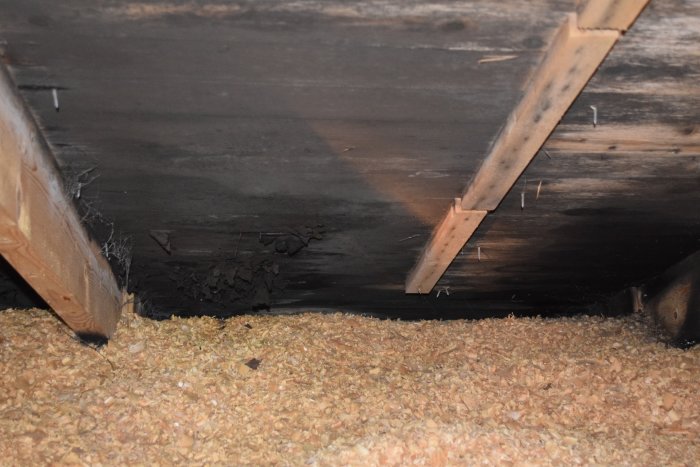
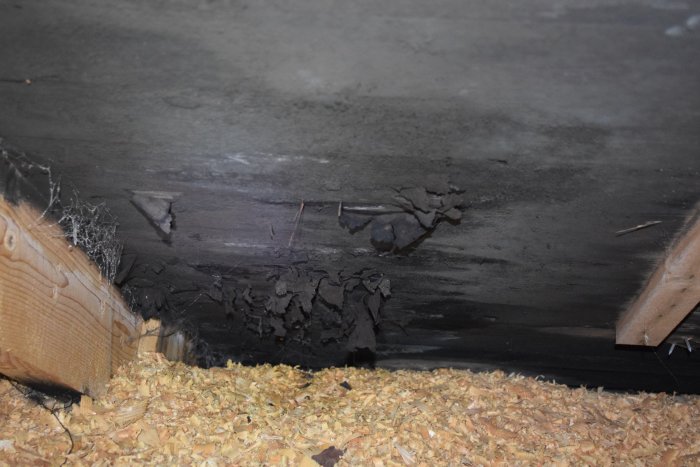
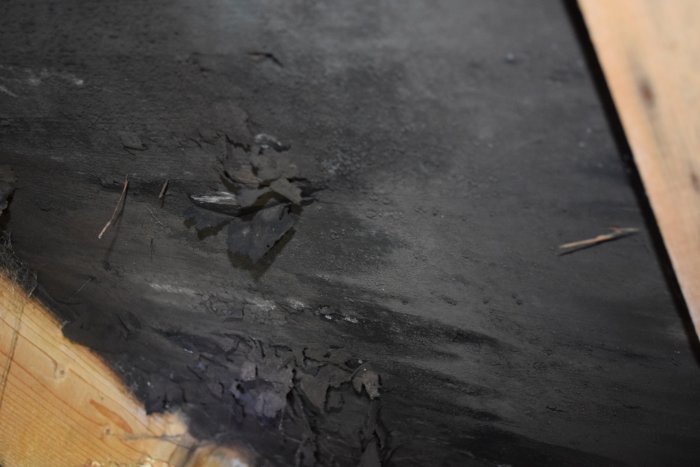
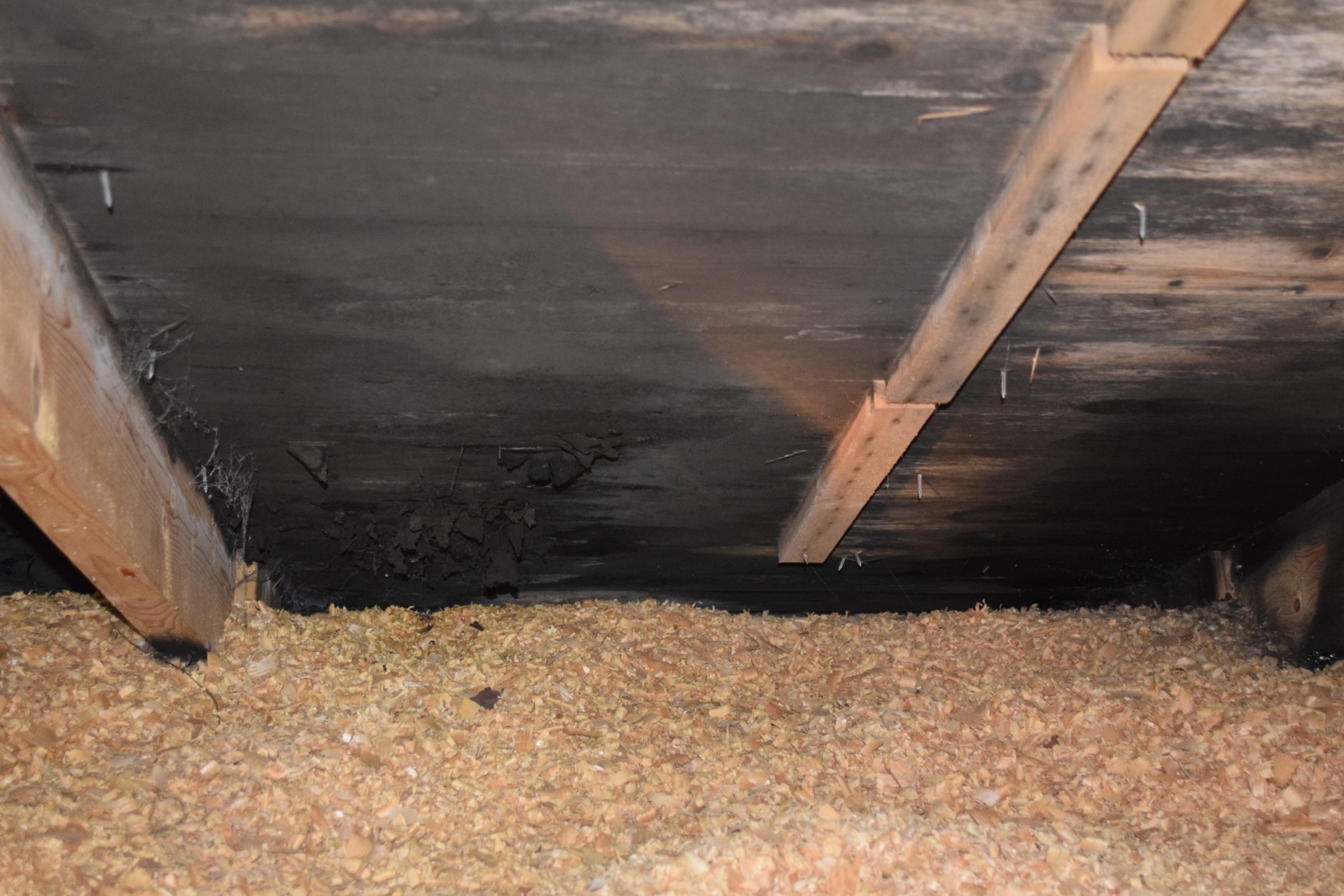
We're out searching for our first house and today we looked at a single-story house with a basement. The house is heated with district heating. Since I've read that houses converted to district heating can be vulnerable to mold in the attic due to cold chimneys and colder attics, we brought in a ladder. Oboy, so much mold! It was the worst I've seen. See attached images.
Now to the "problem". We are the only ones who have seen the house yet as we found out it would be sold by a couple of mutual friends before they had a chance to contact a realtor. So I feel there might be an opportunity for a good deal for both us and the sellers, IF one gets control over the attic.
The house was built in the early 60s, wood shavings in the joists, a couple of small vents on the gables, no ventilation at all at the eaves. I don't know if there is a vapor barrier... I understand that the roof needs to be torn up and redone, and that might be okay. But I don't want the same thing to happen to the new roof. The mold primarily grew at the eaves and maybe 1.5 meters up, almost around the entire house. The ridge looked relatively healthy.
Spontaneously, I get a feeling (but might be wrong) that the problem isn't primarily about the ventilation. (even though the ventilation is part of the problem)
Could it be that the roof is worn out, i.e., the tar paper and whether it's metal, tiles or similar, have leaked so much that it caused these damages?
There is probably no vapor barrier, so you should shovel away the wood shavings, apply vapor-tight plastic in the rafter bays, and then fill in insulation again (perhaps spray ecowool as loose-fill or similar). And if you're redoing the roof completely, consider external insulation to increase the temperature on the roof sheathing so that it doesn't condense as much.
That's how I would reason at least. With such a roof, there should be some room for negotiation...
Hello again and thank you for your responses! Sure, it could be that the damage comes from the outside.
However, several things suggest the opposite:
1. The roof (concrete tiles + felt) was redone in 1980, according to the previous inspection, and should be airtight, it's not that old.
2. The damage is not local but along more or less the entire house.
3. It was worst closest to the attic hatch.
4. If you look closely at one of the pictures, you see growth on the underside of a roof truss but not on the sides.
This is my highly amateur analysis, I should add...
Removing wood shavings, installing a vapor barrier, and adding new insulation seem wise. What do you say about the ventilation then? Open the eaves and install more gable vents, or try to limit the ventilation?
Absolutely, that's how it is. Considering how it looks, something must be done. And not doing it properly with new råspont, paper, and tiles would almost be a dereliction of duty. But I don't want to climb up to the attic in two years and find it the same way again
I didn't dare touch it, I think I would have died on the spot... All jokes aside, I had a moisture meter with me and it measured 24% in the tongue-and-groove boards, and where I measured it still looked fairly healthy.
Update:
Today the house was appraised by a realtor. He thought that "it's not that bad" and that "it hasn't grown much since the last inspection." I don't know whether to laugh or cry at this crazy industry...
I agree (as usual ) with Locke that it's probably necessary to replace everything from the sheathing and upwards.
And then I would have made the attic uninsulated, with a vapor-permeable roof membrane and foam insulation under the new tiles.
This makes it less critical to prevent moisture from the living area from reaching the attic.
Regarding the matter with foam plastic on roofs:
I'm a bit hesitant about that. I have personally renovated the roof and built a climate attic with Thermisol but I'm not quite ready to give the thumbs up yet.
Apart from the purely physical construction concerns, there is an enormous fire load to consider, and I'm actually not sure that the Thermisol roof meets the requirements to withstand an aerial fire.
In densely built (residential) areas and on multi-family houses, the Thermisol solution might not be suitable.
...but there are other ways to do it. Parallel roof?
Vi vill skicka notiser för ämnen du bevakar och händelser som berör dig.