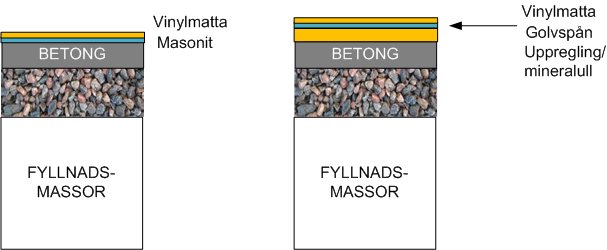
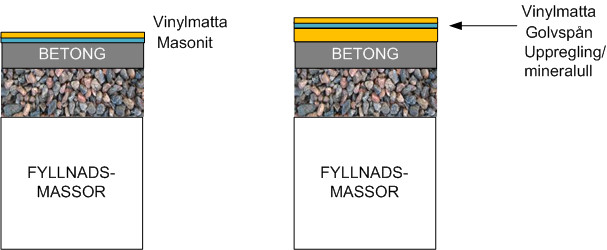
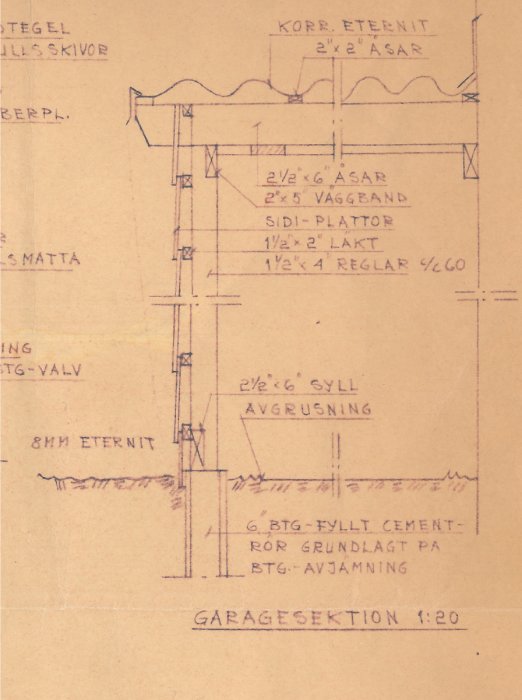
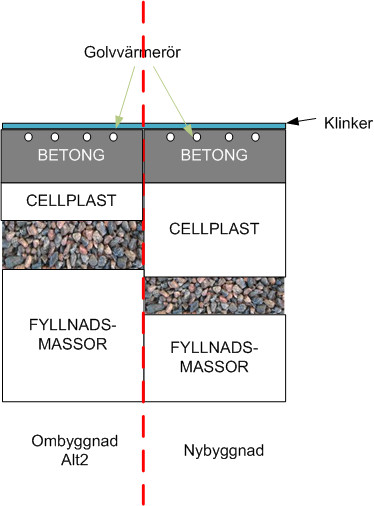
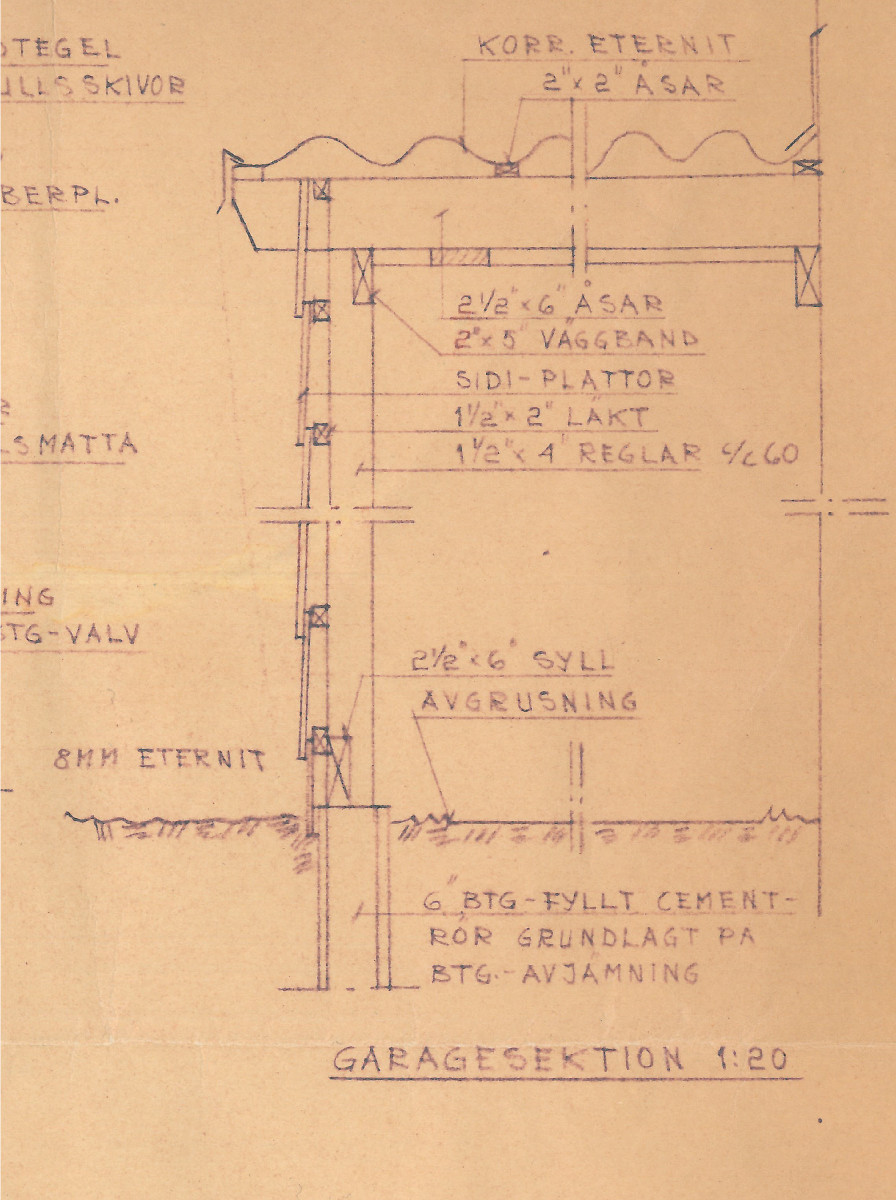
My old garage, which is now converted into living space, is a real eyesore. The garage previously had a gravel floor and is built on pillars according to the construction drawings. Directly on the gravel, a rough concrete slab has been poured. In one part of the garage, which is a hobby room, fiberboard (I think) has been laid directly on the slab and then a plastic mat on top. The rough-cast slab also slopes. In the other part, which is a hobby room and bathroom, a raised risk construction with 5-10 cm of mineral wool as insulation has been built. No moisture problems seem to exist.
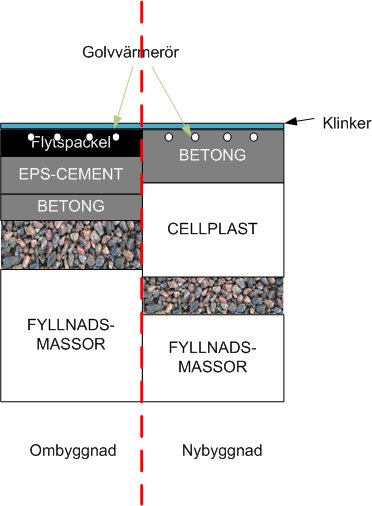
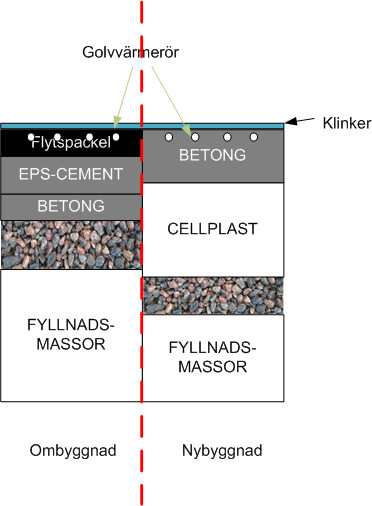
The plan is now to expand the garage sideways, and then I was thinking of building a proper ground slab with embedded underfloor heating. And then I'm considering doing something about the floor in the hobby room section as well. The rec room + bathroom I'll take care of later to optimize for ROT and because I have absolutely no desire to redo the bathroom at this point. My idea is to apply EPS cement as insulation on the uninsulated slab and then self-leveling compound to cover the underfloor heating, and then tile the whole thing so you get a continuous tiled surface.
Is this a good idea? Or will I have problems somewhere? And how much heating loss will there be, considering I expect to have a maximum of 10 cm of EPS cement? And can EPS concrete + self-leveling compound withstand driving a car onto it (the new section might function as a garage)?
Partly, the increase in energy consumption seems insignificant. Maybe at most a 10-15% increase in energy consumption for a smaller part of the house. The increased comfort is easily worth it.
What is worse is the risk of moisture damage. Probably, a professional needs to assess this.
EPS is not a problem to cast yourself. A bit "messy" with all the cell plastic balls flying around.
On the forum, there's often talk about casting with leca balls instead, where you mix a batch of concrete/cement in the mixer and pour in leca balls. Cheaper and easier to make a large volume of.
I now think that EPS is either convenient for smaller projects like bathrooms if you do it yourself, or buy it mixed from a company with the right machines for big jobs. Otherwise, I would have considered the leca model and renting a large mixer.
Keep in mind to create an expansion joint with a soft joint where the tiles meet so that it doesn't crack if they move slightly differently. EPS Cement is mixed by yourself in a 100l barrel with a drill + mixer.
Smart, I hadn't thought of that. If you use regular square tiles, it will be perfect to lay a joint there.
This new EPS concrete you mentioned also seems interesting. How much better is it compared to "regular" EPS concrete?
I have spoken with an experienced constructor about this who thinks the idea is sensible, and that a little poor insulation does not entail any significant additional costs in increased energy consumption and there should be no major risk for adverse moisture migration.
However, I have checked what EPS concrete costs and it seems to be 5 times more expensive than regular EPS. That is 5000 SEK/cbm for EPS concrete and 1000 SEK/cbm for regular EPS. At the same time, regular EPS insulates twice as well. And for the recreation room + garage section, about 5 cbm of insulation will be needed. Which means a cost difference of 20000 SEK. So I have started thinking about tearing out the weak concrete slab and casting a new one with EPS at the bottom. Since it's about 25 sqm, I suspect I could manage it over a weekend with a rented demolition machine. Since we are casting a new slab next to it anyway, it shouldn't mean that much extra work to cast a new slab in the garage as well.
The question is just how this fits with the existing construction. The constructor thought it was a good idea not to dig out more because it might affect the pillars that the garage section is constructed with. And how do you handle the 2½" x 6" sill that holds the construction together between the pillars? You don't want to cast it in, but the concrete slab will end up above the sill's level.
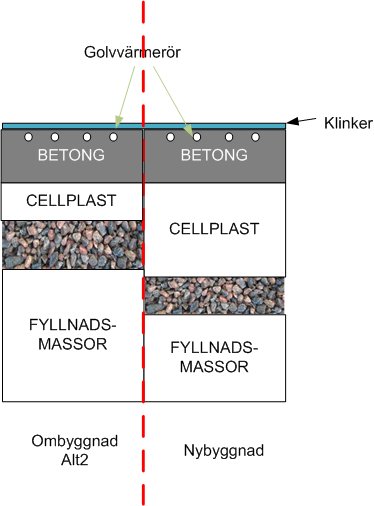
The problem has been solved by adjusting the planned floor height in the basement room down by 12.5 cm. On the rough cast concrete slab, we will lay platon (with ventilated baseboards), cellplast, routed chipboard, underfloor heating, and wood parquet. This gives us about 10 cm of cellplast.
Thinking a bit more about this and have measured more accurately... In the ugly garage section, which is 14 m2, there will be 13 cm of EPS concrete + 2 cm of screed. In total, that will be 1.8 cubic meters of EPS concrete at 5000 SEK per cubic meter. Meanwhile, isodrän costs about 2000 SEK per cubic meter. Shouldn't I then be able to lay out a 10 cm layer of isodrän panels on the existing concrete floor and then pour 3 cm of EPS cement and 2 cm of screed on top?
I see three advantages to this - isodrän has a lambda value of 0.04, which is twice as good as EPS concrete. Then it costs less than half. And it's easier to handle.
There are some problems with the latest proposal:
How thick is the concrete slab? It might be necessary to apply a leveling compound first, which would make this option more expensive and complicated.
I don't think there is any manufacturer of EPS cement that recommends laying it as a layer on top of EPS. However, spacers can be used if you want to reduce the volume of EPS cement.
In this case, the gain in insulation level is small with EPS cement on top of EPS. Maybe it's just as good with cement without EPS beads?
I don't know how coarse the slab is; right now, it's under a vinyl floor. But one of the main reasons I thought about using EPS cement is that the slab is sloping, so it's not possible to lay boards directly over the whole surface. I believe the majority of the slab is smooth. Maybe I could level a section of it?
It's possible that regular concrete could be used. Thinking about it, that's probably a pretty good idea because then I can skip the self-leveling compound as well. That is, lay out the isodrän boards, then set up a reinforcing mesh, tie the underfloor heating pipe to it, and then cast in one go.
The idea to use isodrän as core fillers is good, then I can pour EPS cement and press down as much isodrän as possible into it.
They think it's a bad idea to use Isodrän as a spacer block, as it could also damage the function of the Isodrän.
However, they consider it an OK idea to lay Isodrän on existing concrete and pour a 5 cm concrete slab on top, but they would have preferred the solution of breaking up the floor and laying Isodrän with the recommended thickness. They recommend 95 kPa Isodrän sheets.
Just need to confirm this with the designer then. Sounds like it could be a cheaper solution than the EPS concrete.
The concrete slab will be about 5 cm thick on top of the isodrän, which is actually on the low side for a concrete slab. Can I compensate for the lower thickness by increasing the amount of reinforcement in the concrete? For example, by using double reinforcement mesh.
In the long term, I can expect about 1 mm deformation of the isodrän.
Vi vill skicka notiser för ämnen du bevakar och händelser som berör dig.