
6,439 views ·
15 replies
6k views
15 replies
Drilling in the intermediate floor, OK?
I will soon start with the drainage installation to the upper floor and I'm wondering if it's ok to drill/saw 80 mm holes in the beams (45*220) without reinforcing in any way 
I will indeed reinforce the floor with more beams to get 300 mm center-to-center, but the trusses are attached/resting on some beams (1200 mm center-to-center).
Anyone with any good ideas?
I will indeed reinforce the floor with more beams to get 300 mm center-to-center, but the trusses are attached/resting on some beams (1200 mm center-to-center).
Anyone with any good ideas?
I don't think it's okay without reinforcement at all.
If I remember correctly, you should:
- Make the hole as close to the support as possible (the further from the support, the more the beam is weakened)
- Drill in the middle of the beam, in terms of height
- Reinforce with strips of heavy construction plywood that are glued and screwed on both sides of the beam and both above and below the hole. So four strips per hole.
I could very well be wrong about the details of the reinforcement, can some experienced builder confirm??
If I remember correctly, you should:
- Make the hole as close to the support as possible (the further from the support, the more the beam is weakened)
- Drill in the middle of the beam, in terms of height
- Reinforce with strips of heavy construction plywood that are glued and screwed on both sides of the beam and both above and below the hole. So four strips per hole.
I could very well be wrong about the details of the reinforcement, can some experienced builder confirm??
How many beams do you have to go through until you reach the room?
80's holes are a bit excessive without reinforcement. Can't you go through the framework/board and up to the upper floor in that way and then continue that way instead of through the flooring?
Edit* Is it a new construction or renovation?
80's holes are a bit excessive without reinforcement. Can't you go through the framework/board and up to the upper floor in that way and then continue that way instead of through the flooring?
Edit* Is it a new construction or renovation?
Danne213 said:
The bathroom on the upper floor is located right in one corner of the house, the drainage pipe comes up approximately in the middle, along the outer wall.
The house is brand new with a slab foundation (still lacks interior walls downstairs) Unfortunately, I haven't planned for any more drainage pipes besides the 110 pipe to the upper floor/ventilation (a bit late to redo now maybe).
In the houses I've built, we've always avoided making any large holes through beams, only using conduits, etc.
Whenever possible, we have routed through outer walls/voids and any existing slots.
Now, I don't know how it looks exactly at your place, but if you have pictures, it might make things a little easier.
Are the walls plastered with gypsum on the upper floor?
Whenever possible, we have routed through outer walls/voids and any existing slots.
Now, I don't know how it looks exactly at your place, but if you have pictures, it might make things a little easier.
Are the walls plastered with gypsum on the upper floor?
Exterior walls are completely out of the question (Trivselhus uses a vapor barrier right behind the drywall)Danne213 said:In the houses I've built, we've always avoided making any large holes through the beams, only conduits, etc.
As much as possible, we've routed through exterior walls/attic spaces and any ducts.
Now, I don't know how it looks in your case, but if you have pictures, it might help a bit.
Are the walls drywalled on the upper floor?
Attic space, hmm, then I would have to raise the floor in the bathroom to run the drainpipe in the eaves (requires proper insulation of the pipe)
The drainpipes are 110 and 75 mm thick
The house is 1.5 stories with a mansard roof (unfortunately no pictures right now) The upper floor is completely empty, you can see the outer roof from the lower floor, the frame erection just completed.
Last edited:

Saw on someone's website that the method was used But there it was placed both on the top and bottom, so 4 in total.
But there it was placed both on the top and bottom, so 4 in total.hmmm might be my album???
http://www.minhembio.com/speedomac/45353/
scroll down far and you'll see......
or wait maybe I can insert a picture here....
regards
snickar estwing
http://www.minhembio.com/speedomac/45353/
scroll down far and you'll see......
or wait maybe I can insert a picture here....
regards
snickar estwing
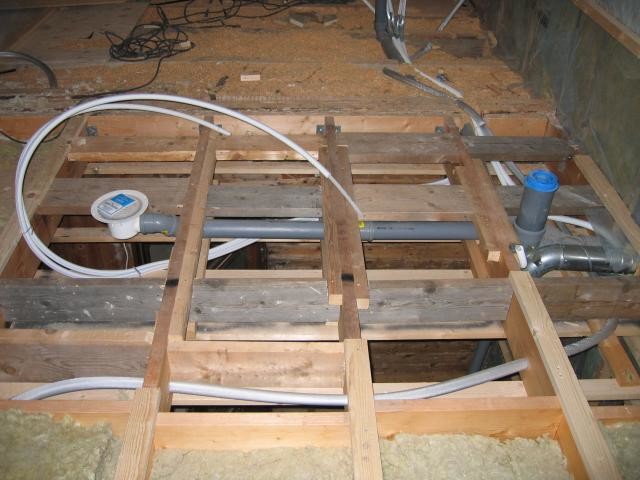
Exactly. But I've been thinking about whether I should use plywood instead. It must make an even stronger joint!
Last edited:
Mount 12mm construction plywood on each side of the 45x220 floor joists, make the plywood pieces 200x600mm. These allow you to make 100mm holes c/c in the floor joists without losing load-bearing capacity, provided you glue and nail them.
Hope you find it useful.
Hope you find it useful.
Is it better to nail or does it work just as well with screws?hempa111 said: