Hello
We have bought a house and opened up the floor to install underfloor heating.
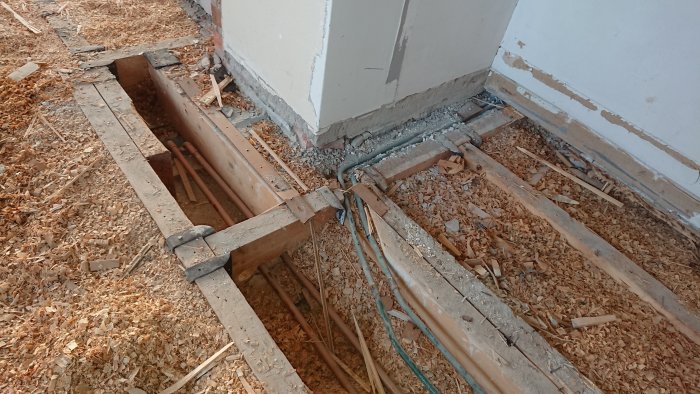
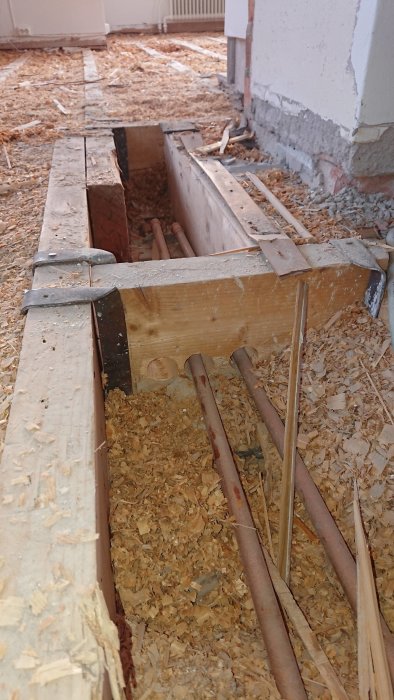
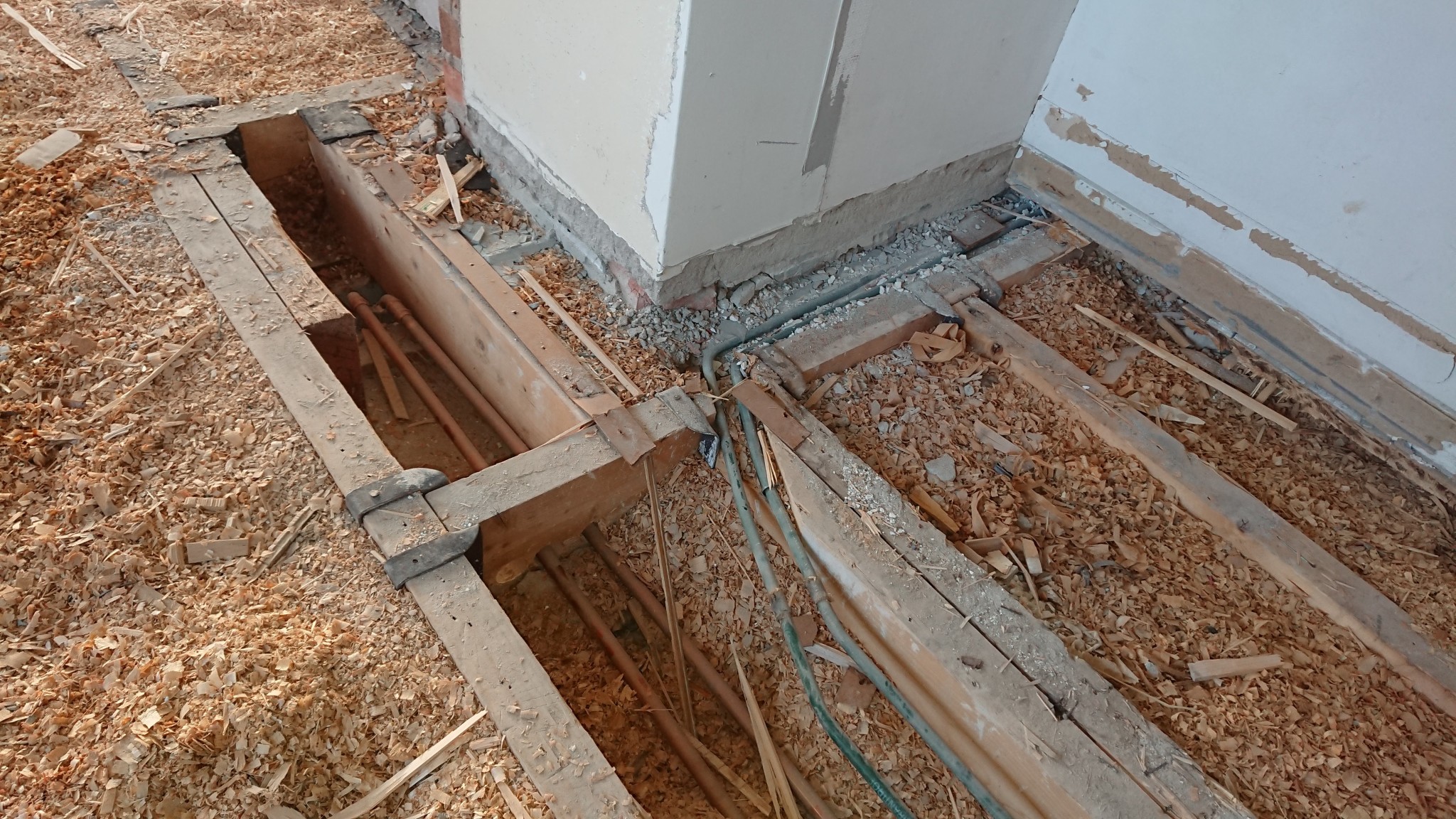
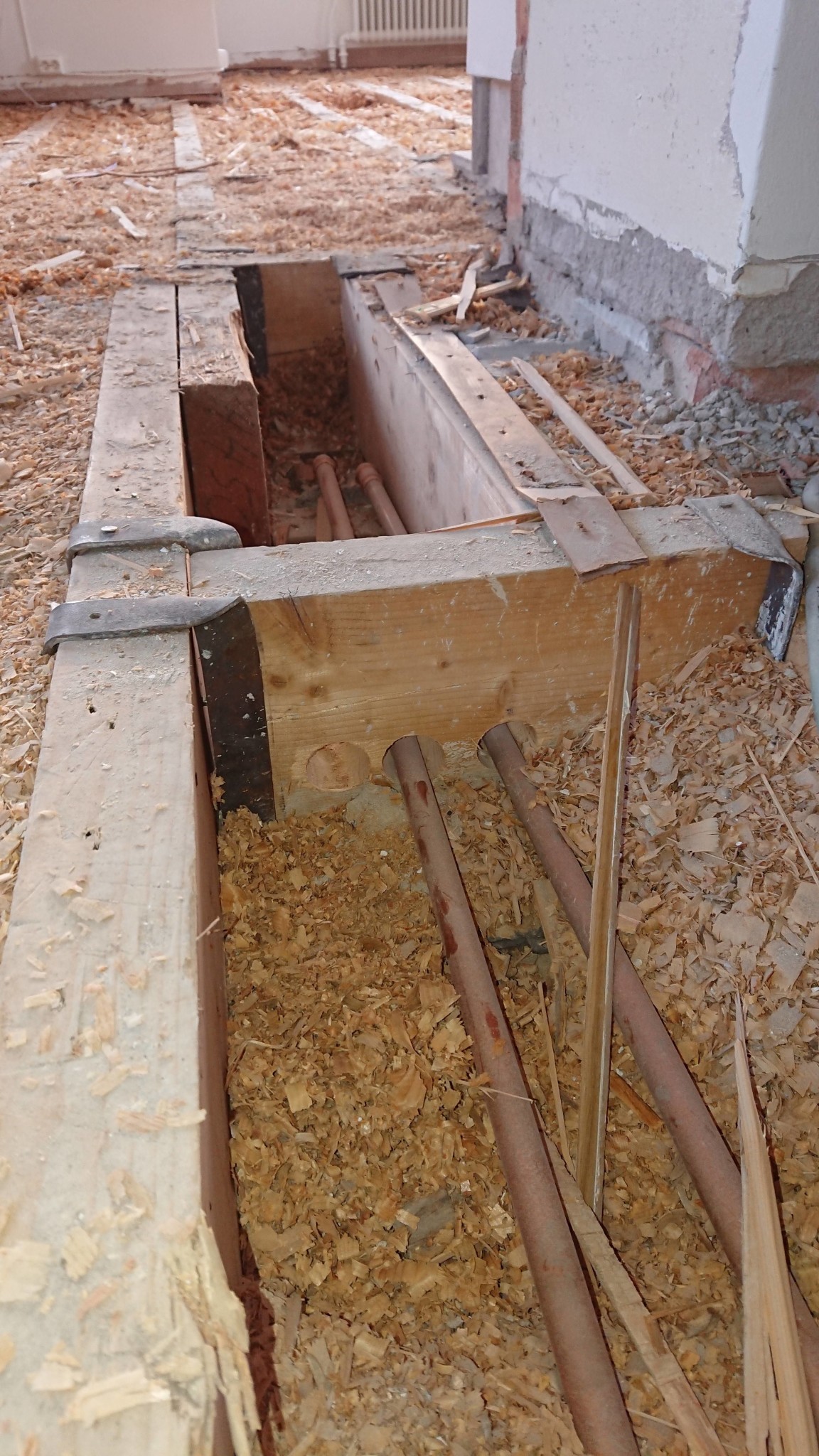
We then discovered that the previous owner drilled 3 holes in a load-bearing beam (supporting the chimney) to reroute heating pipes (supply line), see pictures
Do I need to worry that the load-bearing capacity has been compromised and how can I ensure that it was done correctly?
Grateful for tips on how to proceed.
The holes can be ignored, but having pipes without protective sleeves in this way is foolish. Cut the pipes where they start, and run pex-pipe-in-pipe hose to the destination. If there is a risk of condensation on the pipes (the pipes become cold), water can also drip from the pipes...
The holes can be ignored, but having pipes without protective pipes in this manner is foolish. Cut the pipes where they begin, run pex pipe-in-pipe hose to the destination. If there is a risk of condensation on the pipes (the pipes get cold), water can also drip from the pipes....
But it's the radiator circuit, so it is actually both perfectly fine and approved according to all regulations.
RiR is not a requirement for heating, so why recommend it, it will mean a lot of extra work and joints will be needed as well, the temperature on heating pipes will not be cooler than the surrounding temperature at any given time, so the condensation issue can probably be forgotten.
I have not said that it is forbidden to have pipes-without-pipes in a joist, I have said that it is stupid. Mainly it is because you are forced to make hidden joints.. If you read 3.2.3 in SäkerVatten 2016.1, it sounds like there should also be an inspection hatch at a hidden joint, but I am not so updated on the interpretation of this and it does not matter either. A hidden joint is a bad thing and that's why you run pipes-in-pipes. Was this answer enough for the gentlemen's objections?
I have not said that it's forbidden to have pipe-without-pipe in a joist, I have said that it's stupid. Mainly because you are forced to make hidden joints. Reading 3.2.3 in SäkerVatten 2016.1 it seems there should also be an inspection hatch for hidden joints, but I am not so updated on the interpretation of this and it doesn't matter anyway. Hidden joints are a bad thing, which is why one uses pipe-in-pipe. Was this a sufficient answer to the gentlemen's protests?
Why fix something that isn't broken?
Säker Vatten is not a requirement and regardless, it's the requirements that applied when the work was done that need to be met. Copper pipes, which are a tried and tested method, can last another 100 years (or break tomorrow with bad luck). There's no reason to rebuild all old houses just because new products and directives come out. But of course, one should follow new insights when work is carried out.
Ok, I can answer the same question once again: It is foolish to have hidden joints in a floor structure.
Yep, should we immediately rebuild 2 million apartments even though they evidently work excellent and probably will until it's time to redo everything?
Yes, right now they are not hidden, but I assume that TS plans to put the floor back. Where the pipes go down, it looks like there are two press fittings.
Yes, right now they are not hidden, but I assume the original poster plans to reinstall the floor. Where the pipes go downwards, it looks like there are two press fittings.
I wouldn't choose to have built-in press fittings myself either. But if it's a hassle to change, I wouldn't do it either....
Hello
I found an engineer who could take a look at the matter, I attach his statement here:
"Based on the existing floor joists, both secondary and primary, I see no reason to replace or modify the illuminated beam.
The floor joist provides sufficient load-bearing capacity for the purpose. The floor joist's support rests on a load-bearing wall in the basement and the primary beam's support also rests on a load-bearing basement wall."
So it seems calm, thanks for the reassuring responses in the thread
Vi vill skicka notiser för ämnen du bevakar och händelser som berör dig.




MathiasS said:
