Hello,
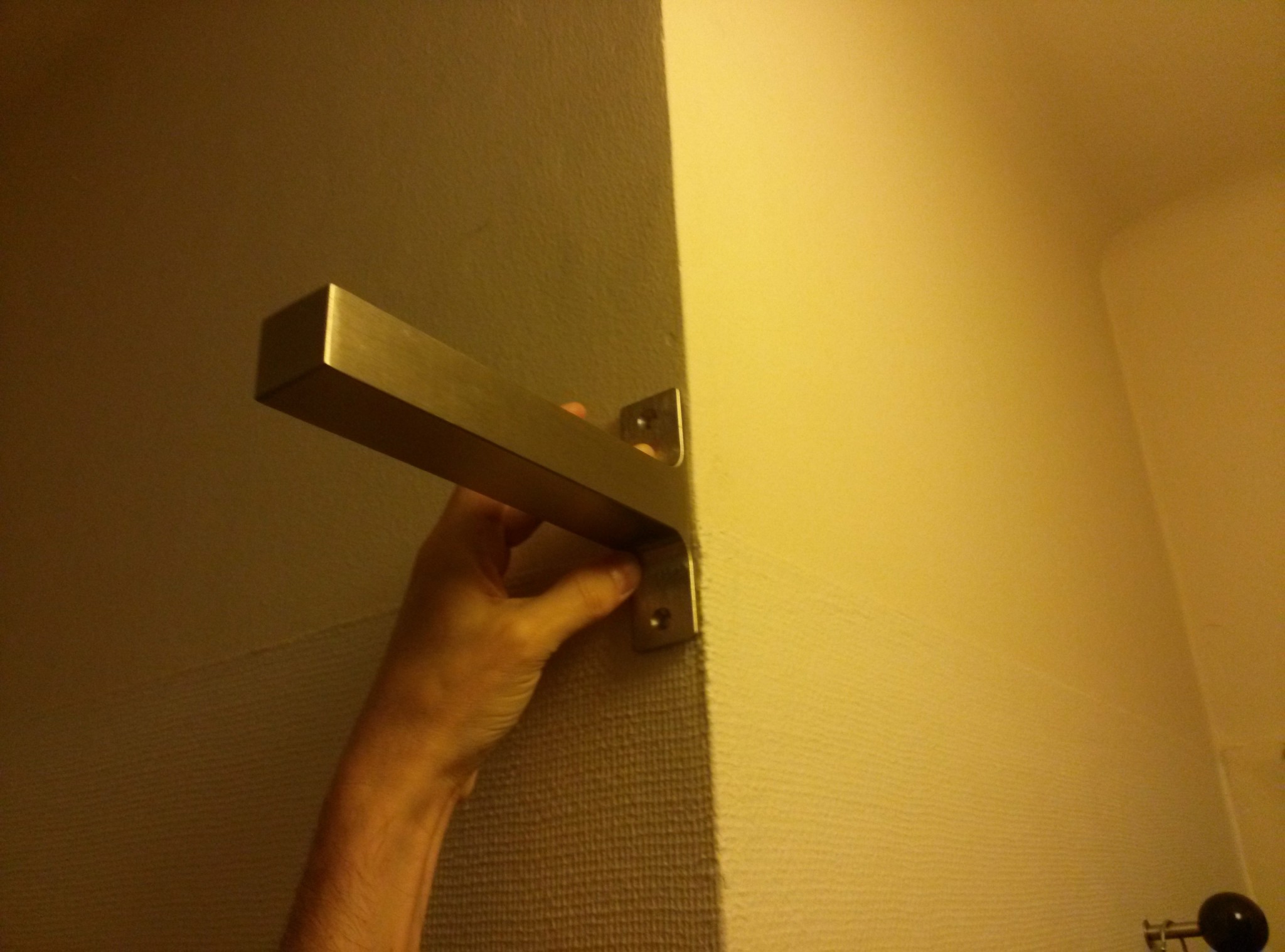
I was measuring where to place the shelf bracket when it suddenly occurred to me that I might be way too close to the corner of the concrete wall (wall against elevator shaft in a house from 1910).
1) Is the load-bearing capacity of the concrete weaker towards the corners? How far in should I place the bracket, or can I have it all the way out at the edge?
2) I assume there are reinforcing bars in the wall, does anyone know the distances they used to be set at when the house was built?
(If I can have it all the way out to the edge, the shelf will be 110 cm with a splice bracket in the middle. Books are to be placed on the shelf.)
1) Is the bearing strength of the concrete weaker towards the corners? How far in should I place the bracket, or can I have it right at the edge?
Yes, it is. The higher the load, the greater the minimum distance from the edge. Typically 50 - 100 mm, but then again, we are primarily talking about lateral forces and significantly larger loads than what that bracket is intended for. I would guess that it's perfectly fine to have it at the edge as shown in the picture.
the risk with that installation is that the wall is plastered? If it's concrete directly under the wallpaper, I don't see any problems with drilling and using plugs either.
The wall is plastered, which means that the plug is not set in concrete or masonry. What is the load on the shelf if only a few photos and small items are held by the plaster? (Although, sometimes old plaster is really bad, if you start drilling, the plaster falls off, probably due to age and too much ballast in the plaster. The easiest way is to test drill.)
I don't know how the walls are built at your place, but in my house from 1942, it's plastered brick. The plaster is in many places 2-3 centimeters thick and is about as good for fastening screws as meringue, so you have to attach everything that needs to go on the walls to the brick further in.
In a corner like yours in the picture, there is a risk that it's impossible to fasten anything other than to the plaster if it's a similar construction, in which case it won't hold. But as I said, it all depends on how your walls are built and how porous the plaster might be.
The wall is plastered, which means that the plug is not set in concrete or masonry.
Good observation! I missed the cove in the ceiling angle, which is a clear sign that the wall is plastered. Would not recommend screwing the bracket into the plaster.
Click here to reply
Vi vill skicka notiser för ämnen du bevakar och händelser som berör dig.