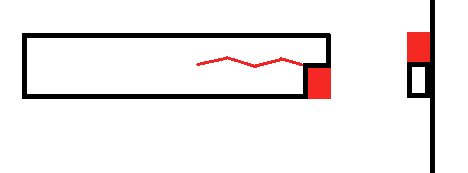
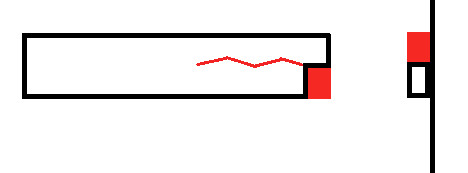
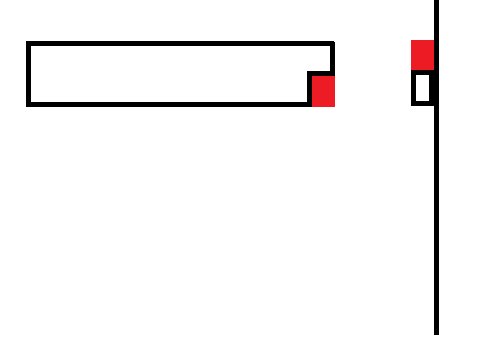
I'm considering installing a 45x145 ledger board on the facade and attaching 45x145 joists to it by making a 70mm notch in the joist and a 75mm notch in the ledger board. Will this affect the load-bearing capacity of the joists or the ledger board? The idea is then to screw the joists together at the notches with a total of 4 screws to ensure support everywhere.
Load-bearing capacity is significantly impaired
Use joist hanger
I'm not so sure about that.
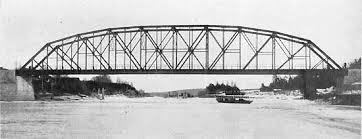
The load-bearing capacity of the beam is essentially determined by the cross-section in the middle. The support points are not stressed in this way. That is why steel bridges often have the highest truss height in the middle, and almost none at the end: https://encrypted-tbn0.gstatic.com/images?q=tbn:ANd9GcThYooTB-45Fsf96HzOQtXrixvaXvCnkqYVVg&usqp=CAU
One must ensure, however, that the beam does not crack beyond the notch. This can be achieved with a vertical screw joint through the beam near the end.
As for the load-bearing beam, notching works excellently if the attachment screws in the wall are located right at the notch connection.
An arch bridge is based on the same principle as a truss bridge and can be calculated in exactly the same way.
It should be exactly the same principle. The only difference is whether the force is compressive or tensile. Here is a good example. https://images.app.goo.gl/xiqvEM79s9rRqu7o8
How about screw-gluing plywood rectangles at the ends?
But that is an arch bridge. It is based on a different principle than trusses...
But the principle you mentioned is clearly visible here:
[image]
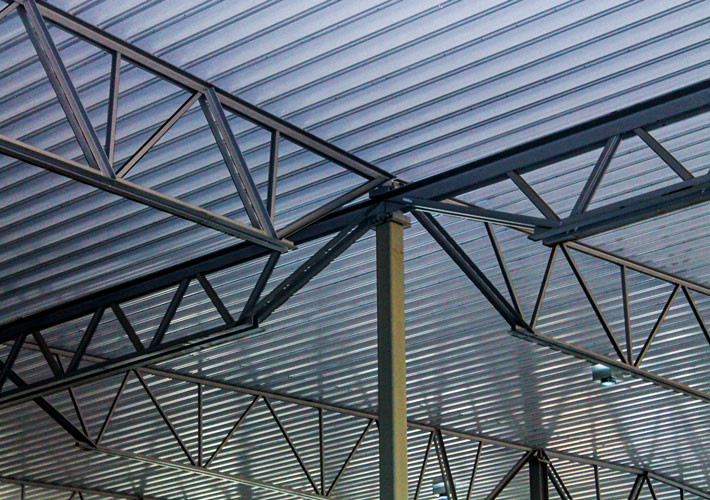
Thank you, that was the image I was looking for. Steel bridges exist with different principles. The image I linked to is a self-supporting arch (vault) and the bridge hangs in rods. Another principle is the truss bridge:
The highest truss height is where the load is greatest.
To help you understand what can happen:
Since it is a wooden beam, where only the upper half carries the load, it can easily crack precisely at the pre-determined break point, which the notch constitutes. So like this, as shown by the red line.
How the crack progresses naturally depends on the fiber direction in the beam:
A bit of off-topic trivia:
We used to live on a street with identical houses, and in front of each house was a garage with a flat shed roof with sheet metal on top. The roof beams were made like in your example.
It snowed heavily one of the last winters we lived there, 2009 or 2010.
One neighbor after another was up on the roof shoveling the snow off their garage roof.
I did the same.
The next neighbor looked at us with superiority and asked what we were doing.
But the next day he was up there shoveling like crazy.
Two roof beams in his garage had cracked as I showed above.
The rest of us neighbors found it a bit humorous.
He was, after all, a professor at Chalmers in wood and steel construction technology
Shouldn't it work with a jack according to TS suggestions reinforced with a low joist hanger? At the supports, it's really only the surface that the beam rests on that's important, and it remains the same regardless of the height of the joist hanger.
Thanks, that was the image I was looking for. Steel bridges come with different principles. The image I linked is a self-supporting arch (vault) and the bridge hangs in tie rods. Another principle is the truss bridge:
[bild]
The highest truss height is where the load is greatest.
Trusses are fun, I calculated in KonstruktionB with an HP57 TI, using Cremona's force diagram https://sv.m.wikipedia.org/wiki/Cremonas_kraftplan when I attended Teknis in the early 1980s. One of the more enjoyable subjects.
It is not entirely correct to make that type of comparison. A bridge span is mostly affected by a torque that normally has its greatest value in the middle of the bridge. The arch shape reflects the value of the moment. A beam support must primarily handle shear forces that require a certain cross-sectional area. If you are meticulous, you calculate this. In the wood guide, there are tables that show the maximum shear force for different dimensions. If you have problems with height, doubling the joists can be a good solution.




harry73 said:
useless said: