I have some issues with slight sway/vibrations in the living room floor when walking with heavy steps or setting down the heels hard on the floor. You can feel it sway a bit and things rattle in cabinets such as a display cabinet that stands on the floor. Not a major problem but a bit annoying.
The room measures 7.2x4.0 m, and under the living room in the basement, there is a room with the same dimensions, 7.2*4m. The plan is to divide the room in the basement with a partition wall (built with leca) into two rooms measuring 3.7*4.0 m and 3.3*4.0 m. This would also make it possible to place a support beam in the ceiling of each room with not too long a span under the middle of the floor joists to stabilize it a bit and reduce some of the sway/vibrations in the floor above.
The ceiling height in the basement is 2150 mm, which essentially excludes glulam as a support beam. According to Moelven's design program for glulam, a glulam beam of 140*225 with a deflection of 8mm would be okay for a 3.7 m span of the beam. However, this would mean that the free height under the beam would only be about 192 cm, which feels too low. So using a HEA/HEB beam seems more realistic. I would need a bit of help with which dimension of HEA (or HEB) should be used to improve the stability of the living room floor somewhat.
Some facts
The living room joists consist of 45*195 beams, with a span of 4000 mm spaced at 500 mm centers. The floor is made of chipboard + 15 mm parquet. There are no loads on the floor joists from partition walls, roof trusses, etc., only the self-weight and live load.
The free span of the support beam (across the floor joists) would be 3.7 m and 3.3 m in the ceiling of the two basement rooms. Assuming a setup of about 15 cm on the new partition wall and in the outer walls in the basement (it should be possible to recess it into the foundation wall by about 15 cm without problem).
If calculating for the beam with the longer span of 3.7 m, what dimension of HEA or HEB is needed? Would an HEA 140 work, or might even an HEA/HEB 120 suffice?
A HEA120 is sufficient. Here's how I've calculated:
Loads from the living room: Self-weight of floor joists (assumed density 420 kg/m^3) and useful load of 2kN/m^2 (200 kg/m^2).
For safety, I've calculated as if the load-bearing beam in the room also supports the floor joists. Thus, the load-bearing beam is subjected to point loads from each floor joist. However, I consider these as distributed loads for the dimensioning of the load-bearing beam.
With this said, I find that the design line load on the load-bearing beam is approximately 8 kN/m and 6 kN/m in characteristic load.
Moment capacity: 35%
Shear capacity: 10%
Deformation: 11 mm compared with L/300 = 3700 mm/300 = 12.33 mm.
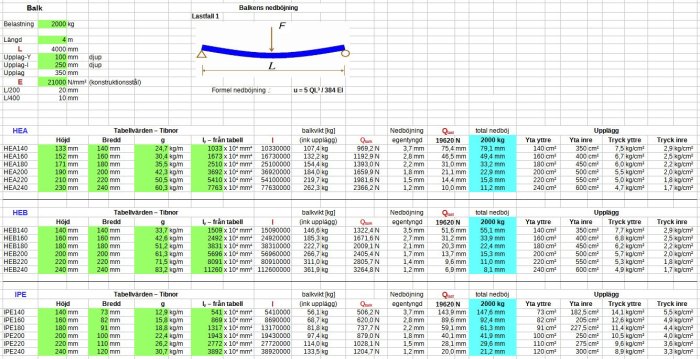
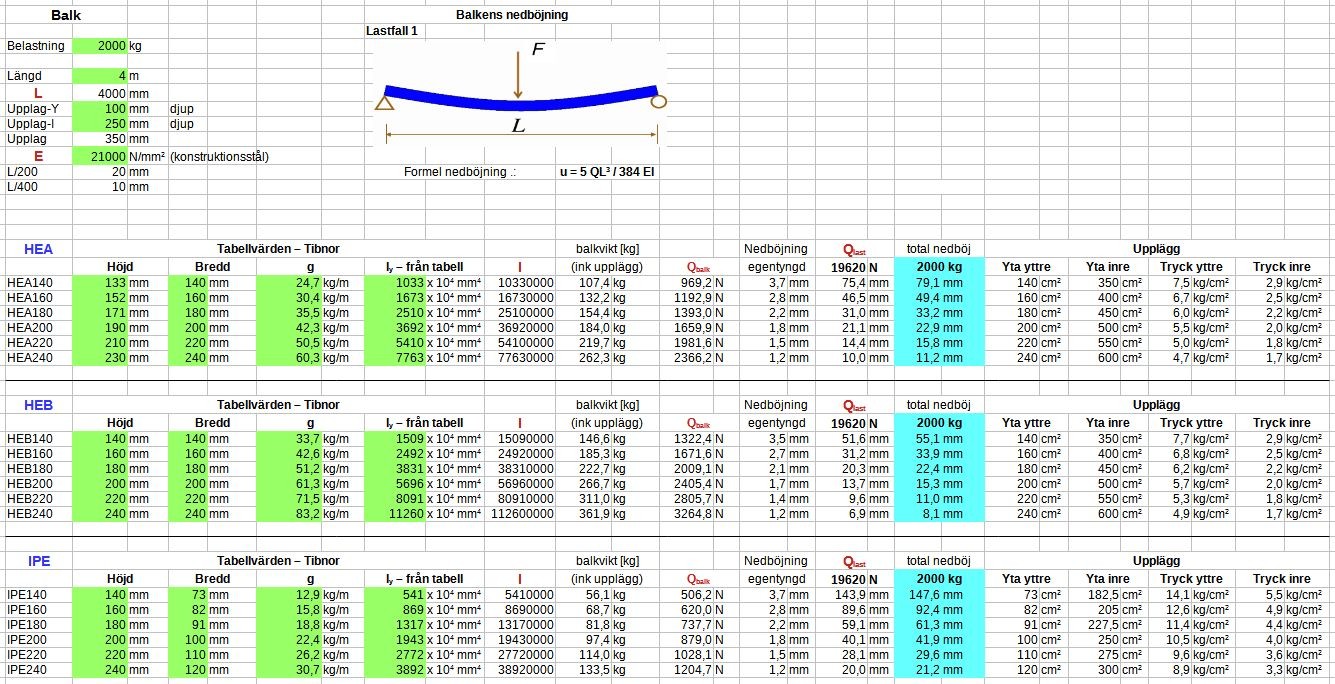
I have tried to compile information for different beams (based on my project)
(not taking responsibility if the formulas are correct - haven't had the opportunity to compare the results to "professional programs")
According to the above, I seem to start ending up at HEA 180... maybe
Can take a look at your thread later. But to start with, you have the wrong formula for deflection if you're calculating a simply supported beam with a point load in the middle (as the picture shows). For such a system, the formula is
Deflection under the point load = (F*L^3)/48*E*I
EDIT: Oh, it was big Q I see now. Never mind then.
Great!
(you're right about the image - it shows a point load )
Isn't the formula for deflection for a point load (u = P x L^3 / 192 x E x I)?
I've also wondered what would happen with an "inlay" of maybe 1-3cm in the middle of the beam?
That would theoretically create a point load in the middle of the beam.
I got hold of a designer who calculated it. With a span of 4 m, he arrived at an HEA160. Deflection under full load on the entire floor would then be 14 mm, i.e., l/350 (floor 0.5 kN/m2, live load 2.0 kN/m2).
Since the floor joists were somewhat undersized from the start (45 x 195 c/c 500), it had more to do with sway and deflection than the strength itself. And sway and deflection are also two different things, I was explained.
I chose to reduce the span for the longer beam from 3.7 m to 3.0 m through another solution in the basement, and then it worked well with HEA140 on 3.0 and 3.2 m spans. Now everything is finished, and the result has turned out great. Not a hint of sway or vibrations in the living room floor anymore.
Got hold of a designer who calculated it. With a span of 4 m, he came up with an HEA160. Deflection at full load on the entire floor then becomes 14 mm, i.e. l/350 (floor 0.5 kN/m2, useful load 2.0 kN/m2).
Since the floor beams were somewhat under-dimensioned from the start (45 x 195 c/c 500), it had more to do with sway and deflection than the strength itself. And sway and deflection are also two different things, I was explained.
I chose to reduce the span for the longer beam from 3.7 m to 3.0 m through another solution in the basement and then it was fine with HEA140 at 3.0 and 3.2 m spans. Now everything is done and the result is great. No tendency to sway or vibrations in the living room floor anymore.
Interesting!
Feels like a sound reasoning.
Started my own question (on the same subject)
[link] But got a bit "stuck."
How much is "my" beam loaded?
How much deflection can be accepted?
How much does the existing sill "help"?
Tried to compile information for different beams (based on my project)
(do not take responsibility that the formulas are correct - have not had the opportunity to compare the result against "professional programs")
[image]
According to the above, it seems I might end up with HEA 180... maybe
AAlbireo said:
Interesting!
Feels like a sound reasoning.
Started my own question (on the same subject)
[link] But got a bit "stuck."
How much is "my" beam loaded?
How much deflection can be accepted?
How much does the existing sill "help"?
Tried to compile information for different beams (based on my project)
(do not take responsibility that the formulas are correct - have not had the opportunity to compare the result against "professional programs")
[image]
According to the above, it seems I might end up with HEA 180... maybe
I am currently dimensioning a beam myself and looked at your calculations for a reference to mine. Scratched my head for a while since they were so different until I realized you set the E-module to 21 GPa. Add a zero and you'll have 210 GPa (210,000 N/mm2), meaning your deflections are 10 times too large. You probably manage with a HEA 140 (haven't calculated exactly).
(see that you are already done with the construction and that everything worked out, but for future reference)
... Add a zero and you'll end up at 210 GPa (210 000 N/mm2), meaning your deflections are 10 times too large. You might manage with an HEA 140 (I haven't calculated exactly).
Thanks for your reaction! (I will check again) - Regarding how it went.
Since last summer was what it was, the digging under the extension was postponed until next summer.
What I find hardest to assess is the load the beam is subjected to (I don't come close to the load others think it should be...)
"Spun around" to buy a beam, realized that the length of the beam doesn't matter..
Beams seem to have a normal length of 10-15m. I barely need 4.5m.
With companies that sell the desired length, there was a pretty high "cutting cost."
Buying 10m would only be marginally more expensive than the desired length, as the shipping was the same up to 15m and no cutting cost.
(but then there's the added question - What do I do with the extra beam? Considering either a crane or two ramps for a driveway. - So I will probably buy 15 meters in early spring. (however, there is a risk that the iron price will rise further... But that's another question)
Thanks for your reaction! (will check once more) - Regarding how it went. Since last summer was as it was, the excavation under the extension was postponed until next summer. What I find hardest to assess is the load the beam is subjected to (I don't come close to the load others think it should be...) "Wandered around" to buy a beam, realized that the length of the beam doesn't matter... Beams seem to have a normal length of 10-15m. I need barely 4.5m. At companies that sell the desired length, there was a fairly high "cutting cost". Buying 10m would only be marginally more expensive than the desired length, as the shipping was the same up to 15m and no cutting cost. (but then what do I do with the beam I have left over? Considering either a crane or two ramps for a driveway. - So it'll probably be 15 meters I buy later in the spring. (although there is a risk that the price of iron will rise further... But that's another question)
What I find tricky is landing on the right requirements for the beam. For my build, I've arrived at a safety factor of 2 against yield and 4.3 against fracture, as well as deflection of max 1/300 of the length which gives a deflection of max 6 mm. Hard to determine if this will be perceived as a rigid or shaky floor.
Hmm..
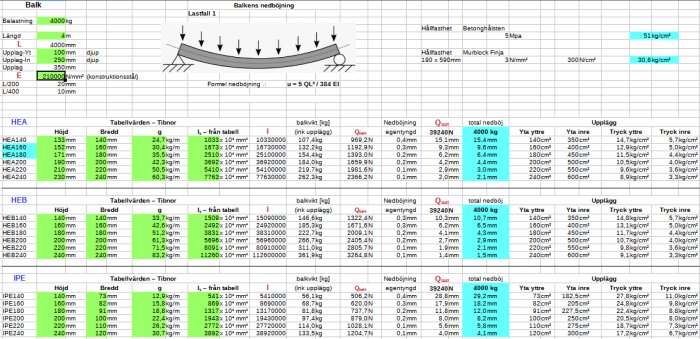
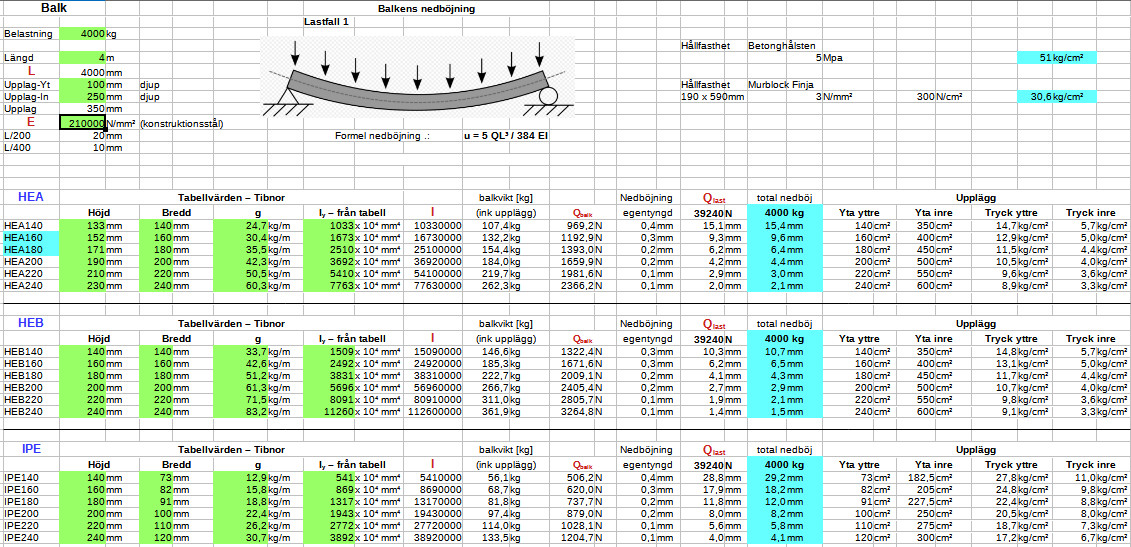
I had already changed to 210000 in my "new" template..
- According to my estimate of 2000kg in the table, I show a doubling = 4000kg
- Also changed the image to "distributed" load.
- Also added what load on the end of the beam it would be.
(To check if LECA blocks and hollow stone have a chance to support the beam - in my case ) (Hope I got it right this time...)
Vi vill skicka notiser för ämnen du bevakar och händelser som berör dig.

 )
)