Hello!
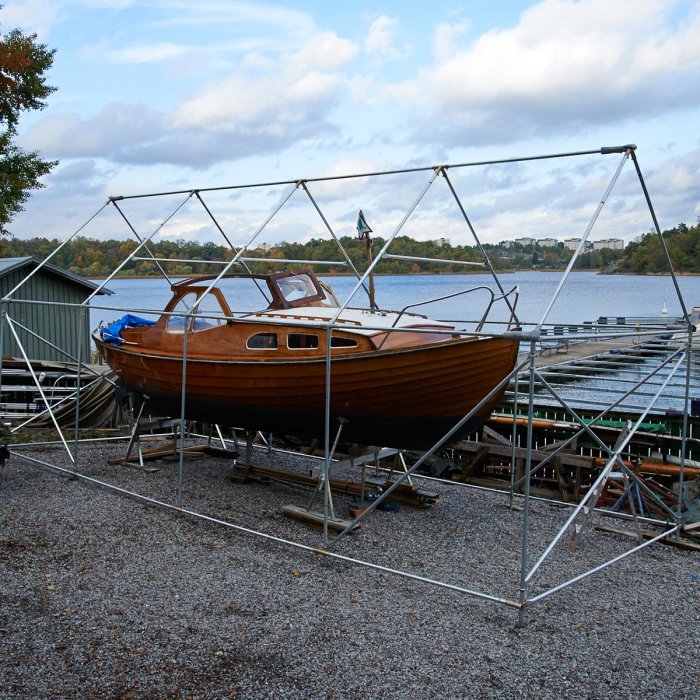
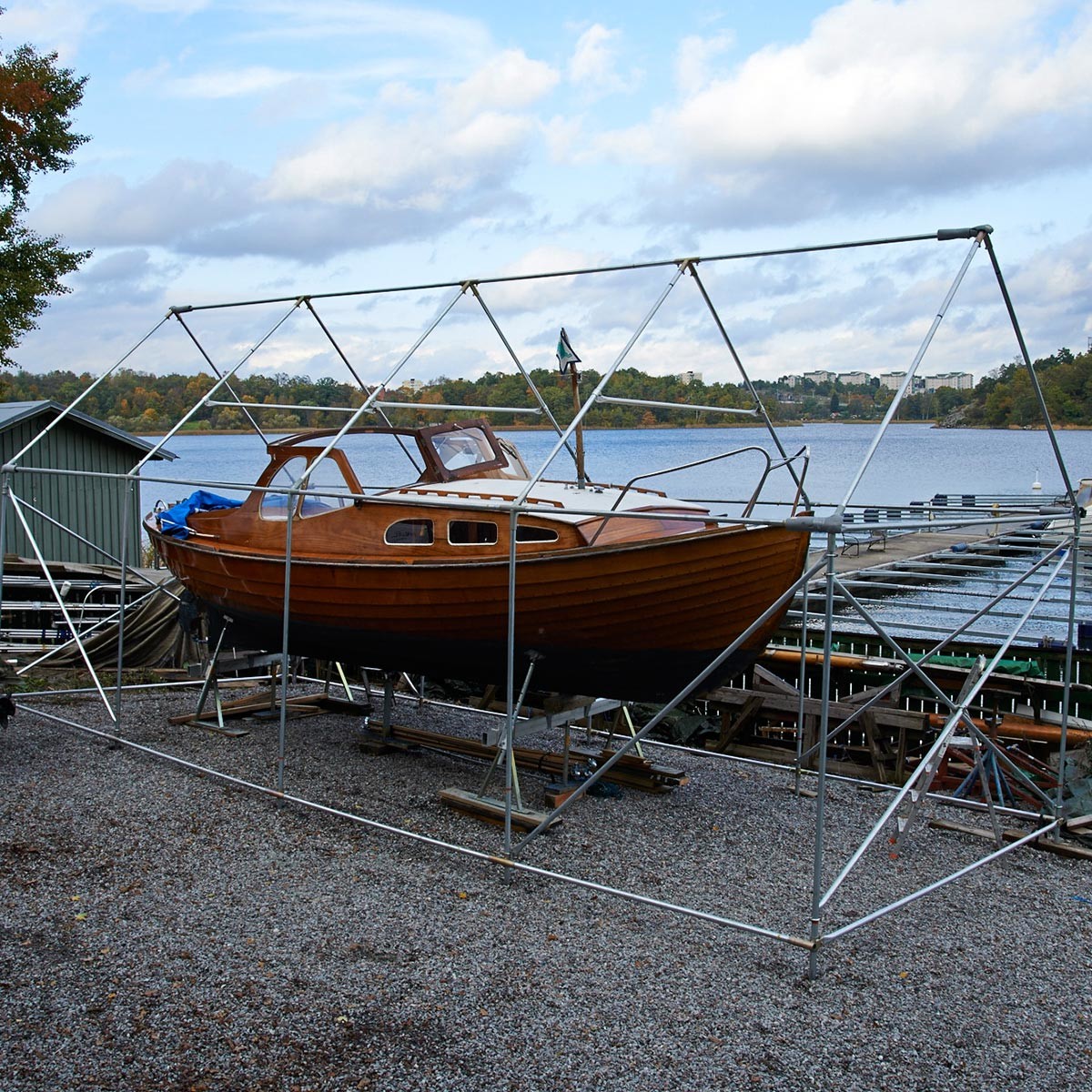
I have a boat and I would like to avoid building a cover framework every year and dragging tarps around. I have received permission from my boat club to build a tent hall. The boat is about 13.5 x 4 m and is 4 m from the ground to the highest point on the deck. There are ready-made tent halls available for purchase, for instance from Dancover, but the size I am looking at has very thick and heavy pipes for the framework.
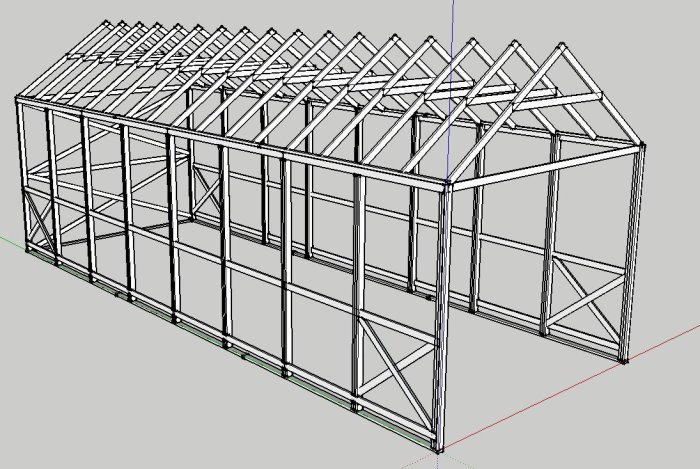
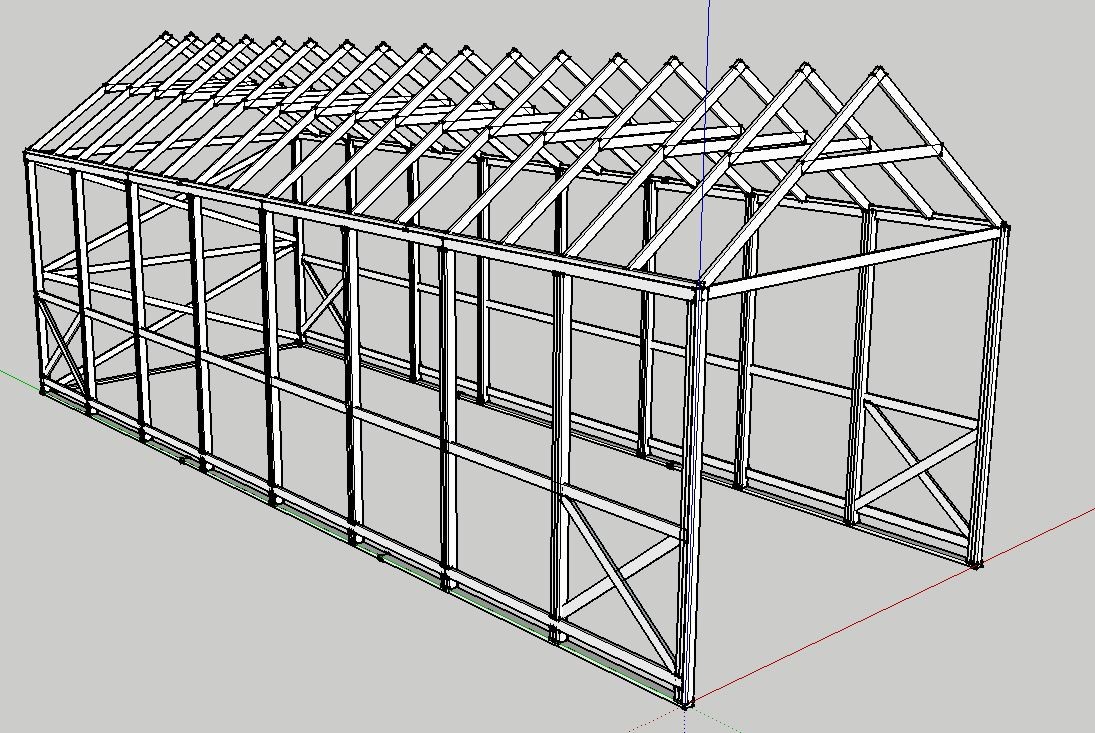
Several people at the club have built similar structures in wood, but they are often intended to be dismantled each year and are therefore a lighter construction. My idea is for the structure to withstand being up year-round, and I shouldn't have to shovel snow or the like. The hall is a total of 5m wide and 15m long, and it is 4m up to the eaves. The idea is to cover the entire structure initially with lighter sheeting. Over time, invest in PVC sheeting instead.
The tent will be located in the Stockholm area.
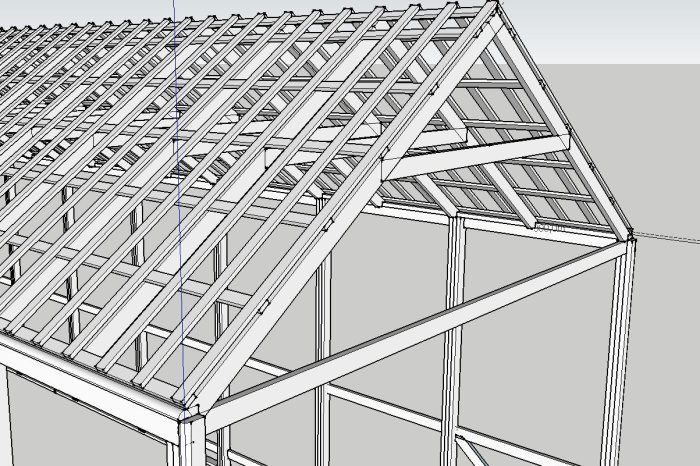
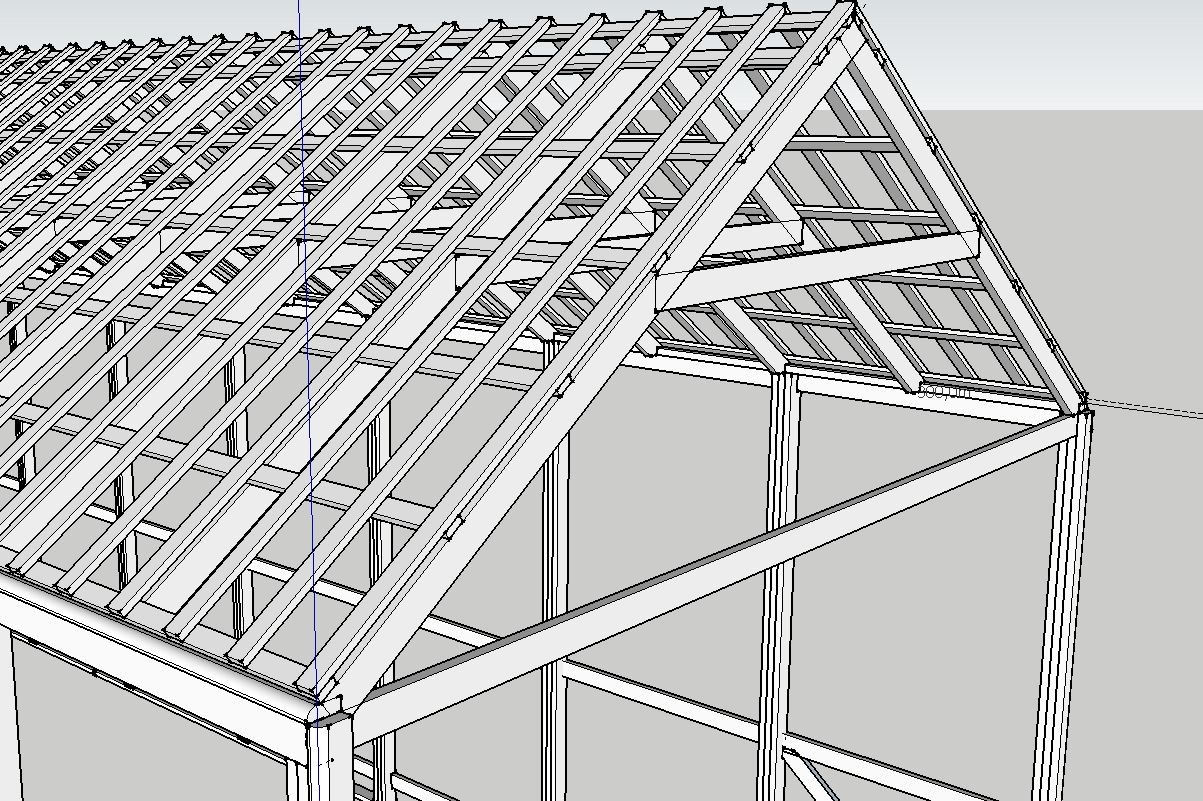
I have attached drawings and have planned the following dimensions for the timber: Roof
Yes, it's probably much easier to order from Dancover. But not as fun. Plus, I believe that a solid wooden construction will last better. But I don't want it to be "too" overbuilt. The problem is that it requires a forklift to unload the tent from the truck. The tent comes in a package weighing a total of 1800 kg. Unfortunately, we don't have a forklift at the boat club. If they need to reload in Stockholm to a crane truck, it costs an additional 5000 SEK. Plus, since there will be very thick pipes, it becomes quite heavy to build.
The price of my build depends on the quality of the tarpaulins I buy. If I buy better-quality regular tarpaulins, the price will be around 30,000 SEK. If I buy PVC, the price will be roughly the same as ordering from Dancover.
The roof slope I have planned is 35 degrees. Dancover only has 30 degrees.
Even though one can accept a fairly large deflection of the rafters' upper legs in this case, I think that 45x120 is too weak. I suggest 45x145 instead at c/c 1200 mm. How would the wall studs align in relation to the rafters when these are at 1200 mm c/c?
Two pieces of 45x120 are sufficient if you mount your kortlingar at mid-height. The bracing in the weak direction is crucial for how much load the posts can bear. Having trusses and posts at c/c 1200 mm becomes tidier.
By the way, what kind of boat is it?
I myself had a mahogany sailboat, 10.15x2.05 m and for that, we bought an old wooden shed + new PVC tarps.
The next boat was 11.00x2.20 but it was made of plastic and had to make do with a Japanese tarp over the cockpit.
It's all a balance between how much you enjoy buying heavy timber and how much you enjoy nailing trusses. For example, if you replace the noggins in the walls with two cross braces in each section, simple 45x145 in the posts will probably suffice. If you build the rafters in w or even better ww trusses, you can also reduce the dimensions there. It's the free span of the beam that makes it weak and the height in the bending direction that makes it strong.
Considering the problem of getting tarpaulin roofs on frameworks to not form ponds (been there, emptied the icy water, lifted out the ice chunks, but never got a t-shirt), I would, eleven times out of ten, buy the cheapest roofing plastic for the roof and cheap tarpaulin for the walls if money needs to be saved. You can even beg for slightly damaged tarpaulin from boat neighbors as it doesn't need to be completely sealed on the sides.
I have some experience with scaffolding. What you're sketching and the advice you've received are expensive and oversized. It's certainly a simple and fun job (like erecting a house frame), but honestly, is it sensible to build it so you can walk on the roof...
You have to consider wind load and snow load. These are the two forces that can break the tent. Wind load is countered by not allowing the wind to catch. Ensuring the tarps are secured in a sensible way. Making the tent heavy enough so it doesn't topple over or lift/fall.
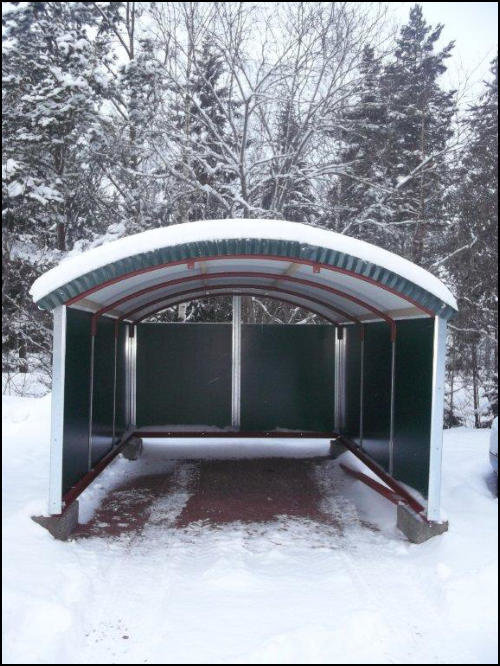
Snow load is a bit trickier. In part, the strategies are opposite to those that handle wind load. Roof angles under 45 degrees allow snow to remain. The simplest way is to build it steep enough so it simply slides off before any load is accumulated. On the other hand, height makes the tent susceptible to wind. Collapse or topple... that's the question.
The structure should also be aesthetically pleasing so as not to be an eyesore for passersby.
I have a proposal for a semi-permanent structure that solves both the wind and snow load problem.
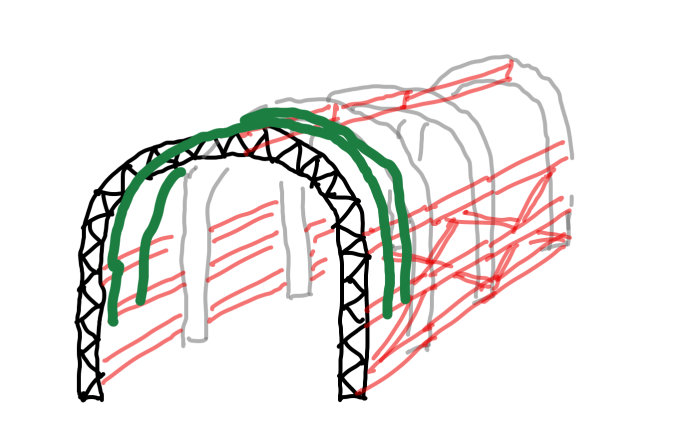
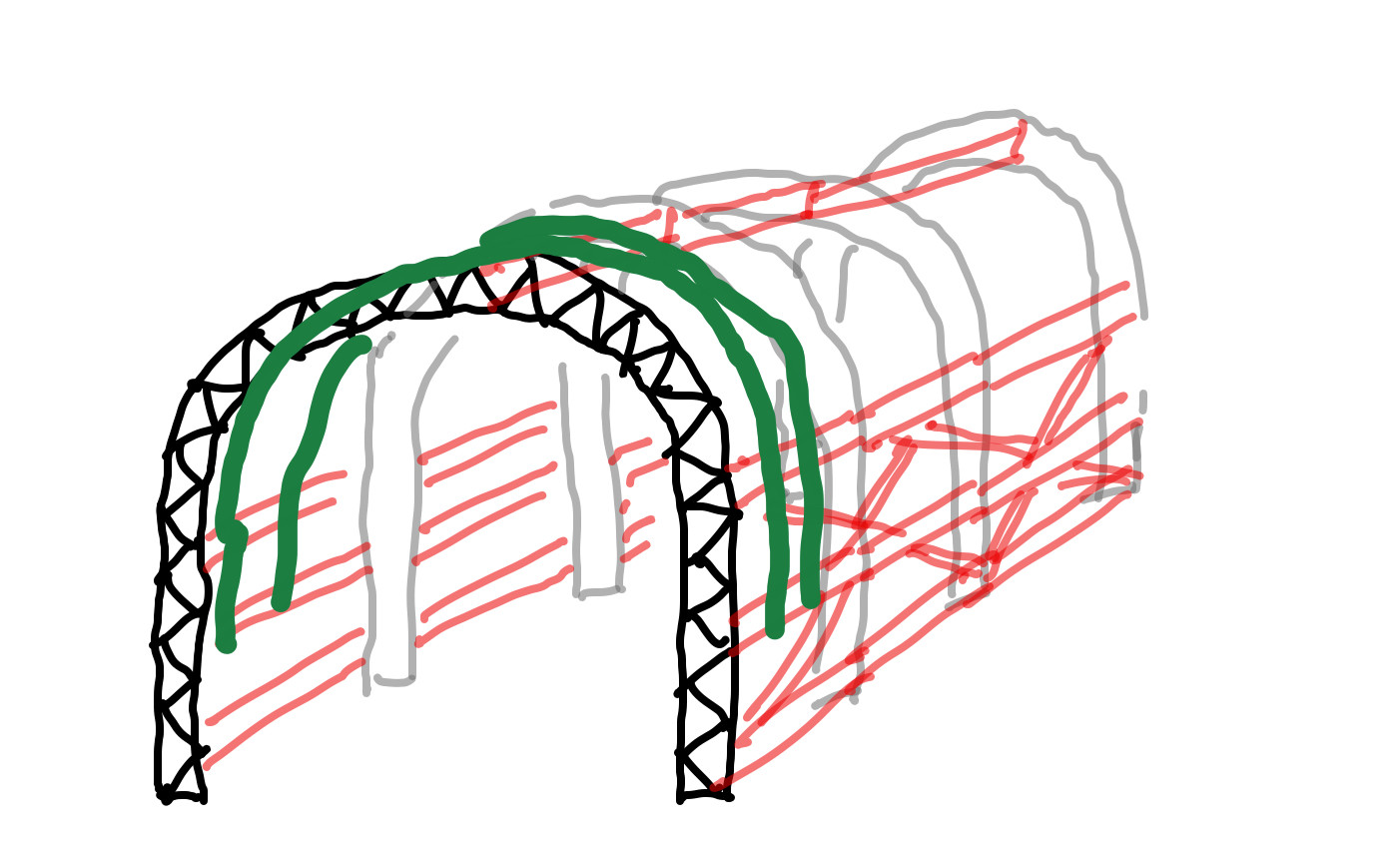
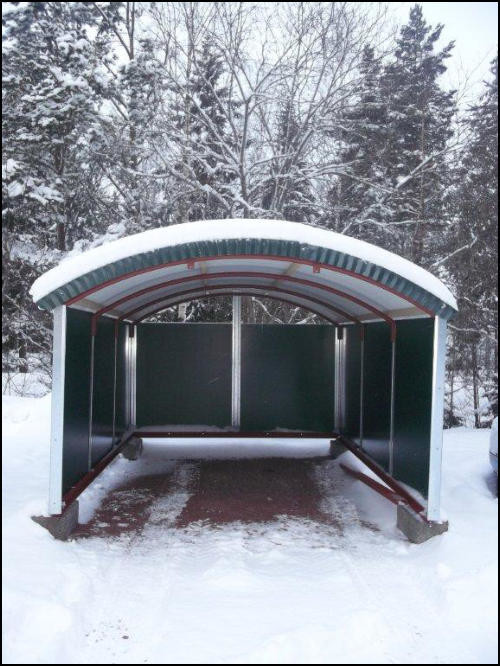
Weld gables/frames in reinforcement bars (black). Pipes are certainly lighter, but we want the weight to hold the construction down. 12mm iron should suffice. 8mm for the truss. Paint with rust protection. Estimate a frame approximately every four meters. Weld joist hangers to attach the longitudinal planks (red). When the frame is erected, brace it thoroughly (also red).
The next step is to install several roof arches made of two-inch PA hose (green) across the tent. Spacing less than 80. They are drawn over the top, but the ends are fastened inside the middle longitudinal plank.
Cheap white Japanese tarps are now put up along the sides (these can be nailed). White to let in light. Cheap because all the damage and mishaps will occur at low heights, and it should be easy and inexpensive to replace.
Then the expensive tarps are pulled over the roof. Important not to nail these. If the frame is well-made, there's nothing sticking out to wear it down. It's much better to allow movement so the tarp can fold in the wind. Use all the grommets and tie them with elastic bands. Adjust the length so that it covers the gable sufficiently to be tied with the same elastic bands to the inner iron.
Several tarps will be needed lengthwise. Overlap from the prevailing wind direction.
Whether it turns out nice depends entirely on how straight it is. Pay all possible care to leveling and positioning. As a bonus, tarps last much longer if they don't crease.
Regards, Findus
PS. Forgot an explanation. PV hose is so stiff that it can easily support a tarp but flexible enough to move and spring around when it's windy. This means all the snow falls off even if it's completely straight along the top. If there is too much locally, the hose bends, and the snow falls down. Then it straightens up again. Elastic bands ensure the tarp is always as taut as it can be. This also helps. A construction with arches makes the tent as low as possible. That's an advantage regarding wind load. PS
PPS. PA hose can be slit along and fitted onto the frames of reinforcement bars so there are no sharp edges anywhere under the tarp. PS
I note that some thread writers have chosen to wake up at the crack of dawn to write posts, which indicates that the topic is engaging.
I agree that applying conventional elasticity theory can lead to some over-dimensioning, but it's difficult to determine where to draw the line. W-trusses do not save timber in this case as they require an underframe and several braces. A 45-degree roof pitch is optimal in most cases.
The TS design has some stability issues. In a post construction, diagonals are needed in all wall and roof planes. Even at the open end (when the boat is in place). When it comes to the posts, support in the weak direction is what determines the load capacity. With two blocking (or cross braces) laterally, you can reduce to 45x95. Anchoring in the ground is, of course, crucial for keeping the tent in place. Its orientation relative to the most common wind direction is also essential.
What kind of boat is it, by the way?
I had a mahogany sailboat myself, 10.15x2.05 m and for that, we bought an old wooden shed + new PVC tarpaulins.
The next boat was 11.00x2.20 but it was made of plastic and had to settle for a Japanese press over the cockpit.
The boat is an older Bavaria 41 that caught fire in the engine room about 7 years ago. After that, a boat builder on Orust spent 6 years renovating it in his spare time. We bought it last year. It has the same layout as before but a completely different appearance inside.
Cross-bracing between each post was what I had in mind, as well as on both gables.
I will sit down and update the drawing based on your wise advice!
Many thanks!
Vi vill skicka notiser för ämnen du bevakar och händelser som berör dig.




KnockOnWood said: