
5,046 views ·
14 replies
5k views
14 replies
Dehumidification moisture damage
Hello, we recently moved into a house and after tearing down built-in wardrobes in a walk-in closet, we discovered mold. We have fixed the issue and are now going to dry out the wall. I have now placed a dehumidifier near the wall where the moisture is. My question is which way should I position it? Should the side that draws in moist air be placed towards the wall, or should the side that blows out dry air be placed towards the wall? I'm attaching a picture; currently, the "suction side" is towards the wall. Grateful for help.
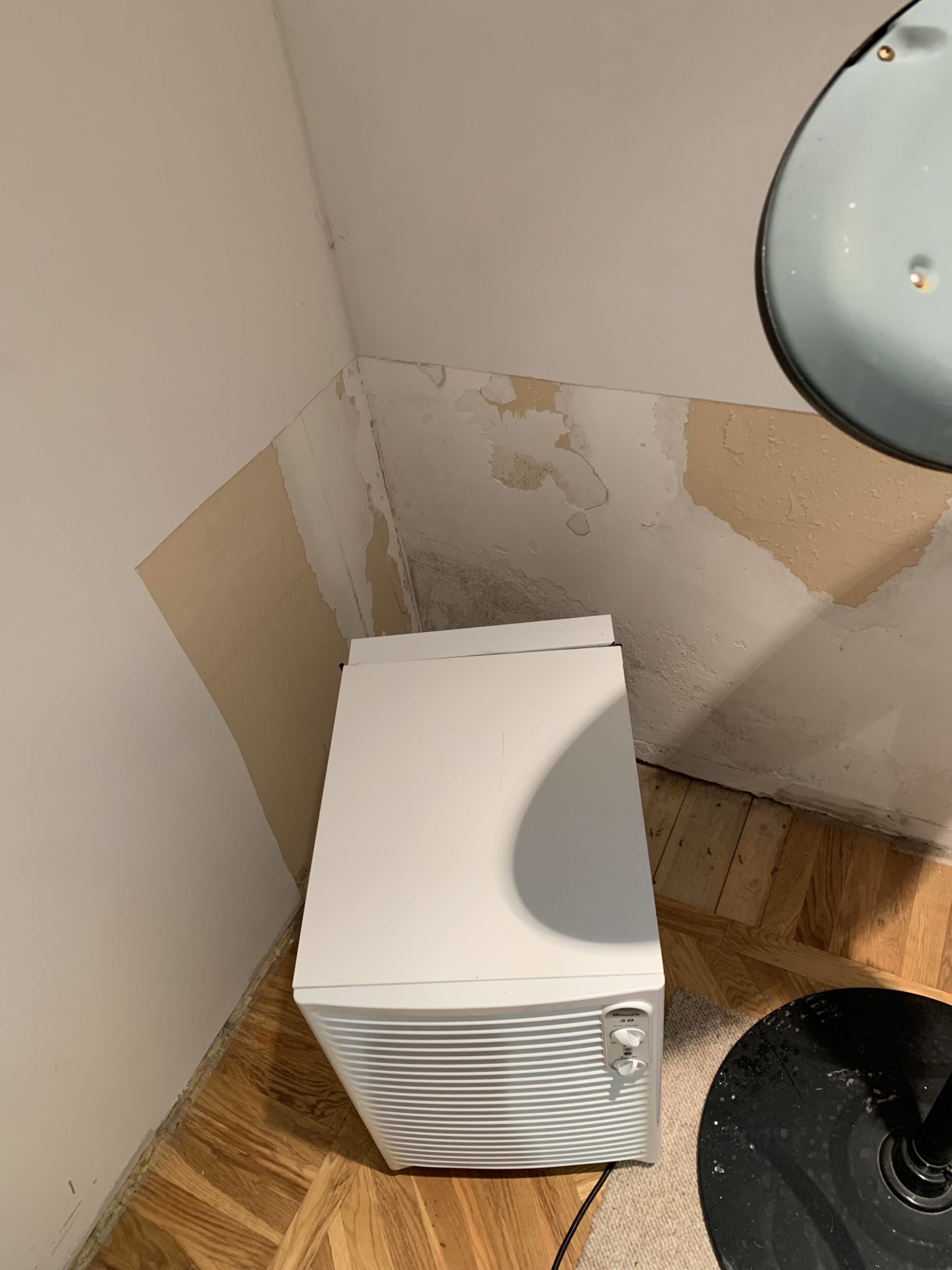

Theoretically, warm air could dry an area a bit faster. But the principle is based on the air condensing in the dehumidifier, which then becomes dry. The dry air in the room then pulls moisture out of the wall as it seeks a higher RH.
I would place the dehumidifier so that it stands as unobstructed as possible and can process a lot of air. No furniture in the way or close to walls that would disrupt the airflow.
I assume it is a stone wall and that you cannot easily remove as much moist material as possible?
I would place the dehumidifier so that it stands as unobstructed as possible and can process a lot of air. No furniture in the way or close to walls that would disrupt the airflow.
I assume it is a stone wall and that you cannot easily remove as much moist material as possible?
Yes, I think that's more effective than trying to aim the dehumidifier. Use infrared heat but keep the dehumidifier so it can work optimally.J Jonas Mellin Valden said:
Is it a basement, by the way? If so, it might be a good idea to consider how the moisture got there in the first place. A drier wall will draw more moisture from the ground if the waterproofing is inadequate on the outside.

Hi, how did you fix the issue and what was the problem?J Jonas Mellin Valden said:Hi, we recently moved into a house and after removing built-in closets in a walk-in closet, we discovered mold. We have fixed the issue and now need to dry out the wall. I have now placed a dehumidifier near the wall where the moisture is. My question is, which direction should I place it? Should the side that draws in moist air be placed against the wall, or should the side that blows out dry air be placed against the wall? Attached is a picture, currently, the "suction side" is facing the wall. Grateful for help
Would not heat up the surface, it can make it more difficult for moisture deeper in to escape.
The error was due to moisture that penetrated through the foundation wall. It has been addressed by removing organic material that was against the foundation, and by casting about 20 cm of concrete on the wall with a slope away from the house. On top of this, some kind of "sheet" has been heat-welded, I don't remember what it was called  . Then a sheet metal on top of that. The foundation is against rock.
. Then a sheet metal on top of that. The foundation is against rock.Ok thanks for the tip. Another question. The dehumidifier is supposed to have a capacity of 20l / day. Now it's been on for a day, and there's less than 1 L in the container. There's a significantly raised moisture content in that part of the wall, so I thought there would be more water, but maybe it doesn't work that way?
oh, I'm venturing into uncharted waters here, so take this as a "guesstimate." Maybe someone more knowledgeable will find the thread and provide a better answer.J Jompa MV said:Ok thanks for the advice. Another question. The dehumidifier is supposed to have a capacity of 20l/day. It has been running for a day, and there is less than 1 L in the container. There is, therefore, a significantly high moisture content in that part of the wall, so I thought there would be more water, but maybe it doesn't work that way?
But I simply don't think you have more moisture release in the room. Water in concrete is quite sluggish if, for example, you compare it to having soaking wet open insulation or some other material that releases moisture faster.
For example, I had a downpour through the panoramic roof of my car. I put in a dehumidifier and probably drained 25-30l of water in 48 hours.
The same dehumidifier is now in our laundry room, where it's not nearly as effective. I also used it in the garage after a water leak, and there wasn't more than maybe a couple of liters after a day.
It might be slightly better if you position the dehumidifier more freely in the room and close doors, etc., to create a closed space.
Thank you for the "killgissningen" I think you're right in your guess and I reason the same way. Following advice, I have moved it more freely into the room and I have closed off the space with construction plastic. The area/room is small, about 7 sqm.
I think you're right in your guess and I reason the same way. Following advice, I have moved it more freely into the room and I have closed off the space with construction plastic. The area/room is small, about 7 sqm.Well, hard to say. But no noticeable effect. Since I don't have direct knowledge on the subject, it's difficult to determine if it's due to 1. A bad dehumidifier. 2. Non-optimal placement. 3. That it simply results in very little water/day when trying to dry out a concrete wall
Click here to reply