
9,009 views ·
13 replies
9k views
13 replies
Damping mat/insulation behind slatted wall
I'm going to install a slat wall model Stonewall. It's a concrete wall, so we'll set up battens first. This means we'll have about a 15mm space behind which I plan to fill with some kind of felt or insulation for even better soundproofing. It's just an empty space otherwise. I don't want to spend a lot of money, so I found, among others, this https://www.biltema.se/bil---mc/biltillbehor/ljudisolering/ljudisoleringsfilt-2000021215
It seems to meet my requirements, but I emailed Biltema regarding whether it is safe to use indoors concerning substances and fibers that might be released into the air and cause allergies or be harmful. But they didn't want/couldn't respond and just wrote that 'it is made of cotton and polypropylene.' Do you think it's safe to use in a living room? I have kids, etc. Or do you have other tips for cheap material that works as insulation behind a slat wall? Performance is not super important; I think of this as a little bonus since the space is created anyway. But I want something safe that gives a certain effect at least. And that can for example be cut or trimmed. Priceworthy as mentioned.
It seems to meet my requirements, but I emailed Biltema regarding whether it is safe to use indoors concerning substances and fibers that might be released into the air and cause allergies or be harmful. But they didn't want/couldn't respond and just wrote that 'it is made of cotton and polypropylene.' Do you think it's safe to use in a living room? I have kids, etc. Or do you have other tips for cheap material that works as insulation behind a slat wall? Performance is not super important; I think of this as a little bonus since the space is created anyway. But I want something safe that gives a certain effect at least. And that can for example be cut or trimmed. Priceworthy as mentioned.

I think you're absolutely right. There's probably no problem with that blanket. Glass wool can emit urea as it sits "open" in various acoustic solutions, which can smell a bit like that.
The sound will go through your ribbed wall, hit the concrete, and go out through the wall again. The ribbed wall will become more effective when it's mounted with space behind it. If you put a piece of felt there, it can only get better, albeit - marginally.
The felt doesn't need to fill the entire space, either, i.e., 15mm.
So, go ahead with that Biltema felt, it'll be just fine!
I would cut it into strips following the studs and staple it to the inside of the studs with a staple gun, like rapid. Biltema has now adapted their staple guns to fit rapid's staple sizes, so if you don't have one, you can safely buy one of those plus staples at Biltema while you're there. 6 or 8 mm should be good.
Good luck, and feel free to post some pictures along the way
The sound will go through your ribbed wall, hit the concrete, and go out through the wall again. The ribbed wall will become more effective when it's mounted with space behind it. If you put a piece of felt there, it can only get better, albeit - marginally.
The felt doesn't need to fill the entire space, either, i.e., 15mm.
So, go ahead with that Biltema felt, it'll be just fine!
I would cut it into strips following the studs and staple it to the inside of the studs with a staple gun, like rapid. Biltema has now adapted their staple guns to fit rapid's staple sizes, so if you don't have one, you can safely buy one of those plus staples at Biltema while you're there. 6 or 8 mm should be good.
Good luck, and feel free to post some pictures along the way
Thanks, nice that someone believes in it. I will definitely get pictures later. Nice that there was a product that was reasonable for this. A lot is so expensive otherwise.
Hi!D doctormirabilis said:
I'm curious how it went with the rib wall? And did it soundproof well? I'm going to do the same thing and am trying to decide what to put behind. I've never framed a wall, so it felt so big, but maybe it's the easiest for better insulation? Considered something like Polaric from Silentswede https://www.silentswede.se/dampmatta-ljuddampning-silentswede-polaric-silver-6 but it seems just more complicated.
//Sara
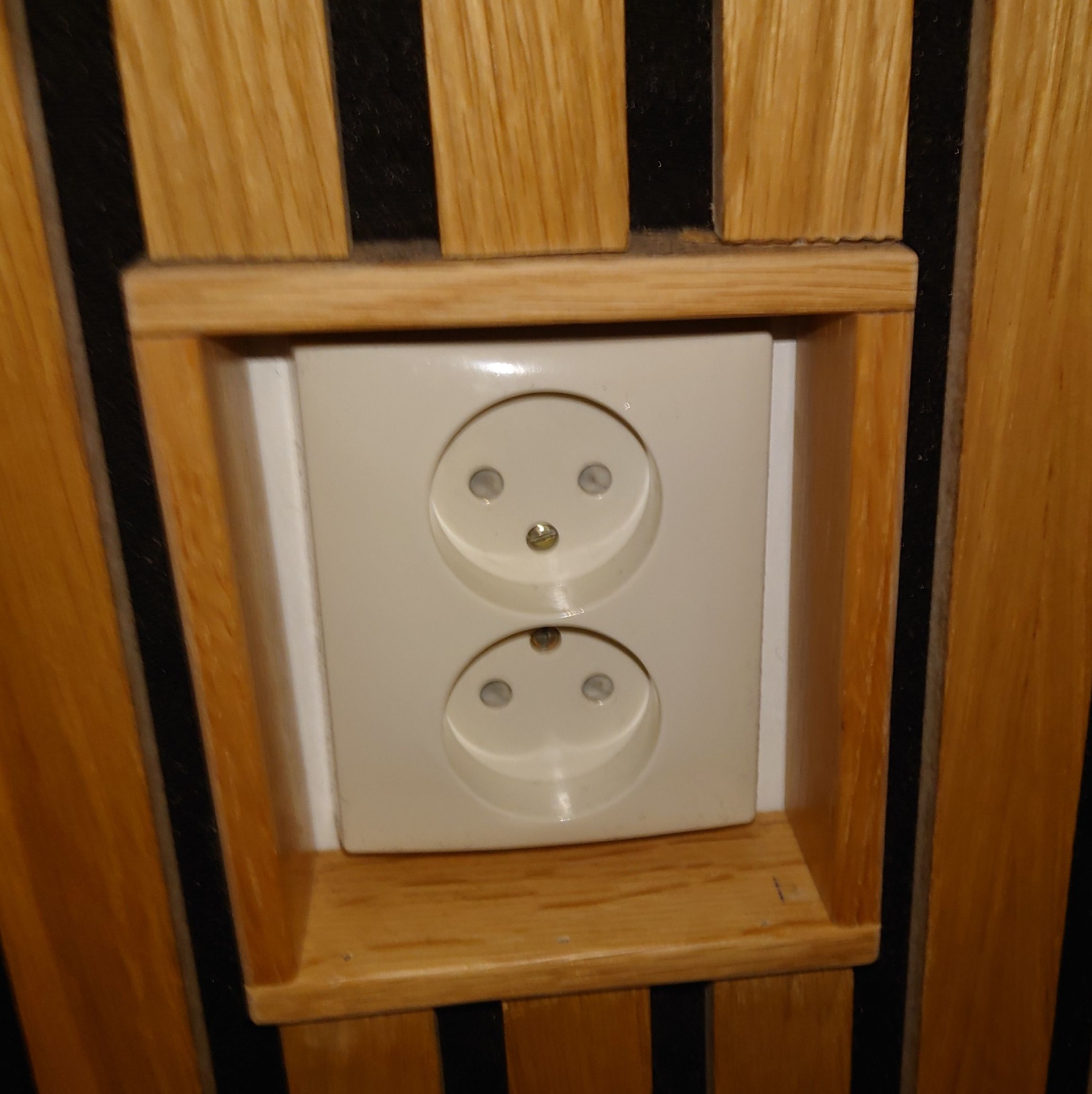
It turned out well! If I had had a bigger room and 'afforded' the space to insulate thicker behind, I would have done it. And used something like stone wool or something else. Because the more, the better, of course, when it comes to absorption. Now, I didn't want to build out too much from the wall, so this turned out well. The fleece was easy to cut and also quite cheap. Used 15mm battens horizontally, 4 (or 5?) and strips of fleece in the channels that were formed. Then the acoustic panel was screwed up with mounting screws. Small frames of oak molding were made around the electrical outlets. Didn't run any cables behind the panel because it wasn't necessary, but if you need, it's easy and convenient to do so.
wow so nice! Ok but did you use wood or steel studs and how did you attach them to the concrete wall? You didn't cover everything with a layer of gypsum but put the slat wall directly on the studs/insulation? What I'm considering is studs, insulation, single-layer gypsum, and then the slat wall on that. I will want to have something like string brackets attached to the slat wall, so it needs to be stable enough for that.D doctormirabilis said:It turned out well! If I had larger rooms and 'space' to isolate thicker behind, I would have done that. And used something like mineral wool or something else. Because the more, the better, of course, when it comes to absorption. I didn't want to extend much from the wall, so this worked well. The felt was easy to cut and also quite cheap. I used 15mm battens horizontally, 4 (or 5?) and strips of felt in the channels that were formed. Then the acoustic panel was screwed up with mounting screws. Small frames of oak list were made around the electrical outlets. I didn't pull any cables behind the panel because I didn’t need to, but if you need to, it’s easy and convenient to do it.
Thanks, I'm really satisfied actually.
The wooden frame is directly on the concrete, drilled and plugged in advance as usual. The hardest part was adjusting to the ceiling and floor since our apartment has uneven rooms and it varies by about a centimeter from one side of the room to the other. We don't hang anything heavy on it, so we didn't have the problem you have with shelves. However, I wouldn't have covered it with plasterboard or another sheet, as you create a hard and flat surface outside the insulation behind the acoustic panel, which somewhat negates the purpose of the insulation acoustically.
To attach heavy shelves, I'm not exactly sure how I would have done it, but you definitely need to screw the brackets into the frame or something similar. I imagine it should be enough, actually; to screw them into the frame? String doesn't have that many mounting points per shelf either. But of course, the frame must be set at a suitable height then.
The wooden frame is directly on the concrete, drilled and plugged in advance as usual. The hardest part was adjusting to the ceiling and floor since our apartment has uneven rooms and it varies by about a centimeter from one side of the room to the other. We don't hang anything heavy on it, so we didn't have the problem you have with shelves. However, I wouldn't have covered it with plasterboard or another sheet, as you create a hard and flat surface outside the insulation behind the acoustic panel, which somewhat negates the purpose of the insulation acoustically.
To attach heavy shelves, I'm not exactly sure how I would have done it, but you definitely need to screw the brackets into the frame or something similar. I imagine it should be enough, actually; to screw them into the frame? String doesn't have that many mounting points per shelf either. But of course, the frame must be set at a suitable height then.
Edit: to mount shelves, you will need significantly deeper studs than we used, so you can screw in proper screws that hold.D doctormirabilis said:Thanks, I'm really satisfied actually.
It's wooden studs directly on concrete, drilled and plugged in advance as usual. The hardest part was adjusting to the ceiling and floor since our apartment has uneven rooms and it varies by about a cm from one side of the room to the other. We're not hanging anything heavy on it, so we didn't have the problem you have with shelves. But I wouldn't have covered it with plasterboard or another board, since you would then create a hard and flat surface outside the insulation behind the acoustic panels, which somewhat negates the purpose of the insulation acoustically.
To mount heavy shelves, I don't know exactly how I would have done it, but you will of course need to screw the brackets into studs or such. I actually think it should be enough; to screw them into the studs? String doesn't have that many attachment points per shelf either. But of course, the studs must be set at a height that fits then.
hmm, yeah so that's kind of my problem, I don't really know how to best do this. It's airborne sound from the neighbors' living room (muffled voices and TV noise) that I want to try to reduce (I understand that it's probably not possible to completely get rid of it) and I've understood that insulating layers are needed behind the slat wall for that. But I'm unsure about how thorough the insulation needs to be, if I "have to" build a wall on the wall or if there are other methods (I've looked into all possible options with damping felt, gypsum, Green glue)?D doctormirabilis said:Thanks, I'm really satisfied actually.
It's a wooden frame directly on concrete, drilled and plugged in advance as usual. The hardest part was adjusting to the ceiling and floor since our apartment has uneven rooms and it varies about a centimeter from one side of the room to the other. I don't hang anything heavy on it so we didn't have the problem you have with shelves. But I wouldn't have covered it with gypsum or another board since that creates a hard and flat surface on top of the insulation behind the acoustic panel, which somewhat negates the purpose of the insulation acoustically.
To mount heavy shelves, I'm not sure exactly how I would do it, but you must of course screw the brackets into studs or something similar. I actually think that should be enough; to screw them into the studs? String doesn't have that many attachment points per shelf either. But of course, the studs must be placed at a height that matches then.
Aha okay, I get it. You want to dampen sound from outside. That's a different story. I wanted to improve the acoustics for my stereo (and also beautify the room), i.e., dampen reflections I created myself. Then maybe panels will work for you. Plywood is really strong, for example? Check with slatted wall manufacturers too, they usually have tips on mounting something heavy like a TV or similar.
If you're going to have acoustical panels on the wall, you should probably do it for the aesthetics though - if your goal is only to dampen sound from the neighbors - and you want shelves on the wall - maybe it's just best to frame, insulate, and put up boards and so to speak build a wall on the wall, and then paint or wallpaper it, etc.? Instead of acoustical panels.
Thank you, we are super happy. The acoustic panel is quite OK in quality! Or okay and okay, it's good I would say. It's MDF/HDF with oak veneer on top and then it’s glued and stapled to a back of stiff felt material. There were some splinters from the edges of the veneer at first but none now. You can't oil it btw (also not needed) according to the manufacturer. Since it's fiberboard inside the veneer, you should be careful if you have it all the way down to the floor and then, for example, wet mop and accidentally come into contact with the ends; it might end up swelling. The carpenter who helped us a bit recommended that we create a gap down below to avoid this. So we let them go just below the upper edge of the baseboard, only.PASwe said:
When framing like us (on concrete), you can't fix anything to the wall either - if it's not screwed exactly where a stud is, so it limits a bit what you can put up. If you know you're going to have something at a certain height, it might be worth placing an extra stud there, I don't know. But on the other hand, the panel is kind of the "thing," so you might not want too much hanging up anyway. We have a small painting and a light wall lamp only, and I screwed them into the stud, through the black felt on the back of the acoustic panel. No need to drill or anything - just hand-drive a short mounting screw right in. The nice thing about the felt on the back of the panel is that it "swallows" the holes if you change your mind and remove something.
Behind the panel, we used this felt from Biltema:
https://www.biltema.se/bil---mc/bil.../ljudisoleringsfilt-1000-x-2000-mm-2000021215
Cut them lengthwise to match the width of the "channels" formed between the horizontal wood studs on the concrete wall. Can't remember if we went one round or two with the felt - I think it was 1 round. Cheap and good felt (some kind of rag, basically), and I figured it would add a little bonus effect anyway, as it would otherwise just have been empty space there under the panel.
Considering building some of my own wall absorbers for hanging in the stairwell too, but then probably some other, thicker insulating material. Maybe there's a thread about that already; if not, I might make a build journal.Sorry if I mentioned any of this in the thread earlier - it was a while since I wrote in it.
Welcome with questions if you have any.
Click here to reply