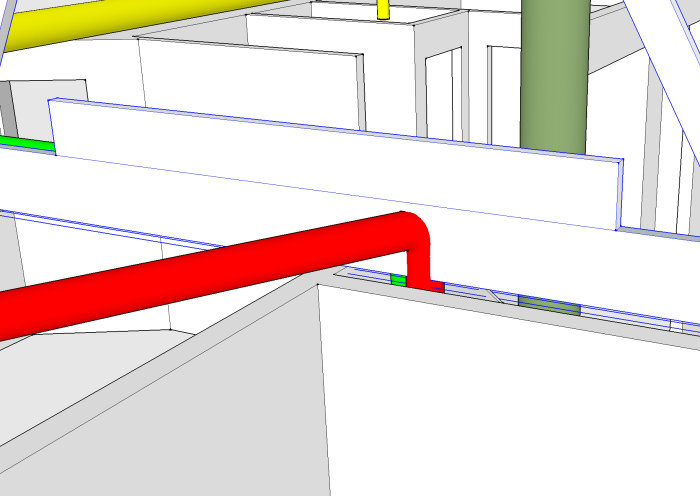
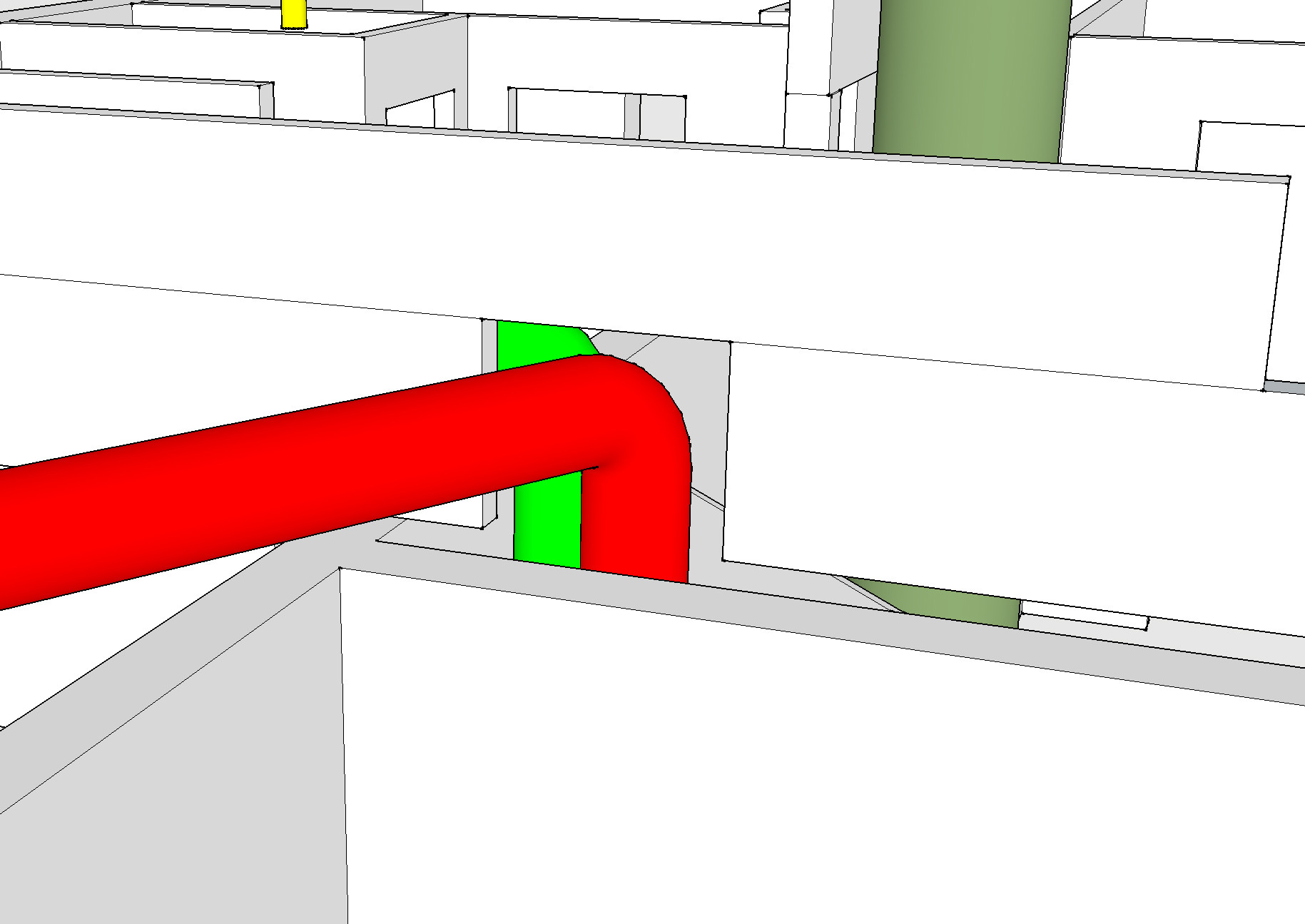
I have a truss that ends up right above my intended ventilation path.
Image 1 shows the problematic pipe in red.
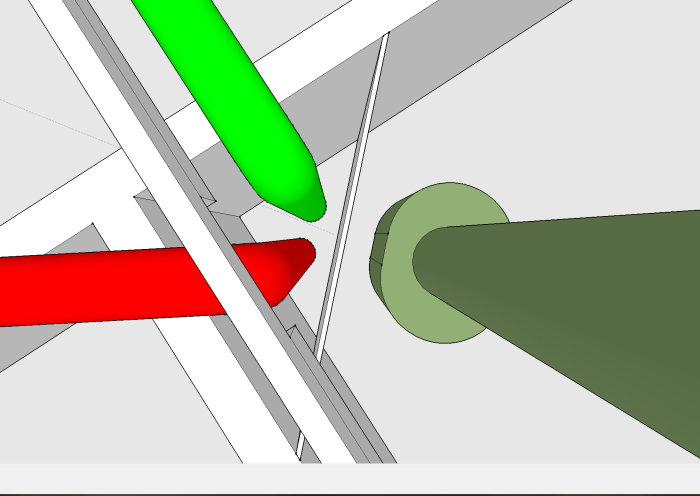
Image 2 shows everything from above, 2 vent pipes, diameter 125 with insulation about 210mm, the green pipe prevents me from moving the red one further away without making a bigger duct, which I don't want as the stove will be in front of the slanted wall.
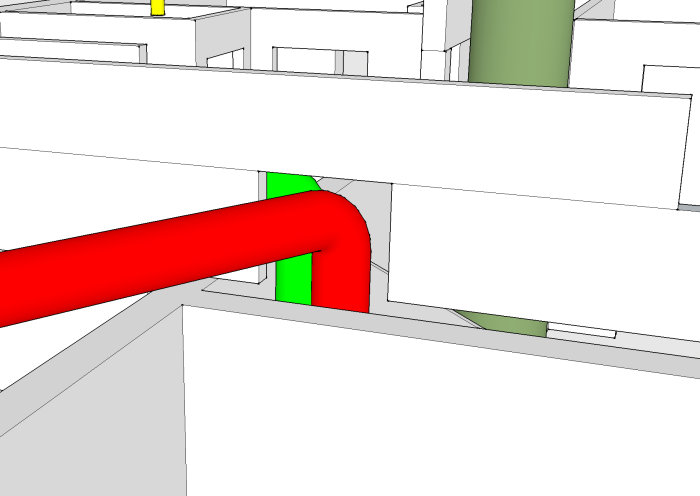
Image 3. I would then like to cut off the lower frame/tie beam and splice above or do something else, it should be possible so that I can place my pipe in the right spot?
My two cents are to make the drum larger, which you don't want to do. Or place the beam higher along its entire length; it's not suitable to splice it as you planned when there are such high tensile stresses as there are in the forearms.
Flat iron is very good at "tensile forces," which (as far as I can see) is what you're missing in your drawings.
If you could "extend" the roof truss so that you can place, for example, a 50x5mm flat iron on either side of the ventilation pipe at the bottom of the roof truss, my feeling is that you'd be in a very good position.
But before I start messing with that, I would examine Robert-san01's comment very carefully!
Flat bar is very good for "tensile forces," which (as far as I can see) is what you are missing in your drawings.
If you could "extend" the truss so that you can place, for example, a 50x5mm flat bar on either side of the ventilation pipe at the bottom of the truss, my feeling is that you would be very well covered.
But before I start messing with that, I would examine Robert-san01's comment very carefully!
Then I should place those before I cut so they absorb the load. I would preferably want to put something over it like in the picture, but with screw plates.
Let's see if there's enough space for the right amount to handle the tensile force.
Do they need to be insulated? Pipes are usually only insulated if they run in a cold space.
It is a cold attic where the truss is, currently with 95mm roof insulation which will be more, but maybe not this summer as there's quite a lot else to do in the house. So the pipe is above the insulation by about 80mm.
My two cents are to make the drum larger, which you don't want to do. Or place the beam higher along its entire length; it's not suitable to splice it as you planned when there are such high tensile stresses as there are in the forearms.
Are there programs that can calculate tensile stress for free, otherwise, I guess trusscon is the only one available as far as I know.
Hi,
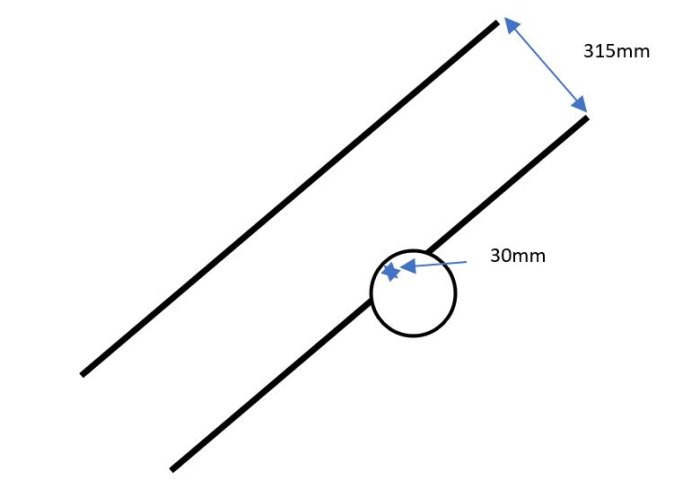
I have a similar question. I need to carve out a small piece of a glulam beam for the roof where it goes up to the peak for ventilation ducts. The beam is 315 mm thick and needs a small rounded section carved out for a ventilation pipe to fit under. The pipe is 125 mm, and I need 30 mm of the beam where the pipe will pass. Do you think this can be done without affecting the structure too much? If not, can I reinforce the beam with nail plates or something similar above the small hole?
Click here to reply
Vi vill skicka notiser för ämnen du bevakar och händelser som berör dig.




Lostmoose said:
Flat bar is very good for "tensile forces," which (as far as I can see) is what you are missing in your drawings.