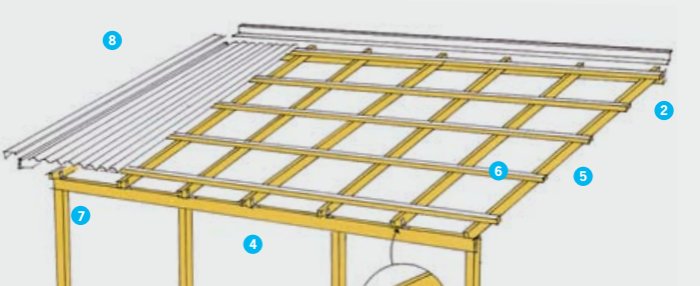
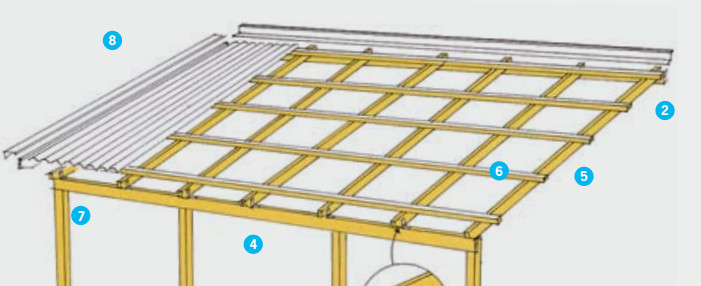
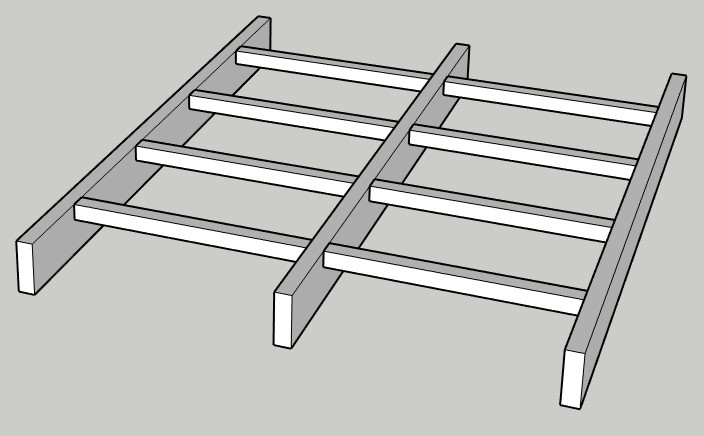
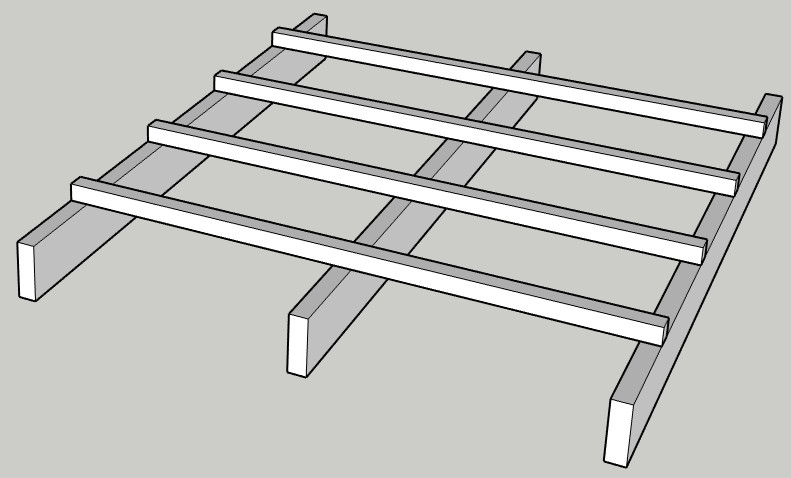
I have a question regarding the installation of a plastic roof and the crossbars/battens/no. 6 in the image below. Do they have a load-bearing function or are they just there to have something to screw the roof into?
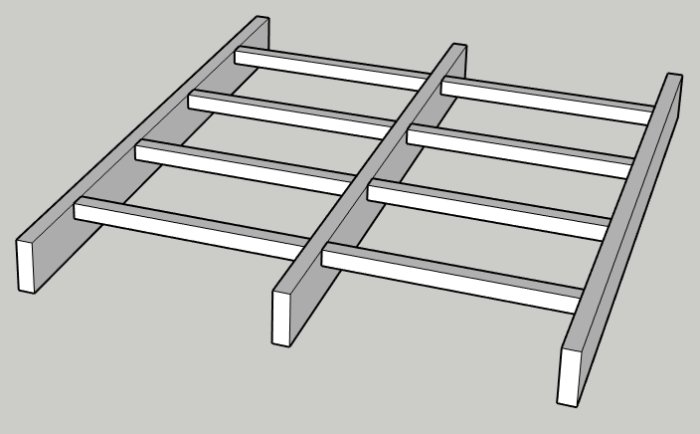
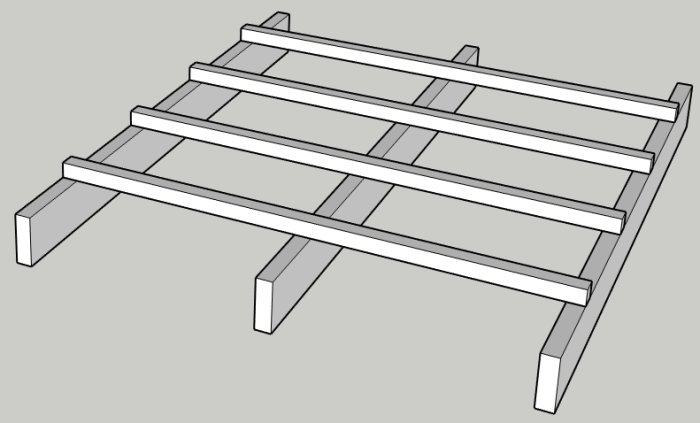
To be clear, does it matter dimension-wise if you saw shorter pieces and screw them between the rafters (not long crossbars mounted in notches in the rafters):
or like this:
Since the rafters will also support the plastic when the rafters and crossbars are at the same level, is there even an advantage to doing so besides achieving a lower profile?
One sees a lot more people making notches in the rafters instead, which must weaken them significantly plus you've paid for a stronger dimension unnecessarily, so that's why I'm a bit unsure. Why don't everyone solve it the way I suggest instead if they want a lower profile, what am I missing?
All parts of a roof structure must bear their own loads. In this case, they won't be very large because the battens are closely spaced and have a limited span. It is always advantageous to use the longest battens or joists possible, as this makes better use of the material.
All parts of a roof structure must bear their own loads. In this case, they aren’t very large since the battens are placed closely together and have limited span. It's always an advantage to use as long battens or beams as possible, as it makes better use of the material.
Could you clarify, what is the "own load" for a short screwed cross beam?
I understand that long beams make better use of material, but having thick (high) rafters and cutting countersink holes thereby weakening the rafters must be the height of unutilized material? Why is it such a common solution, thoughts?
"The own load" consists of the part of the roof surface (dead weight + snow load) that rests on the current part of the battens, and not on any adjacent batten. Notching the rafters is generally inappropriate.
If you increase the dimension that corresponds to the counterbore, it's fine if you like that appearance.
Then, the stiffness of sheet metal varies in the width and length directions. That's why you need battens. If you had the rafters in the other direction, you might be able to skip the battens entirely. (I don't know how that would look.)
If you increase to a dimension that corresponds to the cutout, it's okay if you like that appearance.
Then the stiffness of the sheet metal is different in the width and length directions.
That's why you need batten.
If you had the roof trusses in the other direction, you might be able to skip the batten altogether. (I don't know how that would look.)
/ATW
Now this is regarding a plastic roof, but yes, I've been wondering about the stiffness of the plastic in different directions and if that has anything to do with it. If you had placed the roof trusses the other way with 60 centimeters center to center, you should be able to skip the batten altogether, right? Then again, the batten should also serve a function as a stabilizer for the roof trusses so they don't sway sideways.
Where does one read about this on a theoretical level? Websites regarding construction and dimensioning for constructors?
It depends a lot on your prior knowledge. If you have a high school diploma from a science or technical program, with knowledge in math and physics (especially mechanics), the conditions are favorable. Aim for a basic textbook. There are many pieces that need to be put together. Then you should also know a bit about Husbyggnad.
It depends greatly on what prior knowledge you have. If you have a high school diploma from a scientific or technical program, with knowledge in math and physics (especially mechanics), the conditions are good. Aim for a simple textbook. There are many pieces that need to be brought together. Then you should also know a bit about Building Construction.
As a civil engineer, I'm probably mentally deviant because I prefer to read about the physics behind instead of construction manuals where you only get the results/guidelines, so to speak. So I would like to find a super nerdy construction site with collected info, but that seems difficult. There are for most technical subjects, but not for construction for some reason.
Joking aside, you need to search for structural engineering to deepen your knowledge. It can give better results than Swedish search terms. Also, search on YouTube.
Answer to your question, you are right about the stiffness in the plastic (in civil engineering terms, it's anisotropic). In design, you want to maximize material utilization with a wide spacing between expensive roof beams then either a strong trp sheet across on top. Or roof purlins on the beams plus a lighter trp over the purlins. Private individuals and carpenters do not handle this themselves, so it usually ends up being either under- or over-dimensioned.
Civil engineer is a good foundation for most things... An extremely nerdy construction site is absolutely missing. The calculation handbooks that exist and are poorly explained can create more problems than they solve. House construction, however, is very complex and can involve a significant amount of tradition and practical aspects.
The battens work best if they lie unjointed over more than two supports. They then act as a continuous beam. In such a beam, if it is loaded with a uniformly distributed load, the greatest bending moment occurs over the supports, which counteracts deflection between the supports. The beam (i.e., the battens) can then be made thinner than if it is jointed at each joist it rests on.
Then it would also be the case that if you cut the battens into "small pieces," it's only the joints that support the load resting on them. If you don't add some form of reinforcement at each attachment point and only use screws, wouldn't that also become a weak point?
Even if it's not a matter of huge loads, it's perhaps worth considering...
Batten is not uncomplicated. Large halls have collapsed due to misconceptions and oversights with battens (the beams). House construction can be difficult!
Thank you for all the answers, I'll have to find a book and do some googling in English to build a better foundation (sorry for the pun).
When it comes to plastic roofing, I'm a little hung up on what I instinctively feel is the weak link, namely the plastic itself. It's unnecessary to increase the dimensions of the battens by letting them sit on top of the beams if the plastic breaks much earlier, if you imagine a sheet of plastic without direct support underneath, maybe 1000x600 mm. But maybe I'm underestimating roof plastic, maybe it's enormously elastic and difficult to break?
Vi vill skicka notiser för ämnen du bevakar och händelser som berör dig.