
8,784 views ·
12 replies
9k views
12 replies
Crawl space - is it possible to build safely?

Renovation rookie
· Dalarna
· 3 173 posts
Hello
I'm currently working on a design for an extension. The idea is for a single-story addition of about 40-50 sqm.
One builder recommends a crawl space foundation, and the other recommends a slab. Personally, I'm unsure which to choose.
Is it possible to build a crawl space foundation today in a way that is safe? I understand the differences from the past and why it can be considered a risky construction. But it should be possible to solve, I think. There is a significant cost difference, but I don't want to be penny-wise and pound-foolish.

I'm currently working on a design for an extension. The idea is for a single-story addition of about 40-50 sqm.
One builder recommends a crawl space foundation, and the other recommends a slab. Personally, I'm unsure which to choose.
Is it possible to build a crawl space foundation today in a way that is safe? I understand the differences from the past and why it can be considered a risky construction. But it should be possible to solve, I think. There is a significant cost difference, but I don't want to be penny-wise and pound-foolish.


Renovation rookie
· Dalarna
· 3 173 posts

What type of foundation is there today? The simplest is to continue with the same type. If the finished floor in the existing house is a bit higher above ground than normal, it's easier with a crawl space. Personally, I would prefer a slab on grade if this is possible to eliminate the moisture risks associated with a crawl space.

Varmgrund is an excellent and cost-effective foundation type that removes many of the disadvantages of a free crawl space. Of course, it depends on the ground conditions, but if the house currently stands on a regular crawl space, then an insulated crawl space should work just as well; overall, it's like a slab on grade without concrete.useless said:
The crawl space also has the advantage that you can solve many installations of sewage, electricity, ventilation during or after construction if you want to make changes. I was a strong advocate for a slab on grade in all situations, but now that I live in a newly built house with a varmgrund, it's very nice in hindsight to be able to solve things through the foundation, like electricity to the kitchen island, fresh air to the stove, electrical outlets on the facade, extra water spigots, etc.
We only did a small extension of 15 sqm, but I can still share what we did. It's a concrete block wall all around.Hi
I'm currently designing an extension. The plan is for approximately 40-50 sqm.
One builder suggests a crawl space foundation and the other recommends a slab. I am completely undecided.
Is it possible to build a crawl space foundation today so that it is safe? I understand the difference compared to before and why it's considered a risk construction. But I think it should be possible to solve. Cost-wise, there is a significant difference, but I don't want to be penny-wise and pound-foolish.
-Drainage all around
-Insulated ground fabric sealed at all joints and up against the wall. Looks like a sleeping pad
-No vents
-Installed a dehumidifier with a condensation pipe through the wall.
I feel secure now.

We have an extension in our summer house. The entire house has a crawl space foundation. We have good, sandy soil conditions on which the house stands, so old parts where I've renovated later, after the extension, have been completely dry. The extension is (probably, it wasn't me who did it) done similarly to what Göran Sten mentions above, i.e., concrete block wall, drainage, and ground cloth under crushed stone. However, we have vents and therefore no dehumidifier, but the ground the house stands on is sandy and therefore well-drained.
The house is only used on some weekends in the winter, so that might affect it. My fairly qualified guess is that what affects the most is how humid your soil conditions are. If you have drained around and placed crushed stone under the house, moisture cannot rise from the ground.
We previously had a summer cabin where we had moisture problems in the crawl space. We solved those problems by draining away the water that came from a slope behind the house, properly diverting stormwater (water from a downspout was running under the house), clearing the crawl space of organic material (someone had previously laid wood that had rotted) and soil, and laying sand/crushed stone where moisture accumulated.
The house is only used on some weekends in the winter, so that might affect it. My fairly qualified guess is that what affects the most is how humid your soil conditions are. If you have drained around and placed crushed stone under the house, moisture cannot rise from the ground.
We previously had a summer cabin where we had moisture problems in the crawl space. We solved those problems by draining away the water that came from a slope behind the house, properly diverting stormwater (water from a downspout was running under the house), clearing the crawl space of organic material (someone had previously laid wood that had rotted) and soil, and laying sand/crushed stone where moisture accumulated.
Renovation rookie
· Dalarna
· 3 173 posts
Thank you for all the answers! Varmgrund is something I've been thinking about myself. The extension would face an unfinished basement. It is damp but not a problem since we only have a gym and washing machine there, as well as VP. If we were to drain, the conditions down there would obviously become even better.
Varmgrund feels like a relatively good choice that can be inspected continuously as a manhole from the basement is possible.
Should we go with Isodrän's setup?
Varmgrund feels like a relatively good choice that can be inspected continuously as a manhole from the basement is possible.
Should we go with Isodrän's setup?
Have you tried running it without the dehumidifier to see what the RH is?Göran Sten said:
We only did a small extension of 15 m2, but I can still share what we did. There is a lecablock wall all around.
- Drainage all around
- Insulated ground cloth sealed at all seams and up against the wall. Looks like a sleeping mat
- No vents
- Installed a dehumidifier with a condensation pipe through the wall.
I feel safe now
I roughly follow their principle with boards on the ground. Joints and boards against the wall are glued with Biltema's stone glue. Tjällden has a similar construction: https://tjallden.se/produkter/krypgrund-inneluftsventilerad/konstruktion/
What I haven't really managed to find good information on is how to design the ventilation. It usually says you should take the exhaust air from the foundation and let the indoor air be sucked down through the floors, but I haven't found any more detailed description of how to, for example, ensure the correct exhaust air flow in each room... Some manufacturers have narrow vents that you place along the walls, but I think my plank floors are sufficiently leaky anyway.
Otherwise, you have to do some variant of Träguiden's example. But then all the floors must be fairly tight:
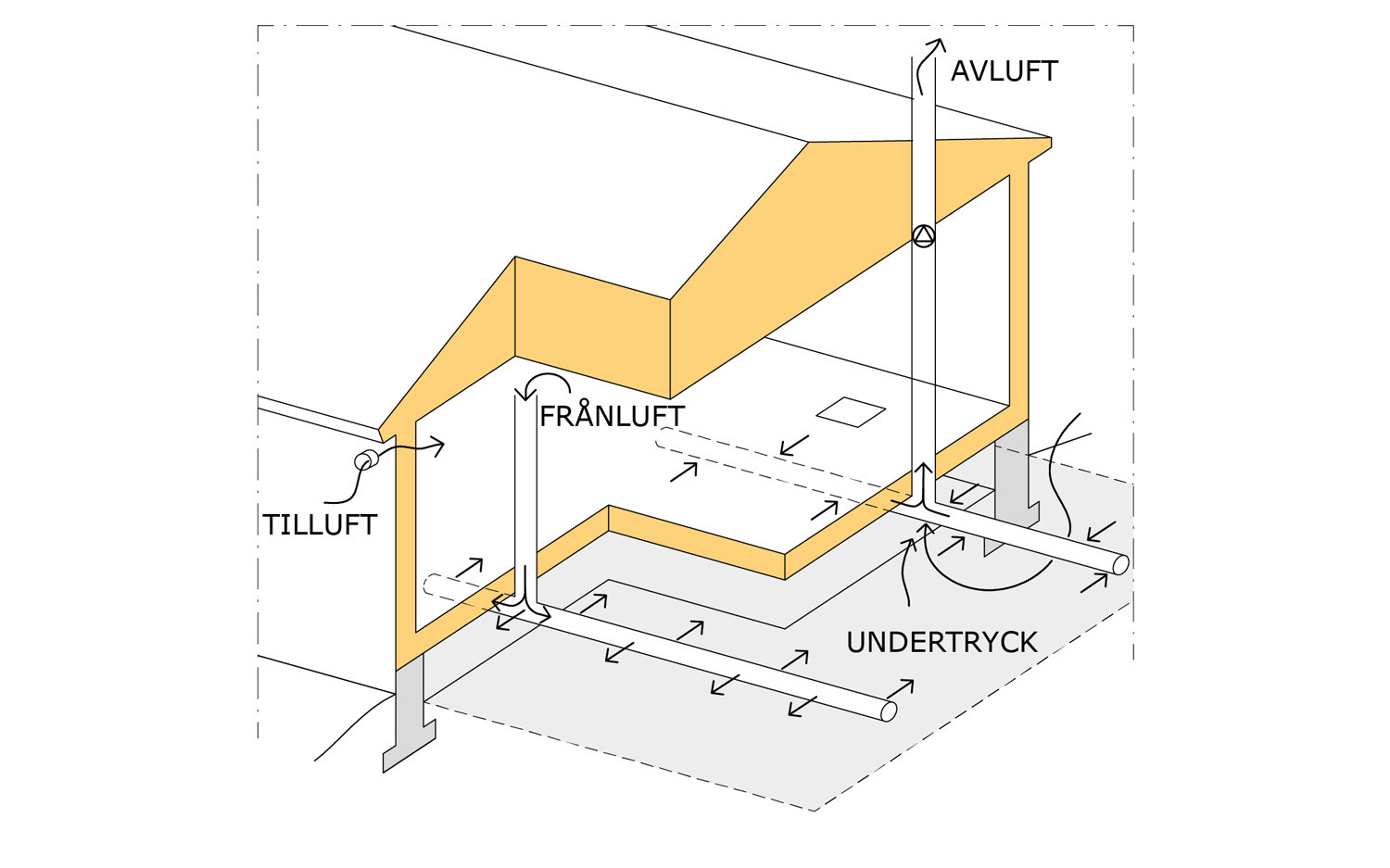
https://www.traguiden.se/konstrukti.../grundlaggning/inneluftsventilerad-krypgrund/
Drain the basement before you make the extension, it's difficult to do afterwards.
Click here to reply