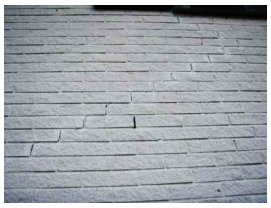
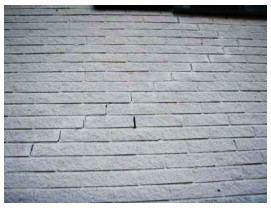
I went to see a house this weekend, attractive price and location but some areas of concern.
There is a crack in the facade running from the upper right corner of the door to a window on the upper floor.
The crack has followed the sealant except for at the very beginning where it went straight through two bricks.
How serious could this be and what can be done about it? What type of professional should be hired
to conduct a more detailed inspection?
It's our first house, so I don't want to buy something that turns out to be too troublesome to fix.
Here is a picture, unfortunately, it is a bit poor and does not show the entire crack. They are from the inspection
report which more or less states that there is a crack that should be checked.
If it is a diagonal crack, it could very well be a settlement issue!
Look closely to see if there are any other signs of cracking that might indicate further settlement problems?
If you can check how the house is founded, you might be able to determine if such an issue is behind it?! If you're lucky, you can find some "technical details" in the municipality's building permit archive. Just request the documents, bring the property's designation, and you'll get the materials available!
We got 2 similar cracks after we drained the house. I have looked around a bit on how serious it can be and have been told that it's okay as long as the crack doesn't get longer or split more.
Same here, we also have two like that on either side of a corner, so it's evident that the corner has sunk somewhat. The important thing is to investigate when the cracks appeared and if they have changed. But considering it looks like mexitegel, I assume the house is also a few years old, and it's not common for settlement damage to occur much later unless you've redone the drainage or the neighbors have blasted.
Assuming it's an old damage, there is no risk, and it's not a problem to fix; it goes quickly and doesn't cost much. A few thousand if you contract out the job. But you should temporarily seal the cracks to prevent water from getting in, which could freeze and expand more during wintertime.
It actually looks like the crack has been repaired before, MaxPax has sharp eyes
That it has been repaired once before and cracks again is not positive. Either the repair is substandard, or the house is moving. The former is better than the latter.
Look closely and carefully, if it has obviously continued to separate more where it is repaired, then you can conclude that it -might- continue to separate over time = negative. But it might also be that it was repaired very early in the stage, then cracked a little more, and since then stopped for X number of years = positive. Or it could be a new damage that has been quickly patched before sale = negative. If it is visible that it was repaired a long time ago (the repair is a bit dirty like the surrounding stones and/or has small growth) and hasn't separated any further = positive.
So hard to say...
Even if the picture is difficult to see clearly, I think it doesn't look like the joints have separated very much.
It is facing brick or (there is a supporting frame behind - check how the windows are placed)?
It is quite common with subsidence. I believe it is very rare for it to jeopardize the load-bearing capacity of important parts; however, it can lead to damage to the roofing or, as here, in the outermost layer of the climate shield.
You have to patch and repair so that the climate shield continues to fulfill its function. If the crack widths start to become excessive (pinky finger?), then one must ask what is really going on.
If you get cracks in a building located on a steep slope or near water, you should take this more seriously.
Click here to reply
Vi vill skicka notiser för ämnen du bevakar och händelser som berör dig.