I need some help to construct a loft in terms of structural strength so that it is as thin as possible, preferably not more than 12 - 15 cm if possible.
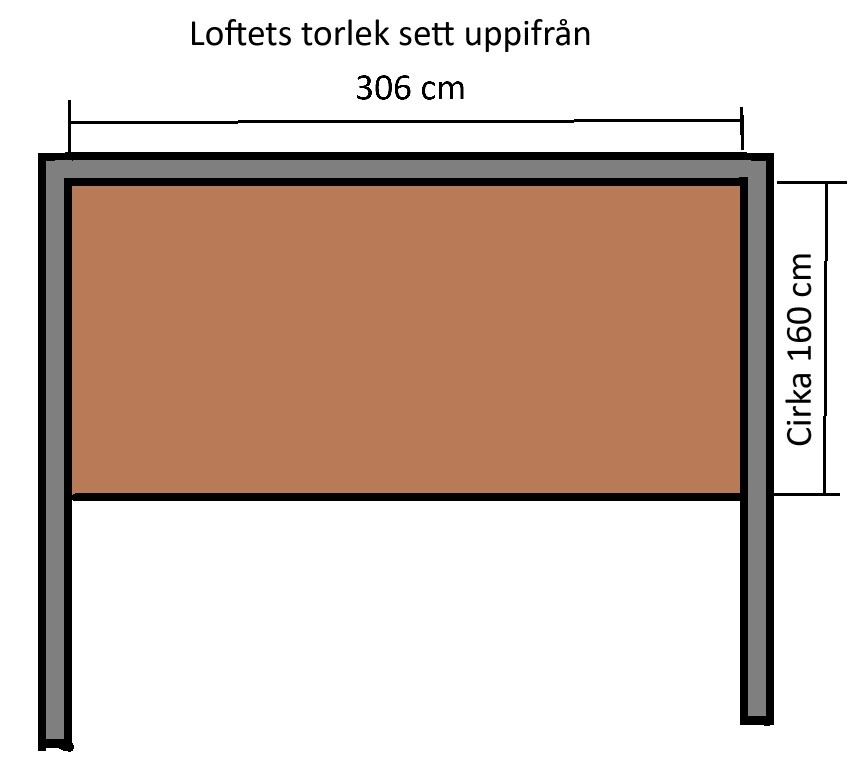
The span is 306 cm and the total area is 306 x approximately 160 cm.
There should not be any posts other than possibly along the walls, without any other support for the entire span except along the walls.
I want to work with wood and wood materials, and as mentioned, I want the thickness of the loft to be as small as possible.
I am considering
12 mm plywood (not "construction grade") glued and screwed/nailed to the underside of the loft and
12 mm particle board as the floor, which is only glued.
These boards are already available.
Fastening to the walls or posts to the floor along the walls I can solve, so it's really just the load-bearing capacity of the loft I need help with, at least to begin with.
The front edge of the loft can have a slightly higher beam than the rest of the loft (serving as a kick guard) so that not everything falls off when it comes near the edge.
Yes, it definitely feels like a 45x95 beam on edge should suffice, I'll try to find something about deflection under approximately these load cases so I should be able to assess if it's sufficient or not.
If the deflection is reasonable (without screw gluing), three beams plus one next to the wall should confidently support the loft for six adults (approx. 1 person/m2). Perhaps an additional beam is needed at the front to bear more load towards the open space. Next to the wall, it should hold without any problems.
Screw gluing will be an extra reinforcement. How do you perform screw gluing so that it is strong and effective?
Number of screws?
Screw length?
Type of glue?
Well, it absolutely feels like a 45x95 rule on edge should be sufficient. I'll try to find something about deflection in these load cases so I can determine if it's enough or not.
If the deflection is reasonable (without screwing and gluing), three joists plus one next to the wall should allow the loft to easily support six adults (approx. 1 person/m2). Perhaps an extra joist at the front is needed to handle a larger load towards the open space. Next to the wall, it should hold up without issue.
The screwing and gluing will be an extra reinforcement. How do you perform screwing and gluing so it becomes strong and effective? Number of screws? Screw length? Type of glue?
Oh, it went awry with the deflection without screwing and gluing. If I've calculated correctly, it becomes 25 mm with a point load of 160 kg. I'll simply have to change the load! After all, it's not likely that there will be a bunch of adults on the children's loft. If I calculate with one adult in the middle of the beam, it gets a bit better at least.
I = 0.045 x 0.095^3 / 12 = 3.21 x 10^-6 m4
δmax=(785 N x 3m^3) / (48 x 11x10^9 N/m2 x 3.21×10^−6 m4) ≈ 12 mm (48 comes from the load case with a beam freely rotating at the ends.)
The second load case (320 kg distributed load) becomes δmax=5q x ℓ^4/384 x E x I = 31 mm
It's not going to happen that four adults hang on the railing, and if it does, the screwing and gluing will assist enough, I believe. We'll see if it might not be a good idea to add an extra beam at the front or if I'll be satisfied with screwing and gluing a 22x125 board at the front that can serve as a combined "cap" at the front, toe guard, railing attachment while also providing some assistance in case a bunch of adults happens to be there.
The deflection is nothing to worry about. For simplicity, you can look at a standard bed with a slatted base, it can easily support 2 adults and has slender dimensions and 70-90cm between the supports of the slats.
The deflection is nothing to worry about. For simplicity's sake, you can look at a regular bed with a slatted base, which easily supports 2 adults and has small dimensions with 70-90 cm between the slats' supports.
There's a bit of a difference between a 90 cm wide bed and a 300 cm wide bed, but it seems to work well to take up the load of several adults with 45x95 on edge and screwed-laminated plywood on the underside. Should handle 20 mm, which is okay in my opinion.
There is indeed a difference between a 90 cm wide bed and a 300 cm wide bed, but it seems to work well to bear the load of several adults with 45x95 on edge and screw-glued plywood on the underside. Should handle 20 mm, which I think is okay.
Screw-glue panels on both sides, preferably set the studs at cc600mm or less.
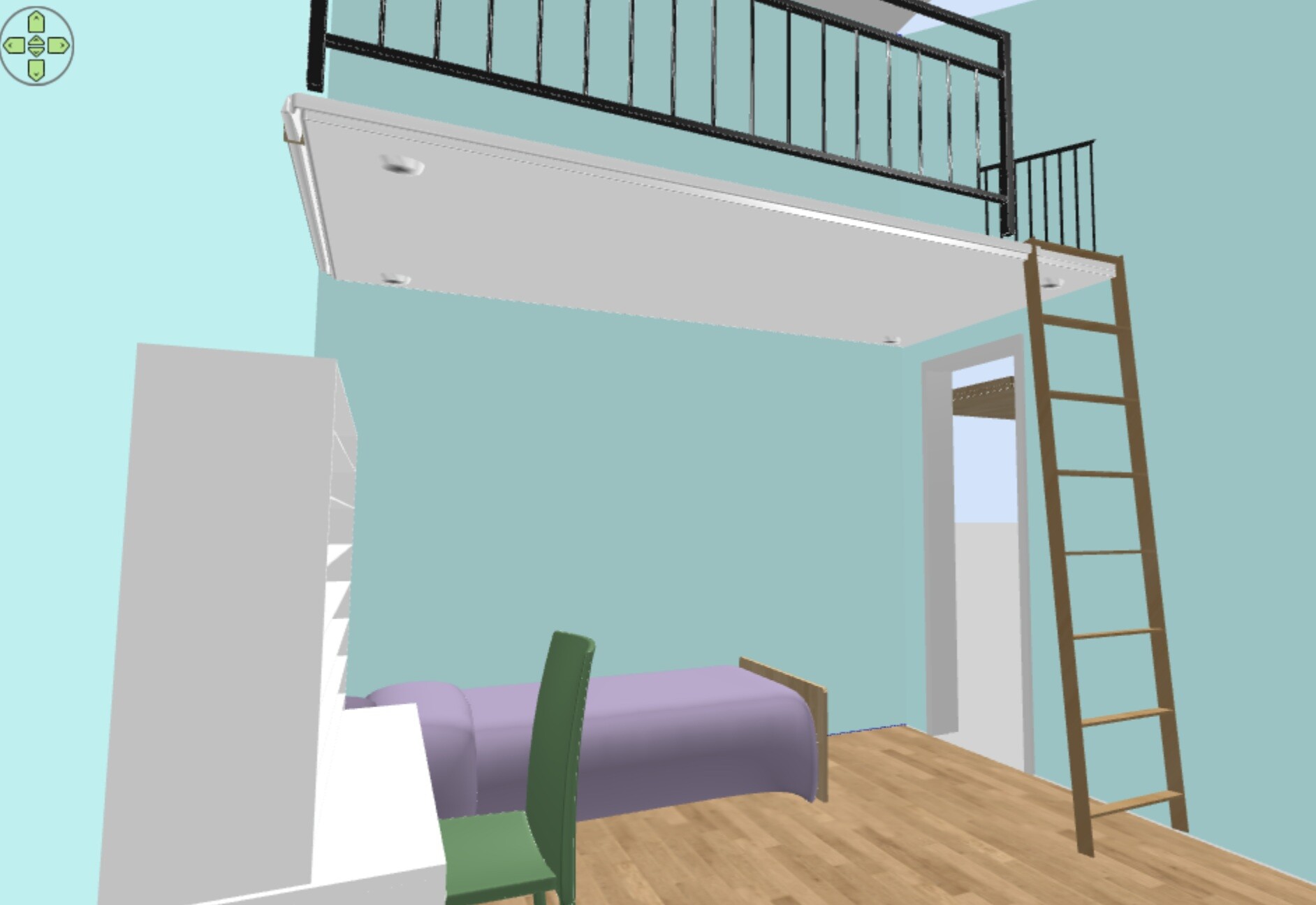
This is roughly how it will be, at least if I get to decide.
They are not spotlights on the underside of the loft; they are the legs of the flying bed I use as a loft in the web version of Sweet Home 3D. I didn't immediately figure out how to add an intermediate level.
Click here to reply
Vi vill skicka notiser för ämnen du bevakar och händelser som berör dig.