
11,120 views ·
15 replies
11k views
15 replies
Concrete slab: thickness and reinforcement
Planning to pour a concrete slab on which a stone oven (approx. 800 kg) will stand.
The slab will be supported by a frame of concrete pillars (approx. 80 cm high), possibly an additional row in the middle if needed.
What thickness should the slab be?
And how strong of a reinforcement mesh do I need? Is it better to have two "layers" of reinforcement rather than one?
I would prefer to avoid the row of pillars in the middle. Can I skip it, or is it needed?
The slab will be supported by a frame of concrete pillars (approx. 80 cm high), possibly an additional row in the middle if needed.
What thickness should the slab be?
And how strong of a reinforcement mesh do I need? Is it better to have two "layers" of reinforcement rather than one?
I would prefer to avoid the row of pillars in the middle. Can I skip it, or is it needed?

Member
· Stockholm
· 1 397 posts
I perceive it as a floor structure and not a slab on grade?
800 kg static load is enormous. You need an engineer to calculate it, but it will require a lot of reinforcement and concrete.
800 kg static load is enormous. You need an engineer to calculate it, but it will require a lot of reinforcement and concrete.
8 kN is a piece of cake for breakfast as a structural engineer
 But it's still important to get it right here so that it doesn't tip over and fall or something. A tall structure on 4 plinths is not self-stable.
Thanks for the reply!
I am not entirely sure about the final weight but estimate it to be 800 kg, based on the weights I've seen specified for other ovens of similar size.
The idea is for the oven to be placed about 5 cm inside the edges of the slab. Under the oven, there is also a slab with an insulating layer of vermiculite/cement shaped so that the oven's stones rest on its outer edge. And this slab will be cast on the larger slab (160 x 175 cm). The oven will be approximately 150 x 170 (a half sphere with an opening that goes to the outer edge of the concrete slab). See the sketch I've made.
There are ovens being built on YouTube where slabs are cast on pillars with thicknesses ranging from 5 cm to what I estimate to be 15 cm, and with varying degrees of commitment regarding reinforcement. And that's why I became unsure and wanted to ask the questions. I also attach a photo of an oven similar to the one I plan to build.
I am not entirely sure about the final weight but estimate it to be 800 kg, based on the weights I've seen specified for other ovens of similar size.
The idea is for the oven to be placed about 5 cm inside the edges of the slab. Under the oven, there is also a slab with an insulating layer of vermiculite/cement shaped so that the oven's stones rest on its outer edge. And this slab will be cast on the larger slab (160 x 175 cm). The oven will be approximately 150 x 170 (a half sphere with an opening that goes to the outer edge of the concrete slab). See the sketch I've made.
There are ovens being built on YouTube where slabs are cast on pillars with thicknesses ranging from 5 cm to what I estimate to be 15 cm, and with varying degrees of commitment regarding reinforcement. And that's why I became unsure and wanted to ask the questions. I also attach a photo of an oven similar to the one I plan to build.

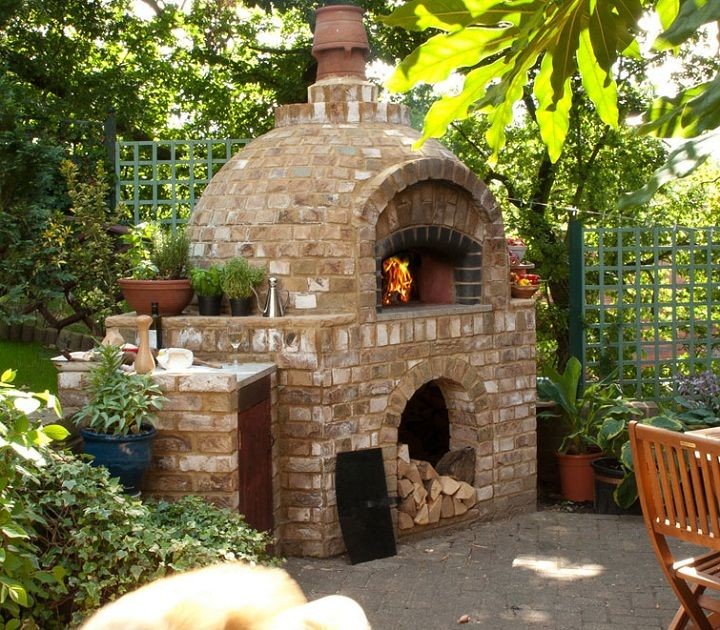

Yes, that's correct. See the photo above.
The estimated number of bricks needed is 250. One brick weighs 2.8 kg, which totals 700 kg.
Additionally, there is the base with styrofoam/cement and an approximately 10 cm thick layer of plaster/insulation consisting of various parts, as well as "decorative stones" and a chimney to be constructed at the front. It's hard to see how it could be under 800 kg.
But to be a bit more precise, we can calculate the dome itself, which will consist of several interlocking divided refractory bricks.
A sphere has the volume: (4*π*r^3)/3.
The outer sphere (radius 62 cm) then has a volume of 998 liters.
The inner sphere (the hollow part, radius 50 cm) has a volume of 523 liters.
998 - 523 = 475 liters. Divided by two since it's a hemisphere = 238 liters of refractory brick (and mortar).
Under the dome, there's a refractory layer of the same brick, with a volume of 60 liters.
In total, we have 300 liters of refractory brick. A brick reportedly weighs 2.8 kg and with the given dimensions, it has a density of 2.13 kg per liter. This gives a weight for the dome plus base = 300*2.13 = 640 kg. At the front, there's an opening, but on the other hand, an arch will be constructed above it, so it roughly balances out.
Therefore, we also have the weight of the chimney, the insulating mantle, and the insulating base plate (vermiculite/cement). And 700-800 kg is not unreasonable?
"Ready-made" stone ovens are sold, which according to manufacturers weigh between 500 and 2,000 kg. The small ones consist solely of domes + chimney.
The estimated number of bricks needed is 250. One brick weighs 2.8 kg, which totals 700 kg.
Additionally, there is the base with styrofoam/cement and an approximately 10 cm thick layer of plaster/insulation consisting of various parts, as well as "decorative stones" and a chimney to be constructed at the front. It's hard to see how it could be under 800 kg.
But to be a bit more precise, we can calculate the dome itself, which will consist of several interlocking divided refractory bricks.
A sphere has the volume: (4*π*r^3)/3.
The outer sphere (radius 62 cm) then has a volume of 998 liters.
The inner sphere (the hollow part, radius 50 cm) has a volume of 523 liters.
998 - 523 = 475 liters. Divided by two since it's a hemisphere = 238 liters of refractory brick (and mortar).
Under the dome, there's a refractory layer of the same brick, with a volume of 60 liters.
In total, we have 300 liters of refractory brick. A brick reportedly weighs 2.8 kg and with the given dimensions, it has a density of 2.13 kg per liter. This gives a weight for the dome plus base = 300*2.13 = 640 kg. At the front, there's an opening, but on the other hand, an arch will be constructed above it, so it roughly balances out.
Therefore, we also have the weight of the chimney, the insulating mantle, and the insulating base plate (vermiculite/cement). And 700-800 kg is not unreasonable?
"Ready-made" stone ovens are sold, which according to manufacturers weigh between 500 and 2,000 kg. The small ones consist solely of domes + chimney.
Last edited:

Member
· Västerbottens län
· 18 072 posts
The dome stands on the edges of the slab, so the slab only carries itself and the pizza being baked.
Make a small edge beam.
Protte
Make a small edge beam.
Protte
The dome is to stand on a 10 cm thick, insulating plate of cement/vermiculite, which in turn stands on the cast concrete slab and which in turn rests on the posts. Then the dome's weight will distribute over the area of the vermiculite plate, which in turn stands in the middle of the concrete slab. In other words, the dome's weight is distributed over a roughly circular area with a diameter of 150 cm, located in the middle of the concrete slab.
Excavate 30cm
Lay geotextile fabric
Lay 20 cm of 8-16 macadam
Pour a 10cm slab with 6150 reinforcement
Allow reinforcement to extend out of the slab where you will place your piers.
Form for piers and the upper slab.
Pour piers and slab 10cm
if you feel unsure about the strength, pour 15cm slabs and lay double layers of 6150.
...that's how I would do it anyway.
Lay geotextile fabric
Lay 20 cm of 8-16 macadam
Pour a 10cm slab with 6150 reinforcement
Allow reinforcement to extend out of the slab where you will place your piers.
Form for piers and the upper slab.
Pour piers and slab 10cm
if you feel unsure about the strength, pour 15cm slabs and lay double layers of 6150.
...that's how I would do it anyway.
Thanks.MathiasS said:
Excavate 30cm
Lay landscaping fabric
Place 20 cm 8-16 macadam
Cast a slab of 10cm with 6150 reinforcement in it
Let the reinforcement protrude from the slab where you will have your pillars.
Form for pillars and upper slab.
Cast pillars and slab 10cm
if you feel uncertain about the strength, cast 15cm slabs and lay double layers of 6150.
...that's how I would do it anyway.
That was pretty much exactly how I had planned to do it if no one had come up with suggestions. And it seems like 10 cm should be enough for both slabs if you look at how other oven builders have chosen to dimension.
I have now dug out, filled with 20 cm of crushed stone, and made the casting frame. I have read (and realized) that the concrete will partially seep into the crushed stone to no benefit. And my first thought was that maybe one could lay a geotextile/landscape fabric between the crushed stone and concrete to prevent this. Or for some reason, is this a bad idea?Z zingo said: