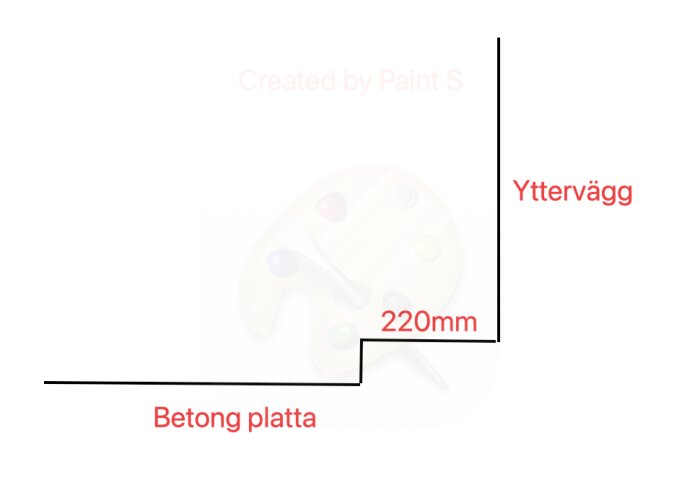
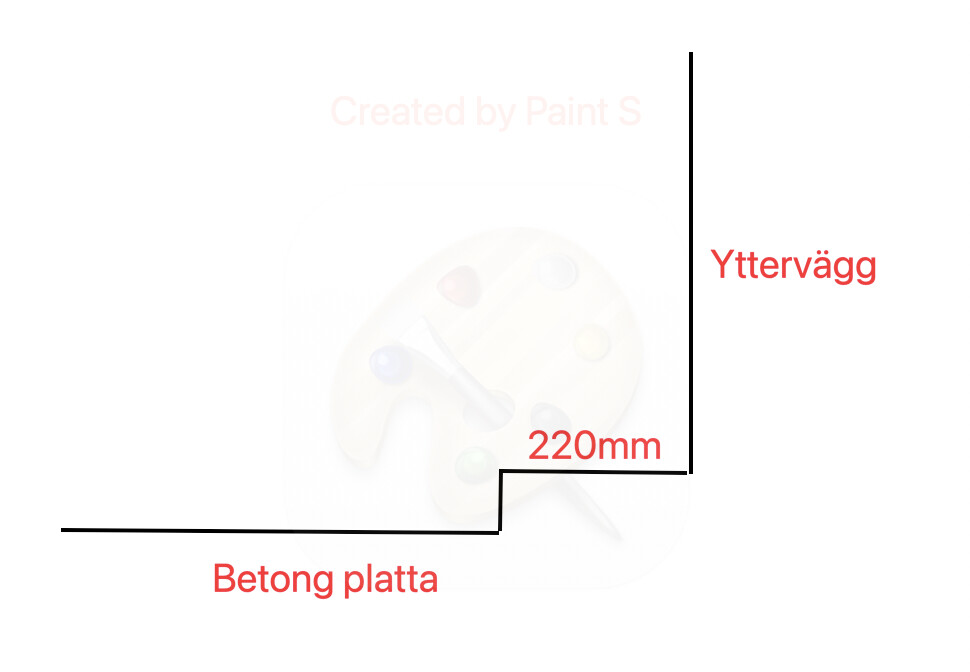
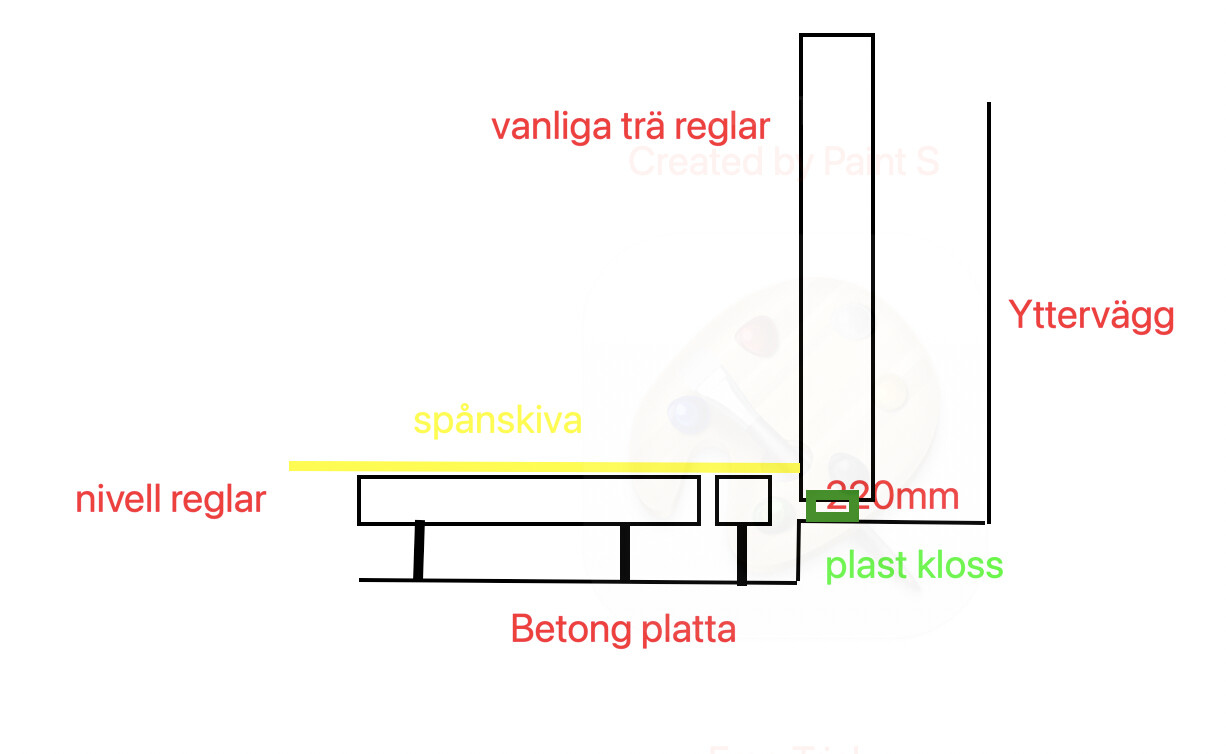
Hello, I recently tore down the basement and as you can see in the drawing I made, I have a rise at the edge of the concrete slab against the outer walls. It's a bit tricky with leveling since it has to be before the actual rise there. The height is about 30-40mm, it varies since it's a rough concrete slab.
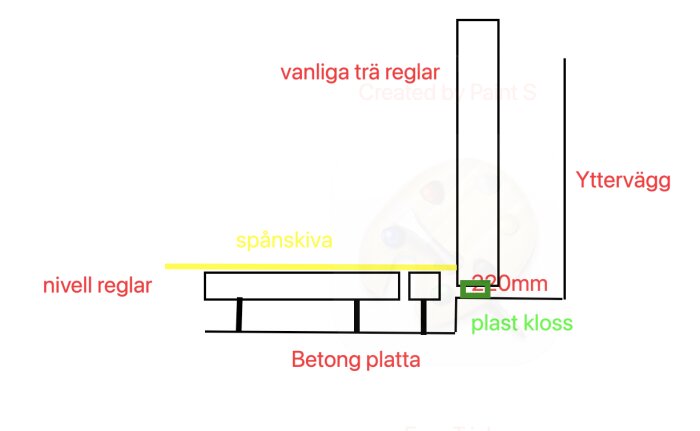
I was considering if it's a good idea to place the leveling joists as close as possible to the rise and then build the wall on the edge where I place plastic pads between the sill and the concrete.
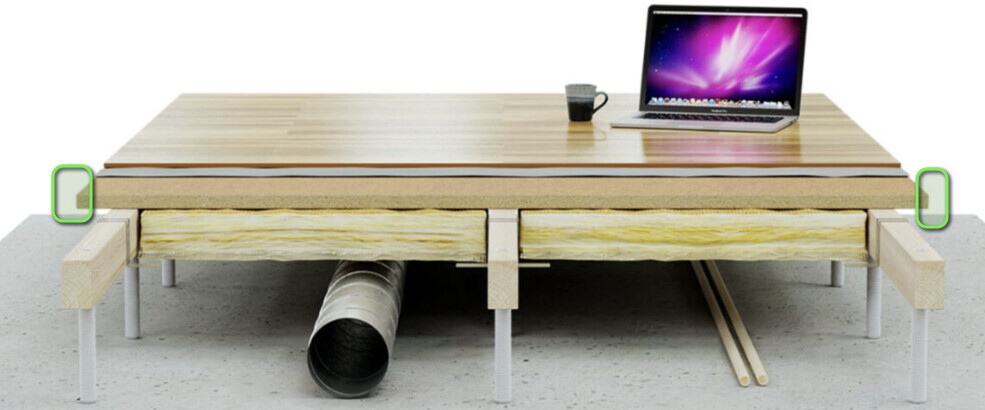
It's important that the height between the slab and the top edge of the joist (Construction height to top of joist) does not exceed 70mm. The reason for this is that we have a staircase that will go down to this floor, and the previous floor had 70mm joists lying directly on the slab. This is what I had in mind, unfortunately, I missed drawing the insulation between the leveling joists and behind the wall.
I lose about 2 sqm by having to move forward the wall, so the room goes from 37sqm to 35sqm, which I can live with.
What would you do? We were also considering skipping the leveling and just pouring concrete on the slab to make it smooth and nice, then use Platon mat, foam, age-resistant plastic, floorboard, click flooring. We plan to run the Platon mat behind the joists and open up towards the upper ceiling angle so the air can circulate, but that idea becomes a bit difficult now that we have that rise at the edges. The rise, if we pour and level the ground, will be about 2 - 4 cm.
As I said, we're a bit uncertain about the alternatives here, so all suggestions are welcome! Thank you in advance!
35m2 with a 220mm height difference becomes almost 8 cubic meters of concrete, I would probably choose to insulate with some strong cell foam 150mm or similar. Alternatively, leveling floor.
Why are you covering concrete with Platon membrane, plastic, cell foam, etc.? Do you have radon problems, or significant moisture?
35m2 with a 220mm height difference becomes almost 8 cubic meters of concrete, I would probably choose to insulate with some strong cell foam 150mm or similar. Alternatively, nivellfloor.
Why are you covering concrete with Platon mat, plastic, cell foam, etc.? Do you have radon issues, or significant moisture?
Sorry, the 220mm is the width; the height is 30 - 40 mm depending on which side of the slab you are on. I apologize for the lack of clarity.
No issues with the slab, it was drained in 2012, dry and fine. Pouring was just an option; we are mostly considering nivell now, but we don't know how to build the walls and floor when having such a height increase.
maybe cast with EPS? and then lay foam and floor on it? platon and a lot of plastic in between only prevent any additional moisture from escaping. Or you could go with tiles over the entire floor.
maybe cast with EPS? and then put foam and flooring on it? Platon and lots of plastic between only means it can’t release any potential incoming moisture. Or you could lay tiles over the entire floor.
You're thinking that you cast up to the elevation and then just lay flooring on it? Feels like it might be a bit too cold. Is the idea then that the wall is built with blocks but the click flooring lies on foam on the actual EPS? Do you think the construction I drew would work well for ventilation in the basement?
It will be cold even if you put on platon unless you add heat. There are cell plastic boards to place on concrete floors where you can lay floor heating cables. They build about 25mm. That's how we did it in the garage when it was converted into a bedroom. Works great, but it probably costs quite a bit to keep it warm. I would place the wall on syllpapp or something similar, just to break the capillary effect between concrete and wood. Then you can attach the horizontal timber to the floor properly so the wall becomes sturdy. If you use nivellgolv to level the step, you can insulate with cell plastic underneath, it doesn't absorb either.
It will be cold even if you add Platon unless you provide heat. There are celloplastic sheets to place on concrete floors in which you can lay underfloor heating cables. They build about 25mm. That's how we did it in the garage when it was converted into a bedroom. Works great, but it might cost a bit to keep warm. I would place the wall on a sill paper or similar, just to break the capillary effect between the concrete and the wood. Then you can fasten the horizontal stud to the floor properly so the wall becomes stable. If you use a leveling floor to even out the ledge, you can insulate with celloplastic underneath, which doesn't have any absorbency either.
Yeah, exactly, then you can lay OSB, then gypsum before you do the floor, and you build the floor on leveling where you lay the floorboard against the wall, there might be 4-5cm where the floorboard doesn't get support, but it shouldn't be a problem. You can then add ceiling angle ventilation.
OSB and gypsum on the floor? You should use floor chipboard, OSB has no tongue and groove, double work with the gypsum and it won't be better than floor chipboard. Floor chipboard costs about 125 SEK/m2, OSB + gypsum about 200 SEK/m2.
With floor chipboard, no support is needed for the last 4-5 cm against the wall unless you want it. But the exterior walls should rest against the concrete floor (with a sill plate between).
No, I mean OSB board on the wall, there are two constructions. One is a nivel floor, but then I will have an inner wall. So I can pull the edges of the floorboard against the wall that I'm building on the elevation.
No, I mean OSB board on the wall, it's two constructions. One that is a nivell floor but then I will have an inner wall. So I can pull the edges of the floorboard against the wall that I am building on the elevation.
OSB and plasterboard on the floor? You should use flooring chipboard, OSB doesn't have tongue and groove, double work with the plasterboard and won't be better than flooring chipboard. Flooring chipboard approx. 125 SEK/m2, OSB + plasterboard approx. 200 SEK/m2.
With flooring chipboard, no support is needed for the last 4-5cm against the wall if you don't want it. But the external walls should be against the concrete floor (with sill paper in between.)
Yeah, exactly like that. Nice, thank you so much for the help!


Hubbe73 said:
35m2 with a 220mm height difference becomes almost 8 cubic meters of concrete, I would probably choose to insulate with some strong cell foam 150mm or similar. Alternatively, nivellfloor.