
5,172 views ·
30 replies
5k views
30 replies
Concrete for refilling around pipes in shower room
KJD said:
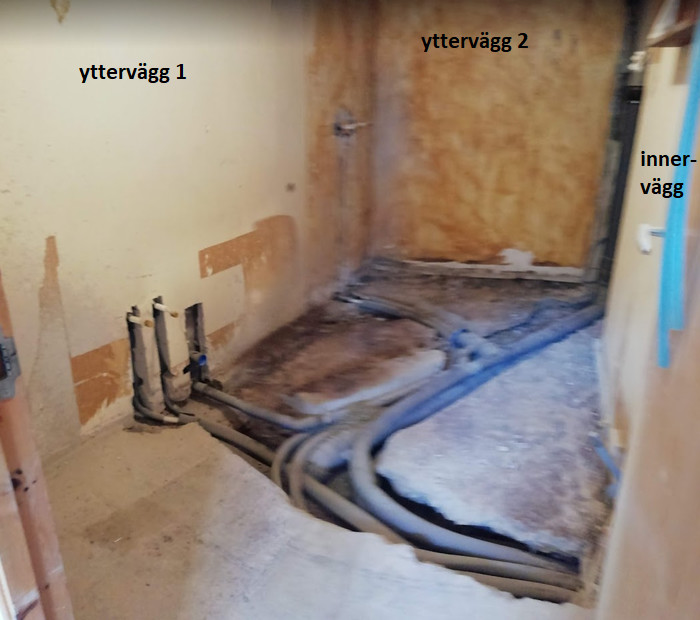
You seem to have found most of it yourself. A bit strange that you have an exterior wall in both directions?I'll see what else I have in the picture wall.
But I have control over the wall, we are going to build an "installation layer" (or blind wall) to secure it, as the wall is made of ciporex elements used as "insulation" according to the original drawings. If there are arguments here that are crystal clear it's certainly interesting.
Then it is indeed the same with the drainage pipe in the wall up - which probably shouldn't be in the "insulation" either, but it would steal so much space that it's a bit painful to have to move it, but sure, it probably should be in a channel too. I'm open to ideas here. (Currently, the old drain meets the new one roughly in the middle of the wall with a rubber sleeve, which will be replaced when we change the pipes up to the entry level).
There are also some pipe bends that are 90 degrees, but will become 45+45.
Was there anything else that @simmeboy, or others, saw as flaws in the drainage installation, I'm interested?
If you could specify more exactly what looks odd it would be interesting to hear.
I must admit I don't quite know about the drainage being embedded in the exterior wall. However, I think it's ok.
If you're going to change the drainage upward later, I wonder how that's going to work if you finish the bathroom first? You should install a jet coupling up at the ceiling so you can access it from above.
I don't really get the feeling that you've had a company involved in this project that is certified by Säker Vatten.
It should also be noted that it's most likely not dangerous at all to embed the water pipes as it's done. If you just plaster and tile over the pipes they won't freeze if you have a normal basement wall and have the heat on inside.
But rules are rules. If you want to do it right you'll have to redo it.

yep, unfortunately I'm not home right now, but I found this one too, which is definitely not better (a "panorama" that went wrong), but it shows the entirety a bit more with installations for the washbasin to the left. Around the corner to the right, it continues with the former sauna which will have a bathtub, etc.
(a "panorama" that went wrong), but it shows the entirety a bit more with installations for the washbasin to the left. Around the corner to the right, it continues with the former sauna which will have a bathtub, etc.
Seems there was an error when you uploaded the image.
Yes, unfortunately, I'm not home now, but I also found this one, which is definitely not better
No, in hindsight, we wish we had chosen another firm, but it is overall a very large project, and two firms chose to decline. The third firm took it but wanted to divide it into stages to avoid getting lost.Krille-72 said:
You seem to have discovered most things yourself. A bit strange that you have an outer wall in both directions?
I must admit that I’m not quite sure about the drainage being imagined in the outer wall. However, I think it’s okay.
If you're going to change the drainage upwards later, I'm wondering how that will work if you finish the bathroom first? You should install a jet coupling at the ceiling so you can access it from above.
I don't get the feeling that you had a firm involved in this project with authorization from Säker Vatten.
Then it should be added that there's most likely no danger at all embedding the water pipes as it's done. If you just plaster and tile over the pipes, they won't freeze if you have a normal basement wall and have heating on the inside.
But rules are rules. If you want to do it right, you'll have to redo it.
We won't complete everything with walls before we resolve the connection upwards; it is very much a logistical exercise since we're renovating a shower room, two guest WCs, and a laundry room right now, and only have a larger bathroom available on the upper floor. You can't finish everything at once; besides, this shower room happens to be right below the larger bathroom on the upper floor.
Another logistical reason is that we aim to install vent flooring in other rooms outside this in the basement but want to complete all chiseling and casting before that. The vent flooring is waiting for us
.marked exterior walls.No, in hindsight we wish we had chosen another company, but it is overall a very large project, and two companies chose to decline. The third company took it on, but wanted to divide it into stages, so as not to get lost.
We will not be finishing all the walls before we solve the connection upwards, it's much a logistical exercise, as we are renovating a shower room, two guest WCs, and a laundry room now, and only have a larger bathroom available upstairs. It's not possible to finish everything at once, moreover, this shower room happens to be directly below the larger bathroom upstairs.
Another logistical reason is that we are going to install ventgolv in the other rooms outside this one in the basement, but want to finish all the chipping and casting before that. The ventgolv is waiting for us
Since each company has an obligation to follow industry regulations or write deviation reports, it seems you should have a construction meeting with those responsible and review how everything is planned. You have quite a few ? that need to be clarified.No, in hindsight we wish we had chosen another company, but it is a very large project overall, and two companies chose to decline. The third company took it, but wanted to divide it into stages to avoid getting stuck.
We will not complete everything with walls until we resolve the connection upwards, it is very much a logistical exercise, as we are renovating a shower room, two guest toilets, and a laundry room now, and only have a larger bathroom available upstairs. It's impossible to complete everything at once, plus this shower room happens to be directly below the larger bathroom upstairs.
Another logistical reason is that we will install ventgolv in the other rooms outside this one in the basement, but want to finish all chiseling and casting before that. The ventgolv is waiting for us
You mentioned ventgolv in other rooms. Is it dry enough in the bathroom to be able to build a bathroom without ventgolv there?
If it is also a larger project, it is very important that you and the company find a good way to communicate in the future.
Perhaps it would be appropriate to invest in an inspector who partially inspects different stages and then conducts a final inspection. It costs a bit, but you save a lot of headache in the end.
Additionally, you put pressure on the contractor to do things correctly. There are many companies that think they are doing things right.
The idea of an inspector was interesting, something I hadn't considered - it's often difficult to question the companies doing the work, and I often find they take it personally. We had planned to bring in another plumbing company with Säker Vatten accreditation to make a proposal for measures before we seal everything up.Since every company has an obligation to follow industry regulations or write deviation reports, it feels like you should have a construction meeting with the responsible party and go through how everything is intended. You have quite a few things that need to be sorted out.
You mention vent floor in other rooms. Is it dry enough in the bathroom to build a bathroom without a vent floor there?
If it's a larger project, it's very important that you and the company find a good way to communicate going forward.
It might be worth hiring an inspector who can partially inspect various stages and then conduct a final inspection. It costs a bit, but you'll save a lot of headache in the end.
Moreover, you put pressure on the contractor to get it right. There are many companies that think they're doing it right.
Sure, some things need to be addressed, but I don't feel everything is completely off the wall, though I could be wrong, and I'm happy to hear more opinions.
Regarding vent floors, it's been fairly thoroughly researched in other threads here on the forum. We haven't had moisture issues, but we're doing it as a precaution (because we have an uninsulated slab) to be able to have underfloor heating. It seems more common to use EPS concrete (which is diffusion-open) in wet areas rather than vent floors, which become relatively complicated in wet areas.
Thanks for the engagement, much appreciated
.From what I can see, the water pipes don't appear to be pipes-in-pipes the entire way? It's hard to tell from the pictures, but I think I see white pex hoses where it should be cast again. If they don't go pipes-in-pipes all the way, you'll never notice if there would be a leak.
If you're having underfloor heating, there's a risk of legionella as the underfloor heating might potentially heat up tap water that lies in the slab.
If you're having underfloor heating, there's a risk of legionella as the underfloor heating might potentially heat up tap water that lies in the slab.
it's pipe-in-pipe all the way, though no insulation above the floor, and possibly the last decimeter before it goes into the wall (maybe that's a problem too - need to check with Säker-vatten).
However, it must not be in this wall as it is here, since it serves as the "insulation" in the construction. As mentioned above, we will move it out to a "blind wall" (aka "installation layer").

However, it must not be in this wall as it is here, since it serves as the "insulation" in the construction. As mentioned above, we will move it out to a "blind wall" (aka "installation layer").
In the image above, there is a wooden block (!) which is a very strange story from the construction (69), I heard from a mason who was around in the '60s that these kinds of blocks were used to set the light concrete blocks on, but then they would put mortar under the wall and remove the blocks. They weren't supposed to remain even then, and here it’s even in a bathroom. Does anyone have experience with this? I'm wondering if it can be classified as a "hidden defect" since it wasn't "detectable" and not "expected" (note - we're not talking about classic sills in the concrete under suspended floors, we had those before - but this is in a wet room). We’ve also found it in the shower, sauna, and laundry room.it is pipe-in-pipe the whole way, however no insulation above the floor, and possibly the last decimeter before it goes into the wall (maybe that's a problem too - need to check with Safe-water).
However, it should not be in this wall as it is here, since it is the actual "insulation" in the construction. Here we will, as mentioned above, move it out into a "blind wall" (aka "installation layer").
[bild]

How did the casting go? Which products were used? I have an almost identical scenario in my basement that needs to be cast again soon. I'm considering using weber 318 all the way up to the regular slip mix and then leveling a slope. (Upcoming bathroom)
built a mold and cast a plinth of coarse concrete, fixed and cast the line drain, and leveled the floor.F Filipbs said: