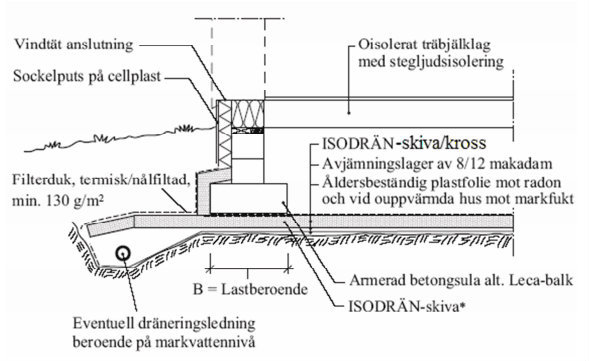
In the future, I plan to expand the house and intend to build a crawl space according to Isodrän's thermal foundation concept.
What I'm wondering about is what compressive strength class I need for the Isodrän panel under the foundation wall.
1.5-story house in southern Sweden.
When pouring a slab on the ground, you usually use S100 as a rule of thumb, right? But it seems like the point loads would be higher when you only have a wall to place the house on instead of an entire slab.
Do you have a calculation that indicates what line load we're talking about? Depends on many factors, house's own weight, wooden structure/stone/, snow zone, light/heavy roofing, etc.
Wooden framework with wooden cladding on the outside. 1.5-story house (actually a single-story with an attic that is too low in the ceiling to be considered living space). Snow zone 2. Concrete tiles on the roof.
The dimensions of the extension to be placed on the foundation are 7.3*4.3 meters. The roof trusses will be on the short walls. (The total width of a roof truss will therefore be about eight meters.)
I will have an interior wall approximately 2.6 meters from one of the short exterior walls. If it makes any difference, I can make it load-bearing and support the wall from below with columns in the foundation.
The timber weighs about 0.5kg/dm3.
Snow zone 2 means 2kN/m2.
Insulation (cellulose) 50kg/m3.
The Lecablock for the foundation: 700kg/m3.
The concrete for the footing: 2400kg/m3.
With all that information, I should be able to estimate the weight of the entire extension. Based on that, it should then be possible to calculate the line load?
I have built some 2-floor houses with concrete intermediate floors. We used EPS with quality 200 there, so I would recommend you use it as it will hold.
I want to have Isodrän (or equivalent) under the sole, according to the sketch in the first post. But it shouldn't be a problem, I thought, Isodrän is also available in quality S200.
But now I checked the numbers a bit and just because both are S200 doesn't mean they are equally durable...
The maximum long-term load on S200 cell plastic (i.e. a maximum of 2% deformation over 50 years) is 60 kPa.
The maximum long-term load on Isodrän S200 is less than 15 kPa. Big difference! And S200 is the strongest Isodrän has.
So I guess I have to calculate a bit on what the actual loads will be.
Under which foam plastic? Check the sketch in the first post of the thread to see the intended construction. The Isodrän will both transport away moisture and function as thermal insulation.
Now I finally have time to do some calculations. I've made some simplifications in places, for example, I haven't accounted for any windows. But I believe I've only made simplifications that make it heavier.
The extension is 7.3*4.3 meters = 31.5 m^2
Outer walls 2225 kg
Floor 693 kg
Interior ceiling 283.5 kg
Interior wall 410.8 kg
Roof (including rafters and gable panel) 2236.3 kg
In total, what stands on the foundation will weigh about 5850 kg
Leca blocks for foundation wall 2226 kg
Concrete footing 3052.8 kg
Total weight including foundation about: 11130 kg
The roof is about 40 m^2.
Snow zone 2 gives a maximum snow load of about 8000 kg
So the weight that will maximum be on the ground is about 20 tons.
Can someone help me with what compressive strength I need for Isodrän/cellplast based on those figures?
Now I am on very thin ice here. If we assume that the entire weight is to be carried by the two short exterior walls on which the trusses rest, the weight is distributed over 40 cm * (4.3 m + 4.3 m). (The concrete footing is thus 40 cm wide). This would result in approximately 60000 N/m^2, or 60 kPa. But in reality, the long side also supports part of the extension's weight. The pillars under the load-bearing wall will also support part of the weight.
Is there anyone here who actually knows how to calculate this?
If instead, you calculate that the entire weight is evenly distributed over the entire sole (that is, under both the outer walls and the pillars under the heart wall), it becomes 30 kPa.
Now we're approaching something that Isodrän S200 could actually handle. Isodrän S200 has a deformation of 4.4% over 50 years at 30 kPa. But I only have 30 kPa when the snow load is at its worst. So it's maybe at most one month a year. Without snow, we end up at barely 20 kPa, and then the deformation is only 2.8%. But it's still over the limit of 2%.
Therefore, I will place every other board (or maybe every third, depending on the price) with regular foam plastic S200 or S300 to increase the load-bearing capacity. They handle 60 and 90 kPa (EPS) or 90 and 140 kPa (XPS), respectively.
Pordrän's strongest corresponds to Isodrän's S95.
Jackon's strongest (only) drainage board, Jackon Superdrän, is at S80.
So the only alternative under the sole (if you want a drainage board) seems to be Isodrän S200.
And the reason for having Isodrän instead of regular cell plastic under the slab is, according to Isodrän, to allow moisture migration from inside the foundation to the soil/drainage outside the foundation. With only regular cell plastic, it becomes too tight.
And the reason for using Isodrän instead of regular foam plastic under the foundation slab is, according to Isodrän, to allow moisture migration from inside the foundation out into the soil/drainage outside the foundation. With just regular foam plastic, it becomes too tight.
Shall we, for simplicity's sake, assume that it's mostly marketing talk? Regular foam plastic surely works just as well from a moisture perspective, as it's not impermeable at all. Why not spend the money on something that makes a real difference?
That a "regular" edge beam is connected to a concrete slab does not affect the strength. Nowadays, we often also insulate the edge beam from the slab to reduce heat leakage.
In the sketch in your initial post, it states that B = Load dependent regarding the concrete foundation. The seller might be able to help you with the calculation, if they want to make a sale. Normally, the loads are likely calculated much more roughly than what you're trying to do in your calculations.
Good luck with the extension!
Vi vill skicka notiser för ämnen du bevakar och händelser som berör dig.