
528 views ·
4 replies
528 views
4 replies
Close off a crawl space and make a WC
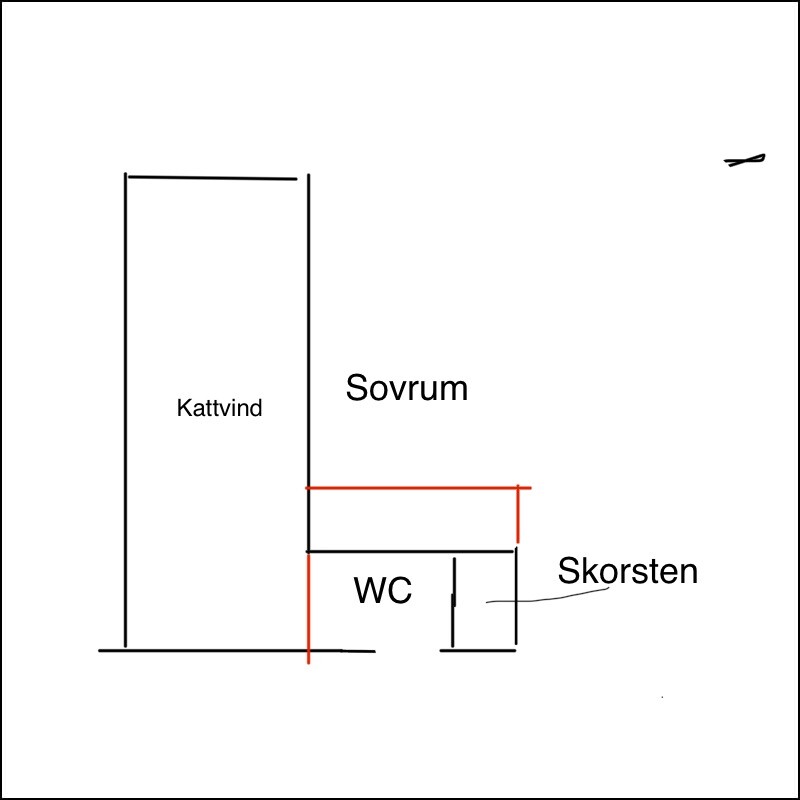
We lack a WC on the upper floor, and I've come up with the idea of converting a storage space. The problem is that you can only stand upright at the beginning of the attic. We have received a quote for plumbing, so we know it's possible to bring up sewage and water, but the big question is whether it is possible to close off the attic where there is no longer full ceiling height. How should one proceed in that case to avoid, among other things, moisture issues? The wall I plan to build won't be openable, but there might be an opportunity to create an access hatch from the bedroom into the closed attic for potential inspection.
My drawing shows the intended plan. Black lines represent the current layout, red lines show how we want it. We plan to tear down a wall next to the bedroom to widen the WC. The measurements aren't accurate in the picture, so please bear with us.
What thoughts and ideas do those with expertise have on this? Do you think it's possible?
My drawing shows the intended plan. Black lines represent the current layout, red lines show how we want it. We plan to tear down a wall next to the bedroom to widen the WC. The measurements aren't accurate in the picture, so please bear with us.
What thoughts and ideas do those with expertise have on this? Do you think it's possible?
Of course, it's possible to do in most houses.
You have to consider how moisture and ventilation have worked so far and try to make as few changes as possible. If it's an old house with virtually no insulation allowing some moisture migration through the walls, it might be better to allow the air to move as it did before the renovation. A lot can be done with foam and similar materials to create slightly thinner walls/ceilings and achieve "adequate" insulation, and sometimes it's better to build a new wall a bit away from the old one if there's a risk of moisture that can't be vented away.
I built a "box" with a toilet in the attic crawl space but left room outside and above so the air can move as before. It worked without issues in the almost 17 years I lived there.
Regarding ceiling height, you don't need full height when you're sitting on a toilet anyway.
Be sure to install a new hatch into the attic crawl space so it can be inspected.
You have to consider how moisture and ventilation have worked so far and try to make as few changes as possible. If it's an old house with virtually no insulation allowing some moisture migration through the walls, it might be better to allow the air to move as it did before the renovation. A lot can be done with foam and similar materials to create slightly thinner walls/ceilings and achieve "adequate" insulation, and sometimes it's better to build a new wall a bit away from the old one if there's a risk of moisture that can't be vented away.
I built a "box" with a toilet in the attic crawl space but left room outside and above so the air can move as before. It worked without issues in the almost 17 years I lived there.
Regarding ceiling height, you don't need full height when you're sitting on a toilet anyway.
Be sure to install a new hatch into the attic crawl space so it can be inspected.
Thanks for the response!P polaris78 said:Of course, it is possible to do in most houses.
You have to consider how moisture and ventilation have been functioning up to now and try to make as few changes as possible. If it's an old house with minimal insulation allowing some moisture movement through the walls, it might be better to leave air movement as it was before the renovation. You can do a lot with Styrofoam and similar materials to create a slightly thinner wall/ceiling and get "adequate" insulation, and sometimes it's better to build a new wall a bit away from the old one if there are risks for moisture that can't be vented away.
I built a "box" with a toilet in the attic but left space outside and above so the air can move like before. It worked without issues for almost 17 years I lived there.
Regarding ceiling height, you don't need full ceiling height where you're sitting on a toilet anyway.
Make sure to add a new hatch into the attic space so it can be inspected.
I realized something last night as well; perhaps it's even worth considering removing the entire wall between the bedroom and the attic space. That way, you can get a larger bedroom.
However, additional insulation is needed; currently, there is 20cm insulation. Also had some wasps in the attic during the summer, so some form of sealing might be necessary?
This feels so difficult to do on my own 😅

In kattvind walls, the roof truss struts are normally located, and they cannot be removed just like that. Often, one strut can be removed by support with the struts on either side, but not more. The planks/boards on the struts, i.e., the actual wall, can have a stabilizing effect, i.e., prevent the house from moving when it is very windy.L Linn LK said:
You're absolutely right about that. It will probably be a small door in.BirgitS said:
In the knee wall spaces, the rafters' support beams normally run, and they cannot be removed just like that. Often, one support beam can be removed by offsetting with the support beams on either side, but no more. The planks/boards on the support beams, that is, the wall itself, can have a stabilizing effect, meaning they prevent the house from moving when the wind blows hard.
Click here to reply