
52,679 views ·
26 replies
53k views
26 replies
Clad pillar foundation
Hello.
Last autumn, I bought a former summer cottage, which we now live in permanently.
It was supposed to be winterized, but it's somewhat lacking.
We found that out during this extremely cold winter.
Among other things, the floor is brutally cold!!
My question concerns the pier foundation. The cottage is only 54 m2 for now.
Natural plot consisting mostly of stone.
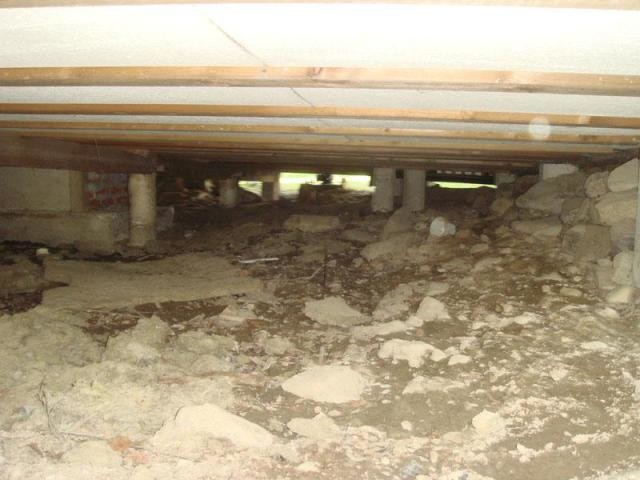
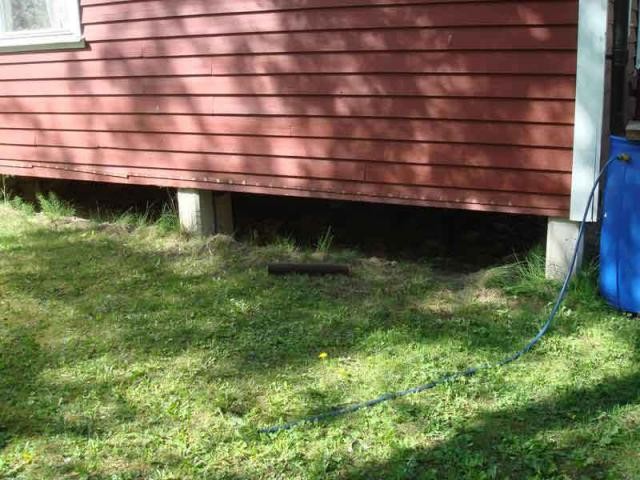
It's on piers, and there's enough room to get around underneath.
Large stones have been stacked all around to protect against badgers.
The ground is some type of sand, mixed with various small stones.
I am now in the process of removing the stones around and will lay down age-resistant plastic.
BUT what do I do next?
Can I cover the foundation with something that doesn't cost a fortune?
Like wood, such as a panel, with associated vents?
Someone suggested concrete blocks, but then I'd have to have something to set them on.
Another person suggested some type of asbestos sheets, but that would be brutally expensive.
Attached are pictures. To the right, you can see the stones that need to be removed.
I would be grateful for tips and ideas!!
Last autumn, I bought a former summer cottage, which we now live in permanently.
It was supposed to be winterized, but it's somewhat lacking.
We found that out during this extremely cold winter.
Among other things, the floor is brutally cold!!
My question concerns the pier foundation. The cottage is only 54 m2 for now.
Natural plot consisting mostly of stone.
It's on piers, and there's enough room to get around underneath.
Large stones have been stacked all around to protect against badgers.
The ground is some type of sand, mixed with various small stones.
I am now in the process of removing the stones around and will lay down age-resistant plastic.
BUT what do I do next?
Can I cover the foundation with something that doesn't cost a fortune?
Like wood, such as a panel, with associated vents?
Someone suggested concrete blocks, but then I'd have to have something to set them on.
Another person suggested some type of asbestos sheets, but that would be brutally expensive.
Attached are pictures. To the right, you can see the stones that need to be removed.
I would be grateful for tips and ideas!!
Last edited:

If the goal is to improve the appearance, then place, for example, pressure-treated wood 22X95 horizontally with a few cm gap between the boards.
If the goal is to increase the heat, I would focus on more insulation in the floor. Some say it's fine to just screw styrofoam under the floor, others say that it's a risky construction due to the risk of moisture above the styrofoam. I haven't read up enough to have my own opinion there.
If the goal is to increase the heat, I would focus on more insulation in the floor. Some say it's fine to just screw styrofoam under the floor, others say that it's a risky construction due to the risk of moisture above the styrofoam. I haven't read up enough to have my own opinion there.
Laying pressure-treated wood seems sensible. Thanks!
So, there was the other part, the heat.
It's foam plastic we have today, didn't know that moisture might be created on the top side.
I've googled it, but can't find anything that says either for or against.
What if you put plastic underneath, against the foam plastic then?
Does anyone know if that's completely wrong?
It should protect against moisture on the top side, it feels like.
So, there was the other part, the heat.
It's foam plastic we have today, didn't know that moisture might be created on the top side.
I've googled it, but can't find anything that says either for or against.
What if you put plastic underneath, against the foam plastic then?
Does anyone know if that's completely wrong?
It should protect against moisture on the top side, it feels like.
Never plastic on the outermost part of a construction!
-not in the Swedish climate at least...
(if we're talking about diffusion-tight plastic)
Moisture is a subject where "common sense" can sometimes
be misleading...
* Moisture is produced inside the house & migrates outward.
* It is the Relative humidity that causes problems:
"Dry & nice," warm indoor air can contain large amounts of moisture without issues,
If this air escapes outward into the construction and cools down, the same air
suddenly becomes "Cold & damp"...
If you want to insulate under the cabin without risking problems, place a
cellular plastic board with an open cell structure ("drainage board") under the joist.
For example, Pordrän, Isodrän, Jackodrän
-not in the Swedish climate at least...
(if we're talking about diffusion-tight plastic)
Moisture is a subject where "common sense" can sometimes
be misleading...
* Moisture is produced inside the house & migrates outward.
* It is the Relative humidity that causes problems:
"Dry & nice," warm indoor air can contain large amounts of moisture without issues,
If this air escapes outward into the construction and cools down, the same air
suddenly becomes "Cold & damp"...
If you want to insulate under the cabin without risking problems, place a
cellular plastic board with an open cell structure ("drainage board") under the joist.
For example, Pordrän, Isodrän, Jackodrän

Foam is excellent for insulating floors, walls, and ceilings. Thermisol and Cellplastdirekt are some brands. Here, for example, you can find info:
http://www.thermisol.se/faq.php?faq=inc.golv.php
http://www.thermisol.se/faq.php?faq=inc.golv.php

To read on thermisol.se:haavard said:
Foam plastic as insulation material
Foam plastic insulation consists of 2% polystyrene - the remaining 98% of the volume is enclosed air that provides the material its thermal insulating property.
ThermiSol insulation does not emit harmful substances and does not contain fibers that can be released during processing and installation.
ThermiSol foam plastic products contain no dyes or other chemical additives and the material is recommended by the Asthma and Allergy Association.
From the brochure Thermisol and the environment (http://www.thermisol.se/pdf/environ.pdf):
EPS is an excellent energy supplement in waste incineration. 1 kg of EPS contains the same amount of energy as 1.3 kg of oil. During complete combustion of EPS, only pure carbon dioxide and water remain.
Old myths die slowly. Foam insulation does not emit more toxic smoke gases than other insulation... however, it has a significantly lower flash point and burns quickly, which makes fire protection with foam insulation nonexistent... and is the reason that the foam should be protected behind fire-retardant materials like gypsum, where it works perfectly well. Personally, I place mineral wool and foam inside the walls and allow the foam to form a self-supporting unit between double interior walls... it does not settle and start to gap.
Moreover, if you build wooden houses and they start to burn to the extent that you need to evacuate, there's not much house to save regardless of whether it's foam or wool in the walls...
Moreover, if you build wooden houses and they start to burn to the extent that you need to evacuate, there's not much house to save regardless of whether it's foam or wool in the walls...
Foam plastic is not dimensionally stable. It expands and contracts with humidity and deforms over time under load.Forbo said:Old myths die slowly. Foam plastic does not emit more toxic smoke than other insulation... however, it has a significantly lower flash point and burns quickly, which makes fire protection with foam plastic non-existent... and is why the foam plastic should be protected behind fire-retardant materials like gypsum, where it works perfectly fine. I personally install mineral wool and foam plastic inside the walls and let the foam plastic form a self-supporting unit between double inner walls... it doesn’t sag or gap.
Additionally, if you build wooden houses and a fire starts requiring evacuation, there isn't much of a house to save regardless of whether it’s foam plastic or wool in the walls..
You are right that fire protection with foam plastic is non-existent. It can be protected, but unfortunately, it doesn’t work very well even when encased because it is more or less impossible to create perfectly sealed surfaces with what you protect it with. Electrical fires also have the unfortunate characteristic of often starting inside the wall behind the protective layer where they slowly spread and penetrate the outer panels.
A wooden house that burns often survives. Renovation is needed, but apart from smoke damage, it is relatively local. With large amounts of foam plastic in the construction, flashover and spread occur almost explosively. Which is not surprising. It is basically just foamed oil.
---
http://www.sydsvenskan.se/sverige/article897281/Idrottshall-i-lagor.html
"...// By half-past one, the fire had caught above the main entrance, in all the Styrofoam used to insulate the hall's new roof. Half an hour later, the forces were forced to retreat and watch as the roof collapsed.
- The Styrofoam gives a very intense fire progression, it releases an incredible amount of energy. //..."
---
http://www.youtube.com/watch?v=bJAWPfZzIKY
Is a fire test of sandwich panels with EPS. Unfortunately, it is not clear what the coatings consist of, but the fire progression is similar once this is breached. (Starts after 1:10)
Last edited by a moderator:

Put up a board between the plinths, then plaster it, and abracadabra it looks like a solid foundation. Attached is a link to my previous house where I did this. http://www.byggahus.se/forum/hemma-hos/147659-mitt-foersta-hus-jag-byggde-om.html
Good luck
Good luck
Set up a panel between the piers.
Exactly what I'm thinking. But what kind of panel?
I've received several suggestions for what to have outward.
Some type of panel, Leca, roofing felt, among other tips.
What's your suggestion for a "panel"?
Exactly what I'm thinking. But what kind of panel?
I've received several suggestions for what to have outward.
Some type of panel, Leca, roofing felt, among other tips.
What's your suggestion for a "panel"?