We have just finished the walls and ceiling on a renovation of a 15m2 extension.
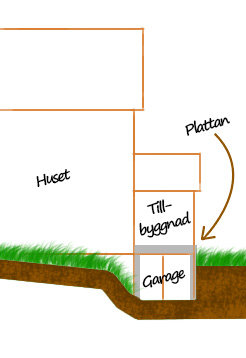
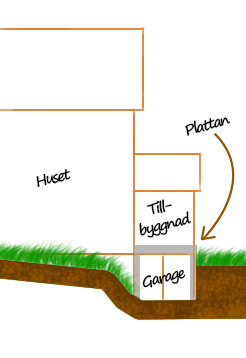
When we bought the house, it was a glassed-in outdoor patio, which we converted into an entrance. The extension (built in the late 40s) sits on what I know is an uninsulated concrete slab above a garage. So it’s not a slab that lies against the ground, but a garage "with air" separating the two.
This is what it looks like approximately.
So my question is; what is the best way to insulate this slab?
One needs to know a bit more to be able to give a good answer. Is the garage unheated/what is its temperature? How much vertical space is there in the extension and the garage? Are you planning to have electric underfloor heating? What type of flooring material do you intend to have in the extension? Is the concrete slab insulated at its edge and, if so, how?
Garage unheated and has the same temperature as the outside
Waterborne underfloor heating that I will float in and lay tiles on it
2.6m height on the extension
2.2m height on the garage
I don't know if it is insulated on the outer edge, I don't think so. It's concrete all the way out.
I can take a picture if it helps.
Thanks for the reply!
Concrete is a fantastic building material, but it has certain properties that must be considered. These include being extremely heat conductive (and cold conductive). Therefore, the outer edge must be insulated, with at least 10 cm insulation, (This provides the standard that applied between 1950 and 1975) otherwise all other efforts become pointless. The slab itself should be insulated on the underside to prevent warm and humid indoor air from condensing in the concrete and making it constantly wet. How this insulation should be done depends a little on how the garage is used. One can glue mineral wool without battens on the ceiling, but the impression becomes nicer if using wooden battens and covering everything with gypsum. The insulation should be at least 10 cm thick, but a ceiling height of 2.10 meters is OK for a garage.
Maybe use tracked EPS for the underfloor heating and install a floating clinker floor. This way, the heated part has no direct contact with the garage construction.
The wall section must have sill insulation, like paper just as in regular houses, to prevent moisture from being transported. You might want to complement the garage's outer wall with IsoDrän boards and nail paneling or re-plaster that part, so it matches the wall line of the extension.
If you want to be picky, the correct terminology is probably vault rather than slab.
The decisive factor would likely be how much you can build upwards from the current concrete vault. If you can place insulation on top of the vault and then cast a layer with underfloor heating, that would be best.
Agree that "vault" is the correct term. A slab lies directly on the ground. The crucial question is the height measurements. What is the maximum height measurement above the current top of the vault that you can accept considering the floor level in adjacent spaces? This must determine the choice of strategy.
Concrete is a fantastic building material, but it has certain properties that must be considered. This includes its extreme thermal conductivity (and cold conduction). Therefore, the outer edge must be insulated, at least 10 cm of insulation, (Then you get the standard that applied between 1950 and 1975) otherwise, all other efforts are pointless. The slab itself should be insulated on the underside to avoid warm and humid indoor air condensing in the concrete and making it constantly wet. How to perform this insulation depends a bit on how the garage is used. You can glue mineral wool without battens in the ceiling, but the impression is nicer if you use wooden battens and cover everything with plasterboard. The insulation should be at least 10 cm thick, but a ceiling height of 2.10 meters is OK for a garage.
Interesting, but what do you mean by the outer edge, is it the actual outer edge of the concrete.
As it is now the vault has an overhang of about 20cm.
What I have done is let the horizontal exterior panel cover the entire edge of the vault. (see picture below).
It feels a bit like it's not such a big problem with condensation. I find the garage to be very ventilated, but of course, I need to be aware of this!
Could you perhaps paint with some sort of wet room paint in the ceiling to keep the moisture out?
corre said:
Maybe run with grooved EPS for underfloor heating and lay a floating klinkers floor. Then the heated part has no direct contact with the garage construction.
The wall section must have sill insulation, for example, tar paper just like in ordinary houses, so moisture does not transport.
Maybe you should complement the garage's exterior wall with isodrän boards and nail the panel or plaster that section anew, so it matches the wall facade of the extension.
That was a good idea with grooved EPS! How does that work with the insulation of the vault edge and underside, is it needed? After the winter, we plan to drain the house and also build a patio at the front of the extension, it will cover the vault edge so maybe it's an idea to cover up the side all the way to the edge.
f91jsw said:
If we're being picky, the correct terminology is probably vault rather than slab.
The decisive factor should be how much you can build upwards from the current concrete vault. If you can lay insulation on top of the vault and then cast a layer with underfloor heating, that's best.
justusandersson said:
I agree that vault is the proper term. A slab lies directly on the ground. The key issue is the height measurements. What is the maximum height over the current top of the vault that you can accept considering the floor level in adjacent spaces? This must determine the choice of strategy.
The floor in the extension slopes (the part I will have tiles on), I have at most 5 cm for leveling compound + pipes + insulation at the highest point against the threshold, the lowest point is somewhere between 6-7cm.
There are many problems at the same time! Warm air can contain more water vapor than cold air. When warm air cools, the water vapor condenses. This is a fundamental physical problem that has nothing to do with an unusually high level of humidity. If you only have 5 cm to spare, the insulation must be placed on the underside of the concrete! You need as much insulation on the outside of the concrete as against the cold space.
There are many problems at the same time! Warm air can contain more water vapor than cold air. When warm air cools, the water vapor condenses. This is a fundamental physical problem that has nothing to do with an unusually high level of humidity. If you only have 5 cm to spare, the insulation must be on the underside of the concrete! You need as much insulation on the outside of the concrete as against the cold space.
I have noted what you write and agree with you. The person responsible for control also wanted garage roof insulation. That insulation will have to be in the future, but regardless of whether I insulate the ceiling to the basement or not, I must still have foam plastic in the floor, right? Is it okay to lay a 30 mm board over the entire area and then pour a layer of self-leveling compound over the pipes (which will probably be either 17mm or 12mm)? What type of insulation is used? Is it Cellplast S80 EPS? (checked at byggmax)
I have never dealt with foam plastic, is it porous?
30 mm cellular plastic is unfortunately quite pointless when today's insulation standard is 30 cm. Skip it. Otherwise, cellular plastic is an excellent material that withstands quite high loads. However, it is flammable.
I think you're wrong there. Uponor recommends at least 150mm for slab-on-ground, but I have a concrete floor that is not in contact with the ground. So if I add 30mm insulation, my guess is that the heat will be retained better. Warm air rises, so why help the heat go down? Also, self-leveling compound is significantly, if not enormously more expensive than expanded polystyrene. If I apply self-leveling compound directly onto the concrete instead, I'm just creating better contact between the concrete and heat. That's self-explanatory. I mean, all insulation helps to retain heat. It's like saying an extra 45mm insulation in a wall or a roof doesn't make any difference.
I would have considered laying grooved EPS over the entire floor, but self-leveling compound the layer as a floating construction.
Then it is not attached to the wall structure. You can, for example, lay a 12mm foam plastic strip against the wall, and when the self-leveling compound is poured out, it does not bond to the wall, but the foam plastic becomes a springy part against the wall.
Then you can continue to attach the wall as intended against the existing garage construction.
Definitely better with 30 mm than not at all. In a freezer, you have around 50 mm, and there it is +25 on the outside and -18 on the inside.
S80 is the simplest quality of foam plastic. It might work strength-wise, but for it not to break when you walk around on it and lay the underfloor heating pipes, it's probably better to choose a slightly higher quality, like XPS, or the boards designed for underfloor heating. I guess you will need to glue or spackle the foam plastic to the concrete flooring so that it has an even contact over the entire surface if the concrete is the slightest bit uneven. Otherwise, there's a risk the cake of self-leveling compound + tiles might crack when it is point-loaded later.
You should not paint the concrete in the garage ceiling or have any moisture barrier there. No moisture barrier on the cold side.
Moisture will likely not become a problem because the tiled floor + foam plastic will be very vapor-tight. Additionally, the concrete flooring will be heated from above and thereby dry out.
It is better to use polystyrene foam than self-leveling compound in the floor. The higher the quality, the better. However, for thermal insulation against a cold space, 30 mm is not sufficient. The Swedish National Board of Housing, Building and Planning's Building Regulations (BBR) has set a maximum U-value for a slab on the ground at 0.15, which corresponds to about 220 mm of Styrofoam. If underfloor heating is to be installed, 300 mm is required. This is naturally not possible in this case, but it reflects the relations. Warm air rises, but another law of physics states that warm air seeks out cold surfaces. An uninsulated concrete slab that lies between an unheated and a heated space will always be damp. In the short term, this is not a significant issue if only inorganic materials are on the top side of the slab, but in the long term, the concrete does not fare well. Feel free to Google unheated slab on the ground and the problems this common 70s construction has caused.
Vi vill skicka notiser för ämnen du bevakar och händelser som berör dig.