
18,937 views ·
18 replies
19k views
18 replies
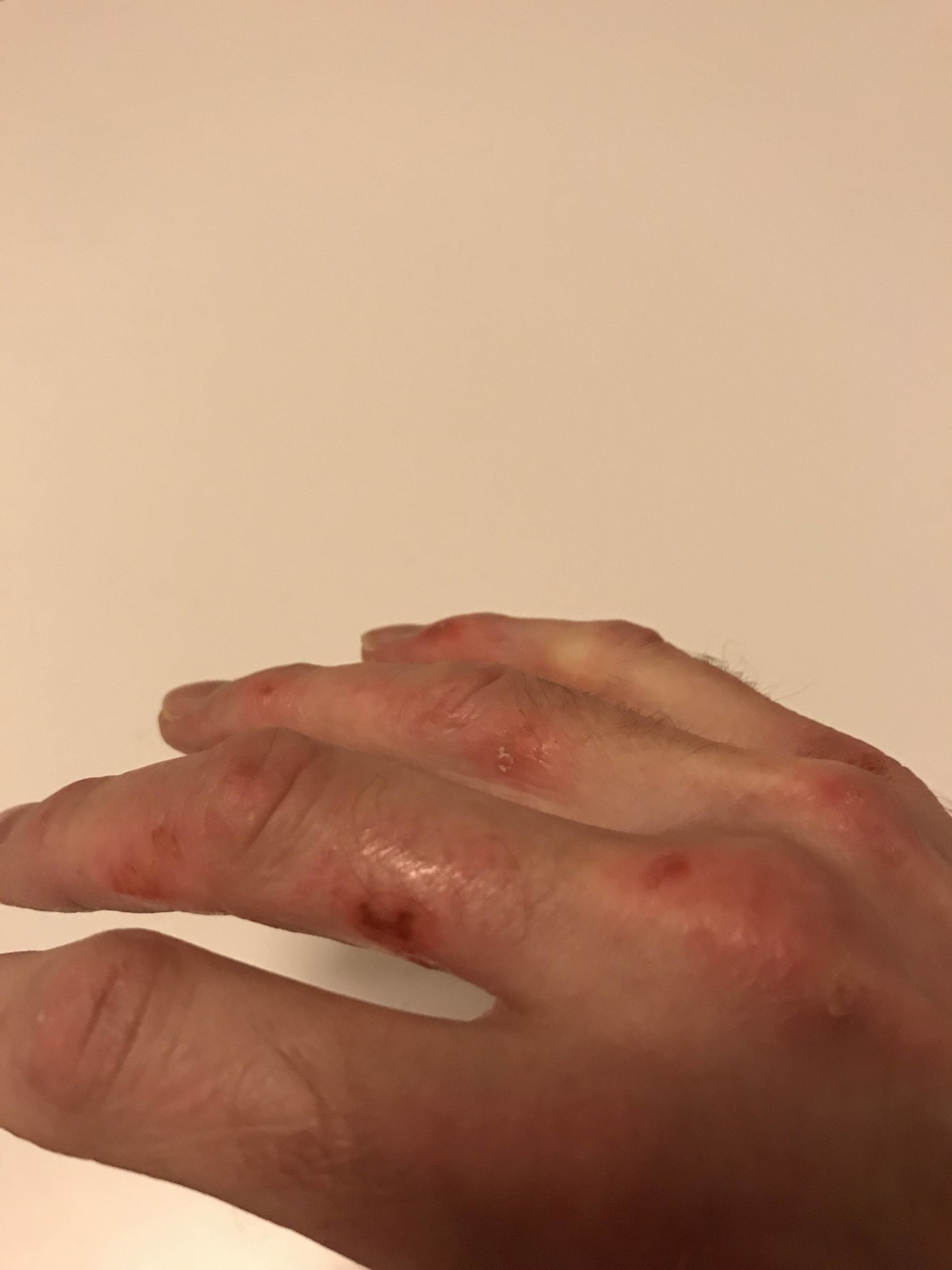
Chemical burns on hands after polishing
I'm plastering my basement walls with hydraulic lime mortar and managed to get plaster inside my gloves. Not much, but enough to cause the burns in the picture. Is this problem isolated to lime mortar or is it common with plaster mortar in general (the "regular" ones contain lime and cement)?
I plastered the first round with heavily coated gloves, but unfortunately, they had fabric on top where the mortar could sneak in. The next day, I had thick latex gloves but somehow plaster got in anyway. Are there better gloves or is the trick just to try to splatter less?
I plastered the first round with heavily coated gloves, but unfortunately, they had fabric on top where the mortar could sneak in. The next day, I had thick latex gloves but somehow plaster got in anyway. Are there better gloves or is the trick just to try to splatter less?
Building conservationist
· Malmö
· 256 posts
Regular use is better, but it also corrodes. However, it is more "pro" related after many days of heavy polishing in the heat, causing similar damage where you sweat, for example (scalp, cap edge, shirt collar, and armpits) and areas that can get very wet (shins and gloves). I replied to you in a pm but can answer here too. Don't get wet, if the gloves get wet, it's better to take a dry pair or go without, but if you go without, it's important the cloth is clean so that the small ballast can't roll around over your skin.


Member
· Västernorrland
· 12 029 posts
If you get those kinds of injuries, it almost seems like you are very sensitive to something in the mixture? Sure, a mixture is a mixture and you should protect yourself, but I've messed around quite a bit with various things and have never experienced it getting like that.


It seems to me that my skin is extra sensitive to the lime. This is the first time it's being exposed to lime, so it might get used to it by the time I'm done.
I'm pretty sure it was during the troweling that I got too messy. On the first day, the trowel ended up in the bucket of water, and I impulsively dipped my right hand (glove with fabric top) directly into the "lime water." Then I continued, which wasn't very smart... I didn't make this mistake during the next plastering session, but there were still some burns, though not as much. However, I felt that some plaster/gravel got into the latex gloves somehow.
The tips so far include using hand cream, keeping the gloves dry, and cleaning the wounds to avoid infection.
I'm pretty sure it was during the troweling that I got too messy. On the first day, the trowel ended up in the bucket of water, and I impulsively dipped my right hand (glove with fabric top) directly into the "lime water." Then I continued, which wasn't very smart... I didn't make this mistake during the next plastering session, but there were still some burns, though not as much. However, I felt that some plaster/gravel got into the latex gloves somehow.
The tips so far include using hand cream, keeping the gloves dry, and cleaning the wounds to avoid infection.

Plaster, mortar, cement, and everything else in that realm is really harsh on the hands. Most treacherous is plaster/mortar/cement-laden water, which you've rinsed with, and where you can't see how much of it is contained. After all the patented solutions with dishwashing gloves, creams, etc., one wonders what it will take for someone to invent a liquid-proof masonry glove that can also withstand the tough wear and tear that such work involves, and still provide finger mobility? Is this more troublesome than driving remote-controlled cars on Mars??

Dip your hands for a while in a moderate solution of vinegar in water to neutralize the strongly basic lime and stop the irritation. Do this every day while you are working. And buy some good hand cream too, like blue Helosan or Atrix for example.
Bricklayers usually or at least used to use the hydrochloric acid that they used in their work.
Bricklayers usually or at least used to use the hydrochloric acid that they used in their work.
Vinegar does not corrode at all in the right dose; on the contrary, I used it in my youth when I had eczema, and it got much better. After a tip from a bricklayer. Of course, you should not use pure vinegar!
Those of you who say it's easier to wash in water, that may be, but sour washing every day works significantly better!
Those of you who say it's easier to wash in water, that may be, but sour washing every day works significantly better!
Ok, there is probably an optimal concentration of vinegar. Also, useless didn't say it was better, just easier to wash with water. Another downside of vinegar is that I personally think it smells awful.
One more question, hardened lime mortar/limewater is classified as non-corrosive even if you were to moisten it again, right?
One more question, hardened lime mortar/limewater is classified as non-corrosive even if you were to moisten it again, right?
Got chemical burns a few years ago when I was cleaning the inside of the outhouse. Sounds like the same problem, gloves that didn't hold up. I found thick long rubber gloves at Bauhaus that worked for the rest of the project. They were dark red. Not very flexible, but I avoided further chemical burns.
If you've read all my posts, you'll see that the masons used hydrochloric acid (HCl dissolved in water): https://www.k-rauta.se/byggvaruhus/saltsyra-nitor-kem-30-procent-teknisk-1lA anhack said:Ok, there's certainly an optimal concentration of vinegar. Then useless didn't say it was better, just that it's easier to wash with water. Another disadvantage of vinegar is that I personally think it smells terrible.
One more question, hardened lime mortar/lime water is classified as non-corrosive even if you were to re-moisten it, right?
Doesn't smell but requires more thought. As the teachers in school taught to make it easier to remember: Siv, which stood for syra in vatten (acid in water). So always a small amount of acid in a larger amount of water, then there are no problems with heat development or splashing.
Edit: I don't remember how much I used to use but around one cap to one liter of water is probably a good start, possibly two. I'll google and see if I can find some old instructions.
Last edited: