
I will lower the ceiling from 3.5 meters to 3 meters and want to build it airy. I will paint between the room BLACK and build the new ceiling with upright boards on edge in squares of 400X400 mm, planning to use 17x95 mm. Has anyone done something similar and has pictures?? The room is 68 square meters.


what I am looking for is images. Lower to hide cable ladders, ventilation pipes, etc. The idea is to mark 400 mm, saw halfway through 17 mm and crosswise the same until you have squares 400x400 mm over the entire ceiling. Searched for images online but can't find anything.
I know what you mean, it's the same as in the ceiling of some shops, painted black above and a framework with hanging planks on edge, and all the fixtures below or between the planks, can look nice, suitable distance on hanging about 150 mm so it's not too dense, but you decide that yourself. Some pictures are hard to come by, sometimes such a ceiling is in trend stores, maybe not with wood, but with sound baffles or rebar mesh.
Correct!!
I will have a store section in the Garage which is 370 square meters. The floor there is polished black granite and I want to lower the ceiling a bit to hide a lot of things and incorporate the lighting, which has an aluminum edge with black in the middle. These are 200mm X 2000mm. But what is the ceiling called, what should I search for?Anders & Ming said:
Then think about the direction you come from the most, so that you have the boards across from you; then you won't see up into the overhead, it looks like a whole ceiling then, otherwise it easily becomes long-winded and everything above is visible.
Edit, there is probably no standard for this; the ones I have been involved with and seen are custom-built and designed according to the space.
Edit, there is probably no standard for this; the ones I have been involved with and seen are custom-built and designed according to the space.
Sure, but I was thinking of fitting them into each other 50/50, then it doesn't matter much.
Images are good even if you have the "drawing" in your head, as you can miss details and get inspiration.
Aha, now I understand how you want it, the problem is the regulations or the brackets in the ceiling to hang it in, it becomes quite a lot of brackets then. Regarding embedding, do you mean cutting notches in halfway through each board and placing the other board similarly, so it hangs on the first one? If it's a 50X50 grid pattern you're after as you wrote, it won't require as many brackets.
yes but 40x40. I've figured out how to hang it. But there are always people who have better ideas on how to make a nail  on 40x40 I can extract 20x200 cm for the light fixtures
on 40x40 I can extract 20x200 cm for the light fixtures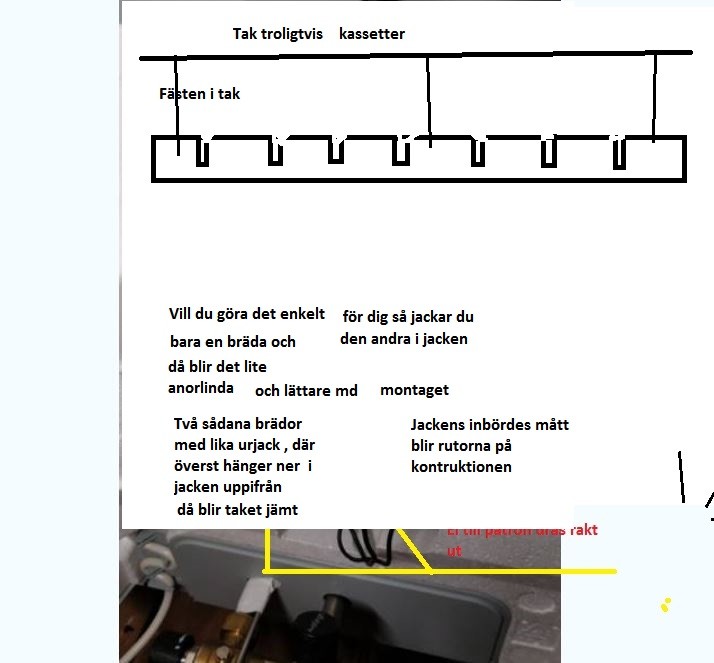
PS it's important to get straight lines on the fixtures because the wood is rigid and can't be moved more than a few mm, if you notch just one board it's much easier to assemble it.
Have you seen those small shelves that exist, you buy a bundle of wooden pieces with notches, and assemble them so they become small square compartments and hang them on the wall?
Have you seen those small shelves that exist, you buy a bundle of wooden pieces with notches, and assemble them so they become small square compartments and hang them on the wall?
Yes, I have checked those shelves... I have newly built the garage and am about to start on the interior now, so today there is OSB in the ceiling, so there is something to attach to. I'm thinking of placing a board around the wall first to hang from, then either with perforated metal straps, but I'm leaning more towards threaded rods with mounts in the ceiling and the inner ceiling. When the board around the walls is in place, you can use a laser to calculate the mounting points in the ceiling so they are aligned correctly.