I'm going to frame against an outer wall and install double plasterboard. I plan to use 45x45 metal studs to build as little as possible, it's 2m to the ceiling and I'll use 120cm wide plasterboards. So the options are 30cc or 6cc. Can I use 60cc or will it be too unstable?
I used 45x45 steel studs against the exterior wall (basement) with OSB+GIPS, cc600. It is quite unsteady and if I were to do the same work again, I would have either chosen cc450 and 900 sheets or cc300 and 1200 sheets. Make sure especially to get the corners right (there are special tracks available), otherwise it will be very unstable when there are no sheets on both sides.
When I installed OSB+Gypsum, the joints were obviously staggered. Regardless, it becomes quite unstable with cc60 and just panels on one side of the studs. The corners are, as mentioned, critical.
Have now put up a layer of plaster and it is fairly stable but on the edge, once the next layer is on it will be stable enough. If I had gone with cc60, I would certainly have had to redo everything, thanks to you I don’t have to
If you install OSB first, should you offset the drywall panels by a few cm so the seams don't align at the same place?
If you're using 1200 boards, they should be offset by 600mm, with 900 boards by 450mm.
For example; the OSB board at the bottom is 1200mm but when you install the first drywall panel, you cut it at 600mm so the seam is in the middle of the OSB board. After that, you continue with full drywall panels (since the seams are now offset) until you come to the next wall where you do the same.
If you install plywood as the first layer, you usually screw the plasterboard only to the plywood when using steel studs.
This way, you avoid pushing the stud away from the plywood, and you don't have to place every other drywall screw in the plyfa screw.
Offset the drywall joint about 10 cm in one direction from the stud.
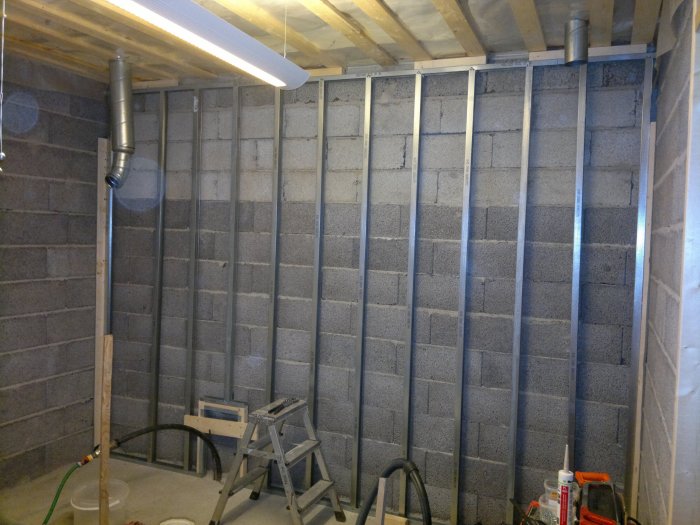
I'm currently working on a similar installation to create an air gap against the basement wall and have set the steel studs at c/c 300mm and will cover it with OSB/Plyfa and gypsum. I found it a bit wobbly, so I will attach an angle iron to each stud, which is screwed into the lecablocks. I tried it on a few, and it stiffens the entire structure. Maybe a little late for you now...
I'm currently working on a similar installation to create an air gap against a basement wall and have set c/c 300mm on the steel studs and will be covering it with OSB/Plyfa and gypsum. Noticed that it's a bit wobbly, so I will attach an angle iron to each stud, which will be screwed into the lecablocks. Tried it on a few and it stiffens up the whole construction. Maybe a bit late for you now...
[image]
Why didn't you screw the upper track into the ceiling logs?
I bought pliers like you have, haven't started framing and been able to test them yet.
Last edited:
Vi vill skicka notiser för ämnen du bevakar och händelser som berör dig.