I am going to cast a platform for the outdoor unit of our new heat pump. It weighs just over 100 kg, and I just want to double-check that I'm doing it right.
Distance between the "feet" 85x45
I plan to cast a platform that is 100x60 with a thickness of 10cm.
I wonder, is there an advantage to making the platform thicker? I'm thinking about vibrations & noise propagating into the house?
How thick a layer of gravel should I lay under the concrete?
With about 5cm to the concrete edge, do I risk cracking when I drive in expansion bolts to fasten the pump? I was thinking of letting the reinforcement form a rectangular grid that extends beyond the drill holes; could that help prevent cracking?
10 cm concrete with reinforcement can handle a 6 mm expander with a washer just fine, no need for large items, just to keep it in place laterally. Under the slab, fill with some coarse crushed stone about 10 cm thick, but think ahead, as a lot of water will run off when it defrosts, so you need a basin with a drain and a heating cable in a hose leading away. It's convenient if you have a downspout that goes into the ground (about 0.6 m minimum to avoid freezing risk), otherwise a stone well about 1 m deep where the hose goes down. You might end up with ice all the way up to the basin if you're unlucky, which is a real hassle to chip away, like solid ice.
I drilled 6mm holes in my concrete slab, which was 10cm thick, 5cm from the edge. Used the hammer drill carefully, but still managed to crack 2 out of 4 holes
You can excavate under the slab if you want, the same size + a little more than the slab, and a depth of at least 0.6 m, preferably 1 m at your latitude. Install a pipe approximately 2 dm from the bottom through the slab when you cast, making it easy to insert a hose with a heating cable in it. The heating cable should lie like a snake in the bowl; there is surely information on how to do this in the installation instructions.
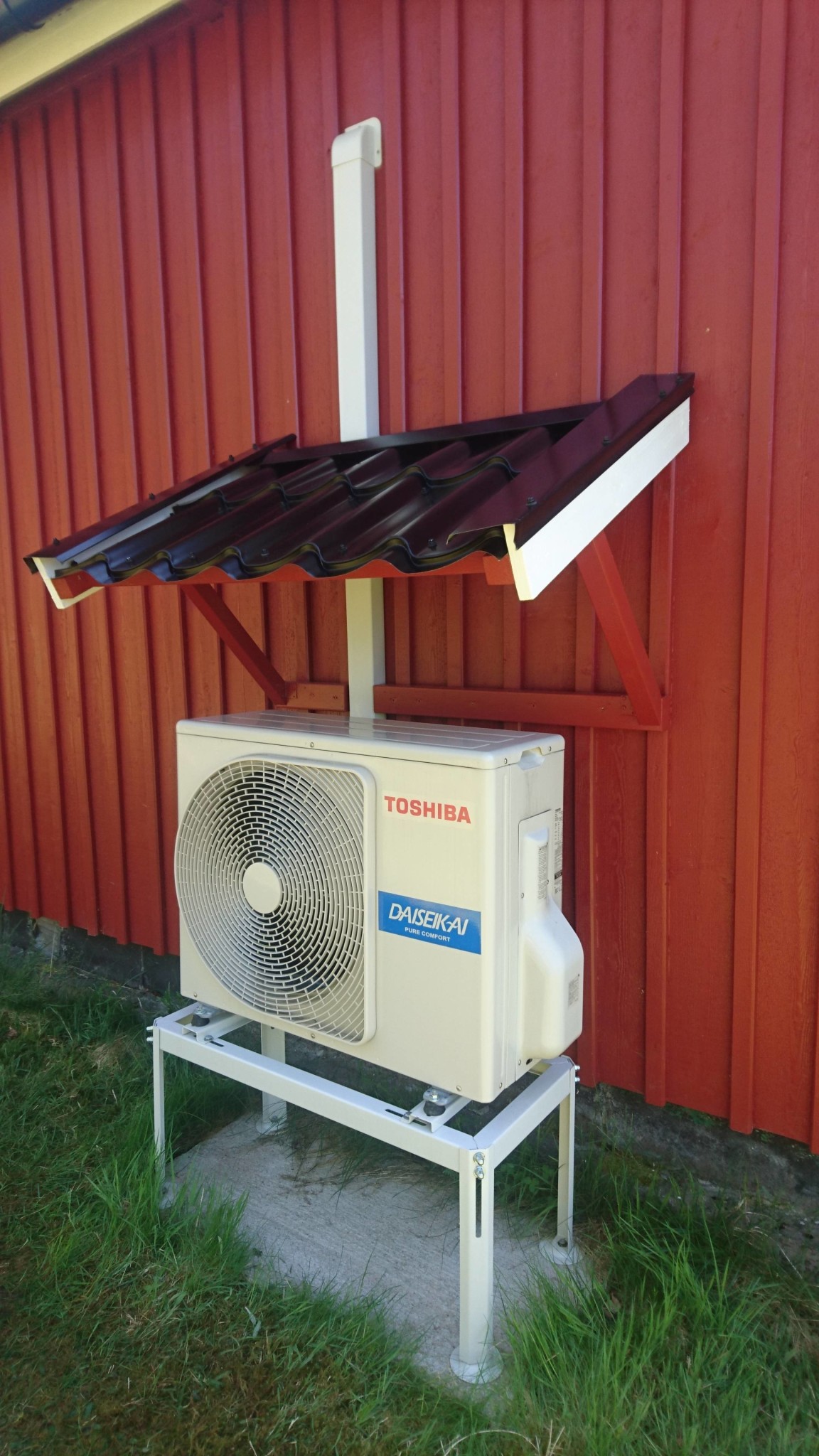
You do not need to screw the stand into the foundation; it stays in place by its own weight. If the stand's legs can be adjusted individually, it's also not critical that the plate doesn't settle. I personally dug about 10 cm deep, placed a wooden frame and a reinforcement mesh on some support beams, and then poured in the concrete. So, no gravel. It has worked for almost two years now (with a minor adjustment of the legs this spring to ensure the pump stands completely horizontally).
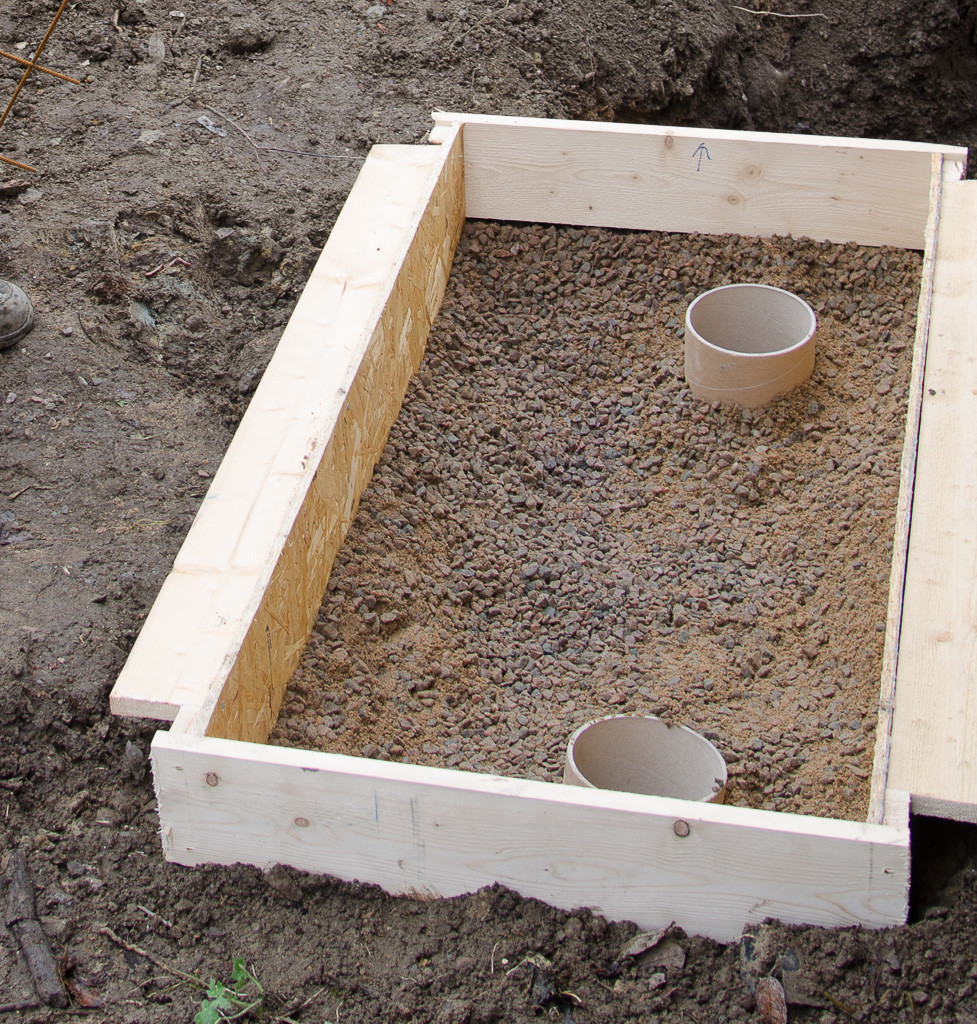
Made a similar slab for a large outdoor unit (16kW), but also put a couple of pipes down deep for some anchoring, probably wasn't necessary... The picture is before the reinforcement was added. Then I don't have a deep layer of crushed stone, drainpipes, or a stone well - just stiff Skåne clay around that slopes a bit away. It works excellently, at most I've had a couple of centimeters of ice on the slab since it was made in 2012.
Ah, you mean like that. But since there is flexibility in all the connections on an outdoor unit, it's probably not a problem in practice. My pumps are loosely placed on regular garden slabs, which in turn are lying on a decimeter of compacted crushed stone. It doesn't need to be more complicated than that.
Ah, that's what you mean. But since there's flexibility in all connections on an outdoor unit, it's probably not an issue in practice. My pumps are loosely placed on ordinary garden slabs, which in turn are on a decimeter of compacted crushed stone. It doesn't need to be more complicated than that.
Good! I won't make things more complicated than that. 👌🏼
Click here to reply
Vi vill skicka notiser för ämnen du bevakar och händelser som berör dig.



Hep said: