I am going to install a ground source heat pump in an existing boiler room. For various reasons, I am considering casting a concrete pad 5-10 cm thick to place it on.
The boiler room currently has a slab on grade.
What should I ideally use, and how should I handle the seam between the floor and the wall? What needs to be done to the existing floor? Does it need to be reinforced? The wall is drywalled with wooden studs behind it.
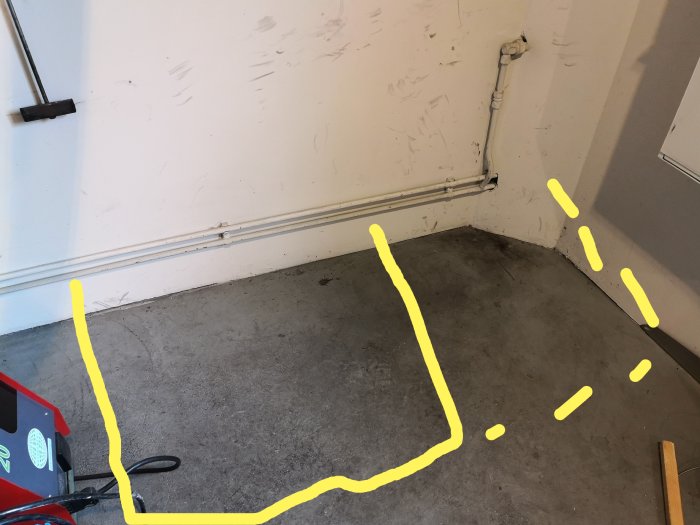
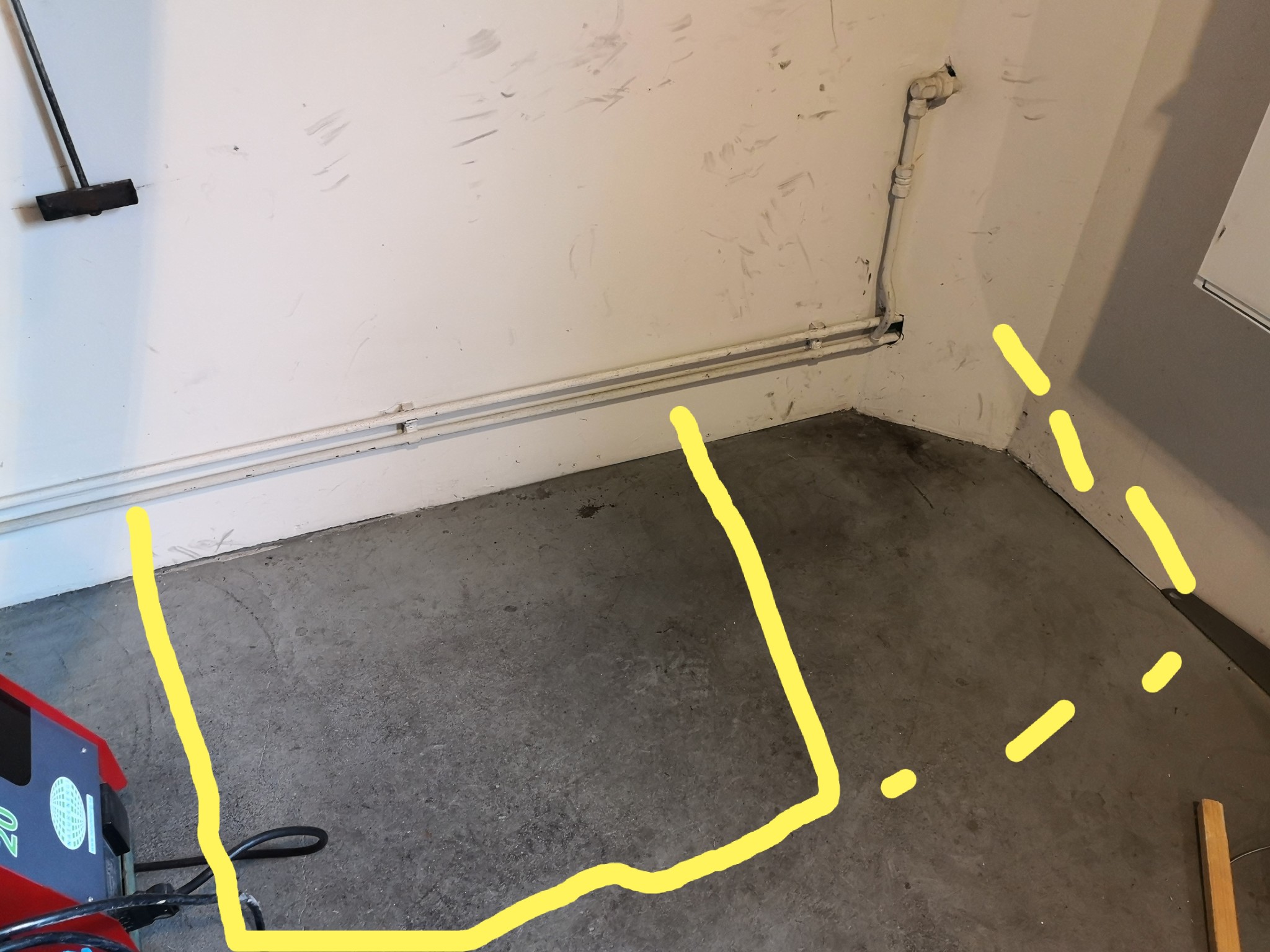
The plan is to cast within the solid yellow area, possibly also the dashed part.
Agree. I would have drilled down a couple of rebar stumps (or equivalent) into the existing floor as well. Maybe grind the surface with an angle grinder and diamond blade too, it's just as well if it becomes uneven.
No, I don't want to complicate it. Just a thought, it's the junction between the wall and the floor. Isn't there a risk that moisture seeps in there which isn't good for the studs in the wall? Should something be placed in between? How does it work with concrete directly against drywall? What type of concrete should be used, or is some form of filler better?
Doesn't the pump need access to an overflow drain with a floor drain and slope?
Yes, unfortunately, the previous owner who built the boiler room didn't think it was necessary to have a floor drain for the boiler. So one reason for creating the slope under the pump is that we will be able to fix the slope and floor drain once the current boiler is removed.
Wastewater from the water heater and expansion is currently directed to the adjacent bathroom.
Place a thin piece of foam plastic as a spacer between the existing and new surface. Against the floor and against the wall. Then it’s easy to remove if desired.
I would have just placed some tar paper or construction plastic against the wall. However, it's important to anchor down into the existing slab if you want the new concrete to remain in place.
I would just put some roofing felt or building plastic against the wall. However, it's important to dowel into the existing slab if you want the new section to stay in place.
I wouldn't think it's necessary to fasten/dowel a 10 cm concrete slab to the floor... What would make it move?
I wouldn't think it's necessary to fasten/dowel a 10 cm concrete slab to the floor... What would make it move?
/ATW
Concrete adheres poorly to concrete without primer or dowels. What causes it to detach is shrinkage and rapid water loss from the new concrete into the old slab. Placing four dowels - concrete screws, rebar etc. is a cheap insurance to ensure the slab stays in place.


Cruzze said:
